49 works in this view — arrow keys or swipe to move between them.
Dance in Art
Decoration de la salle de spectacle
Unknown artist
- Collection:
- Prints depicting dance
- Source:
- New York Public Library
- Rights:
- Public domain — free to use, share and adapt.
- Recorded as:
- Public Domain
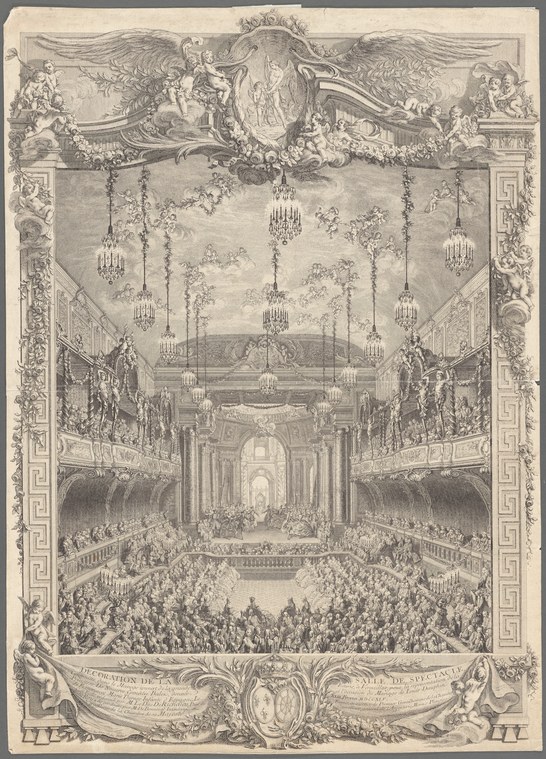
This print is among the most concrete surviving documents of baroque court theater architecture, showing the actual space in which the court ballets described in librettos and choreographic manuscripts were staged. It provides crucial evidence about sightlines, the relationship between stage and audience, the presence of musicians and stage machinery, and the integrated spectacle that made baroque dance inseparable from music, poetry, and visual design.
What you are looking at
This is an engraved architectural elevation of an ornate baroque theater interior, shown in cross-section to reveal the full spatial depth from stage to audience. The theater is a tall, narrow rectangular hall with a deeply recessed stage framed by a grand proscenium arch, and multiple tiers of galleries rising steeply on both sides. Suspended from the ceiling are numerous multi-armed crystal chandeliers that provide theatrical illumination. The stage and gallery spaces are densely populated with hundreds of figures—seated spectators in the galleries, standing attendants, and on the stage itself what appears to be a formal court procession or assembly rather than active dancers. The composition is framed by an elaborate ornamental border of scrollwork, putti, drapery swags, and architectural ornaments, with a cartouche at the bottom. The entire image is rendered in fine engraved lines typical of 17th-century aristocratic print culture, emphasizing the wealth, scale, and geometric precision of the space.
The dancing
The hundreds of human figures are rendered as small details distributed across the composition to establish the spatial hierarchy and scale of the theater. Those on stage and in immediate view of the stage appear formal and processional rather than actively dancing—standing, walking slowly, or in static poses of ceremony. The figures in the galleries are seated or standing as spectators. No dancers are shown in recognizable balletic or dance positions; bodies are upright, formal, and hierarchical rather than in the lifted frames or dynamic weight shifts that characterize baroque court dance.
The dance depicted
This print depicts the architectural setting for court spectacles rather than dance itself. The theater is designed for the kind of elaborate court ballets that dominated 17th-century European aristocratic entertainment, in which dance, music, poetry, scenery, and machinery combined in multipart performances. The formal procession visible on stage is likely part of such a spectacle—possibly a prologue, interlude, or the ceremonial gathering that often framed the danced portions. The image documents the venue and the occasion rather than capturing the dance in action.
How it was made
This is a finely detailed engraving, identifiable by the precision of parallel line work (hatching and cross-hatching) used to create tone and shadow, and the fine detail of the ornamental borders. Engraving of this scale and quality was a costly, laborious process, implying this was made for a wealthy, educated audience—likely court circles or collectors of print albums of notable architecture and spectacles. The print's circulation would have been limited; it served as a prestige document of court infrastructure and magnificence rather than as a popular broadside.
About this work
This engraved architectural print documents a baroque court theater, its grand interior space designed to house hundreds of spectators and present elaborate court spectacles combining dance, music, and scenery. The image is valuable not as a depiction of dance in motion but as evidence of the physical context in which baroque court ballet took place—the scale, the sightlines, the machinery, and the ceremony surrounding performance. The formality of the composition, the precision of the engraving, and the dense crowd of attendants underscore that this was a major institution of courtly power, where dance played a central ceremonial role even when not actively being performed at the moment the image was made.
How to look at it
Look first at the architectural logic: notice how the stage is elevated and deeply recessed, and how the galleries rise in steeply raked tiers to give all spectators a view of the stage floor and the aerial machines suspended above it. Observe the hundreds of tiny figures and try to trace the sight lines—where would a dancer on that stage be visible to whom? The dense crowd is not mere decoration; it documents the fact that court ballet was a highly attended ceremony of state. The ornamental border and cartouche format indicate this is a formal, prestige document, likely from a printed album of court architecture or spectacles.
The period
This engraving dates from the height of baroque court spectacle, likely late 17th or early 18th century, when such elaborate indoor theaters were symbols of absolute monarchical power. The grand ballet de cour tradition—developed in France and imitated across European courts—required purpose-built theaters with sophisticated machinery, sightlines to accommodate hierarchies of viewing, and space for large orchestras and corps of dancers. This print was made at the moment when that tradition was at its apex before the rise of professional theater and the Enlightenment's reshaping of spectacle.
Where it lives
This print is held in the NYPL's collection of prints depicting dance, catalogued under the title 'Decoration de la salle de spectacle.' The holding treats it as a dance document despite its focus on architecture, which is appropriate: the building itself is inseparable from the dance practices it enabled.
Dance in this work
Questions about this work
Can you identify which theater this is?
The catalogue record does not specify. The architectural style, the engraving technique, and the formal grandeur are consistent with late 17th-century French or German court theaters built for princely collections. Without a signature, date, or inscription visible in this image, identification must remain open.
Where are the dancers?
The figures shown are mostly spectators and ceremonial attendants. This print captures the theater as a formal space and setting rather than a moment of active dance performance. The architectural precision was what mattered to the print's makers and audiences—evidence of a court's wealth and power.
What is the cartouche at the bottom?
It likely contains a title and possibly a dedication or attribution, but the engraving's resolution in this reproduction makes the text illegible. Such cartouches in prestige prints often named the architect, the patron, and the occasion, or cited a printed source like a libretto.
Why is this in a dance collection?
Because the history of dance is inseparable from its spaces and institutions. This print is crucial evidence of how baroque court ballet was staged, the scale of the enterprise, and the elaborate visual and spatial context that dancers inhabited and spectators experienced.
More dance artwork





