49 works in this view — arrow keys or swipe to move between them.
Dance in Art
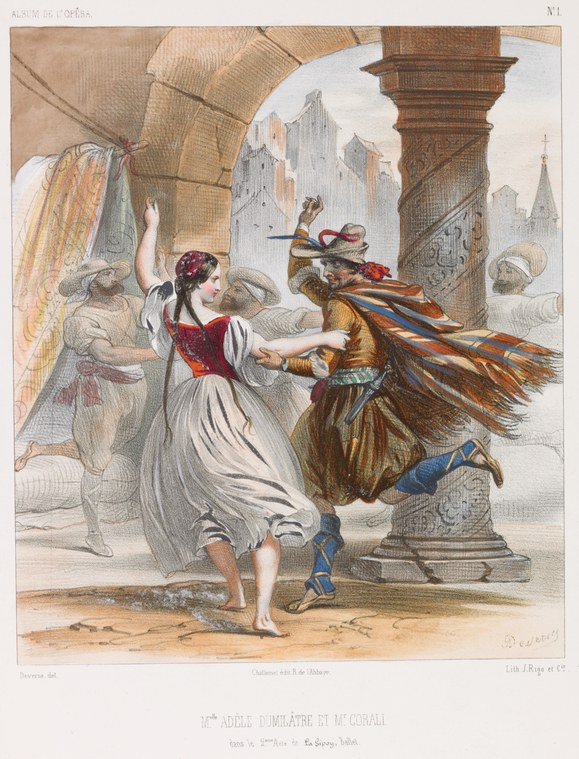
M'elle Adèle Dumilâtre et M'r Corali dans le 2eme acte de La Gipsy, ballet
Unknown artist
- Collection:
- Prints depicting dance
- Source:
- New York Public Library
- Rights:
- Public domain — free to use, share and adapt.
- Recorded as:
- Public Domain
Dumilâtre and Petipa were among the era's most celebrated dancers; their roles in *La Gipsy* were signature parts. This print preserves a moment from their partnership and the precise vocabulary of their bodies—how they held themselves, the line of their port de bras, the narrative gesture—in a way that written description cannot. It is a primary document of how Romantic ballet looked to its contemporary audience.
What you are looking at
A theatrical scene set within a columned arcade, with classical architecture framing the action. In the center, a male dancer in brown and gold striped costume with a red hat reaches toward a female dancer in white muslin who turns away, her arm raised. To the left, a female figure in classical drapery (possibly a spirit or supernatural being) hovers or floats, rendered in pale tones. The background shows a cityscape with towers and spires receding into mist. The floor is bare stone; the lighting is cool and dramatic, concentrating on the central pair. The composition is diagonal, with the woman's body angled away from her partner in a moment of resistance or evasion.
The dancing
The male dancer leans forward with weight committed, one arm extended toward the woman in a gesture of pursuit or appeal. The female dancer arches her torso away from him, her head turned aside and one arm raised in a classical port de bras that suggests both defense and grace. Her body describes a serpentine curve. The supernatural female figure on the left appears weightless, her arms arranged in a balletic frame. All three figures occupy distinct spatial planes, creating depth. The male's costume and posture suggest character dancing rather than classical technique; the female dancers embody the ethereal, elongated lines of Romantic ballet.
The dance depicted
This is a scene from *La Gipsy*, a Romantic-era ballet, showing the two named principals—Adèle Dumilâtre and Lucien Petipa (identified as M'r Corali in the inscription). The moment appears to be a dramatic encounter, possibly a pas de deux in which the male character pursues or implores the female; the presence of the supernatural or allegorical female figure suggests magical or fantastic content typical of Romantic ballet. The woman's pose—arched away, arm raised in classical frame—shows the balletic vocabulary; the man's energetic, character-inflected costume and forward lean suggest a role demanding both mime and dance. The image captures the blend of narrative drama and formal dance that defined the genre.
How it was made
This is a hand-colored engraving or lithograph, likely a wood or steel engraving with watercolor or gouache applied by hand. The fine cross-hatching visible in the drapery and background, the precision of the architectural detail, and the soft gradations of color all point to printmaking rather than painting. The technique allowed wide distribution of the image as a theatrical souvenir or review; such prints were standard documentation of successful ballets and their celebrated dancers. The hand-coloring—evident in the skin tones, the woman's pink ribbon, and the man's costume—was applied after printing, a labor-intensive process that indicates this as a high-quality theatrical merchandise object.
About this work
A theatrical scene from *La Gipsy*, a Romantic ballet, showing its two principal dancers in a moment of dramatic encounter within a classical architectural setting. The image documents not only a specific work and its celebrated performers but the aesthetic vocabulary of Romantic ballet—ethereal female bodies, character-inflected male roles, supernatural or allegorical figures, and the narrative intensity of the genre. As a hand-colored engraving, it is a theatrical souvenir from the mid-nineteenth century, intended to circulate knowledge of the ballet and its stars among an urban, literate audience. The work belongs in a dance collection as both a record of a specific choreography and a window into how Romantic ballet was experienced, consumed, and remembered.
How to look at it
Observe the precise moment the artist has frozen: the woman's body in flight or refusal, the man's forward reach, the supernatural figure hovering to the side—this is not a stable pose but a moment of dramatic tension within the choreography. Notice how the engraver has rendered the woman's muslin skirt and drapery with fine line-work to suggest weight and movement; the man's costume is more densely hatched, anchoring him. The classical architecture frames the action as theatrical spectacle, but the sky and distant towers blur into mist, emphasizing the fantastic or romantic register of the scene. The print's hand-coloring is selective—the female dancers' flesh tones and the male's richly colored costume draw the eye to the central trio.
The period
This print dates to the Romantic era of ballet (approximately 1830s–1860s), when Romantic ballet reached its height in Paris and London. The genre prioritized ethereal, otherworldly female dancers—often in roles as sylphs, spirits, or exotic characters—and energetic male character dancers who supported them while performing more grounded, narrative roles. *La Gipsy* (choreographed by Joseph Mazilier, 1839) was one of several exotic or Orientalist ballets that captivated Parisian audiences. The print format reflects the era's intense consumption of ballet imagery: engravings and lithographs of celebrated dancers and scenes from current productions were standard theatrical merchandise, as central to the cultural life of the opera-going public as photographs would later become.
Where it lives
This is a hand-colored engraving or lithograph held in the New York Public Library's collection of prints depicting dance. It is catalogued as theatrical merchandise from the mid-nineteenth century, likely published in Paris or London during or shortly after the ballet's premiere or subsequent revival.
Dance in this work
Questions about this work
Who were Adèle Dumilâtre and Lucien Petipa?
Adèle Dumilâtre (c. 1821–1909) was a celebrated French ballerina of the Romantic era, renowned for her technique and dramatic presence. Lucien Petipa (1815–1898) was a leading male dancer of the same period and the father of Marius Petipa, who later became ballet master of the Imperial Ballet in Russia. Both were stars of the Opéra in Paris.
What is *La Gipsy*?
*La Gipsy* (The Gypsy) is a three-act ballet choreographed by Joseph Mazilier with music by Hippolyte Monpou, first performed at the Paris Opéra in 1839. It tells the story of a gypsy woman and was one of several exotic-themed ballets that dominated the Romantic stage, combining narrative drama, character dancing, and magical or supernatural elements.
How were theatrical prints like this one used?
Prints of celebrated dancers and famous ballet scenes were sold to opera-goers as souvenirs, hung in homes and studios, and circulated among an urban middle-class audience. They documented current productions and celebrated the dancers, much as playbills and photographs do today. The hand-coloring made each print unique and premium, increasing its cost and status as a collectible.
More dance artwork





