49 works in this view — arrow keys or swipe to move between them.
Dance in Art
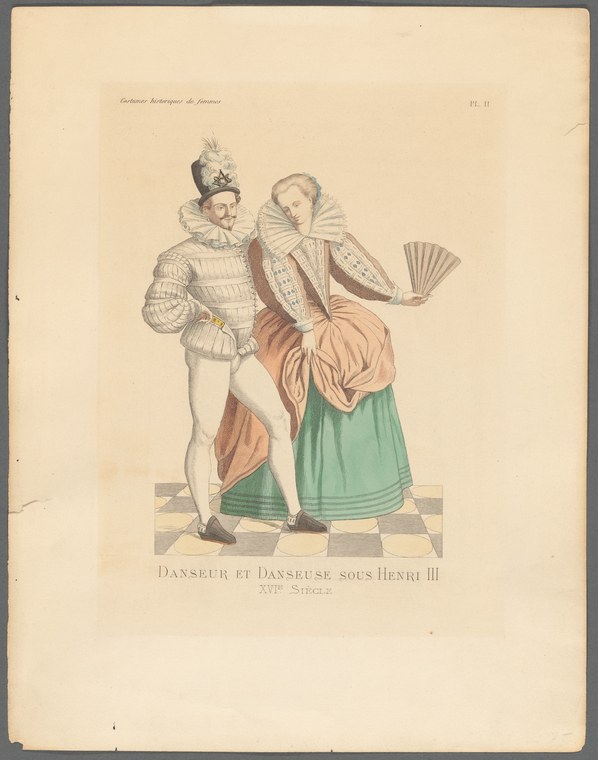
Danseur et danseuse sous Henri III, XVIe siècle
Unknown artist
- Collection:
- Prints depicting dance
- Source:
- New York Public Library
- Rights:
- Public domain — free to use, share and adapt.
- Recorded as:
- Public Domain
This image is one of very few documentary sources for how Renaissance court dance actually looked—what the bodies did, how partners related, and how dance was integrated with costume and props. It shows that 16th-century court dance was not the reconstructed spectacle of later ballet, but a form of social interaction in which careful footwork, precise posture, and the handling of garments and accessories were all part of the choreography.
What you are looking at
A man and woman stand face-to-face on a checkered floor in a formal court setting. The man, positioned on the left, wears elaborate Renaissance military dress: a heavily quilted and pleated doublet in cream and rust tones with prominent vertical ribbing, a short cloak draped across one shoulder, and a tall feathered cap. His right leg is extended forward in a lunge or stepping motion. The woman wears a full-skirted gown in sage green with a peachy-pink overskirt or panel, the skirt gathered and voluminous; she wears a large, intricately pleated white collar or ruff and a white coif. Both figures are rendered in three-quarter view, leaning slightly toward each other in a posture suggesting courtship or intimate social engagement. The woman holds a large fan, which she displays toward the viewer. The palette is restrained—naturalistic flesh tones, cream, muted greens and pinks—and the figures cast subtle shadows on the floor beneath them.
The dancing
The man's weight appears to shift forward onto his right leg, which extends in front of him; his torso and gaze are directed toward the woman, his arms at his sides or loosely held. The woman's stance is more upright and contained; her hips face slightly away while her torso turns toward the man, and her arms are occupied with the fan, held open and presented. Neither figure is in a closed partner hold; instead they occupy the same intimate space as if in conversation or flirtation. The spatial relationship—close but not touching—and the balance of their postures suggest a social dance or ceremonial encounter familiar to the court.
The dance depicted
This appears to depict a Renaissance court dance from the reign of Henry III of France (1574–1589), as the title states. The dress, the checkered floor (a common stage convention), and the formal staging all point to a basse danse or one of its contemporary variants—dances that emphasized noble bearing, measured steps, and intricate floor patterns rather than vigorous movement. The man's forward extension and the woman's controlled posture, combined with the fan—a crucial prop in 16th-century courtly interaction—suggest a moment within a larger choreographed sequence, probably a branle or galliard variant. The image captures not the peak of a leap but a moment of approach or conversational proximity, which is characteristic of how Renaissance dance imagery freezes the social and erotic dimensions of court dancing.
How it was made
This is a hand-colored engraving or etching, identifiable by the fine linear cross-hatching used to model form and shadow, the precise line work defining the pleats and texture of fabric, and the restrained application of watercolor or gouache over the printed base. The technique allowed for wide circulation—prints could be duplicated and distributed among the courts of Europe—and the hand-coloring suggests this was a luxury object intended for an educated courtly or antiquarian audience. The inscription at the foot and the plate mark visible at the edges confirm it as a print from a historical or costume documentation series.
About this work
This is a documentary engraving of a courtly dance from the French Renaissance, probably produced in the 16th or 17th century as part of a series on historical costume and court practice. It captures a moment of intimate social performance—not a theatrical ballet, but the lived dance of the nobility, where stepping, proximity, and the display of fine dress and accessories were inseparable from the movement itself. The work belongs to a tradition of prints that recorded court life and fashion for circulation among the educated elite, functioning simultaneously as historical record, fashion plate, and guide to proper social conduct.
How to look at it
Observe the precise balance of the figures: the man leans forward in a gentle lunge, his weight active; the woman remains more vertically aligned, her posture regal. Neither touches the other, yet they occupy an intimate conversational distance—this is the spatial syntax of a court dance, not a theatrical embrace. Notice the fan: it is not merely a fashion accessory but an active prop, part of the choreography of flirtation and display. The checkered floor beneath them is a theatrical convention signaling 'this is a staged or documented moment,' not a snapshot of casual movement. Look at the precision of the pleating on the man's doublet and the woman's ruff: the engraver's attention to fabric detail reflects the importance of costume in the dance itself.
The period
During the reign of Henry III (1574–1589), the French court was at the height of its aesthetic refinement and political use of elaborate court ceremony. Dance was central to courtly life—a means of displaying status, forming alliances, and demonstrating command of one's body and dress. The basse danse and branle, the dominant forms of the period, had evolved from earlier medieval forms into highly formalized, documented practices. By the late 16th century, the production of costume and dance documentation in print was well established; prints served both as records of contemporary practice and as aspirational guides for courts throughout Europe. This particular image belongs to a wave of antiquarian interest in court costume and practice that began in the 16th century and continued through the 17th.
Where it lives
This work comes from the NYPL Prints collection documenting dance through history. It is part of a series on historical dance and costume, likely 16th or 17th-century in production, and was created as an educational or antiquarian document for a courtly or scholarly audience.
Dance in this work
Questions about this work
What dance is this showing?
The title identifies it as a court dance from the reign of Henry III (1574–1589), most likely a branle, basse danse, or related court form. These were the dominant social and ceremonial dances of the French nobility. The measured posture, the close conversational distance between the partners, and the formal setting all point to an intimate court dance rather than a theatrical performance.
Why is the woman holding a fan?
The fan was not merely a fashion accessory in Renaissance court life; it was an active prop in the choreography of courtly interaction. It could be used to signal, to frame the body, to extend the arm's line, and to manage proximity and distance between partners. In this image, the woman's display of her open fan is part of the dance itself.
How do we know this is from the 16th century?
The dress, the style of the engraving, the title's explicit reference to Henry III, and the overall aesthetic all point to the late 16th century. The quilted doublet, the pleated ruff or collar, and the proportions of the skirt are all consistent with 1570s–1580s fashion. However, this may be a later print documenting earlier court practice, which was common in antiquarian collections.
Is this a ballet?
No. This is a court dance—a social or ceremonial form performed by the nobility themselves as part of courtly life. Ballet as a theatrical form did not emerge until the early 17th century and was distinct from these intimate court practices. This image documents the lived dance of the aristocracy, not staged performance.
More dance artwork





