49 works in this view — arrow keys or swipe to move between them.
Dance in Art
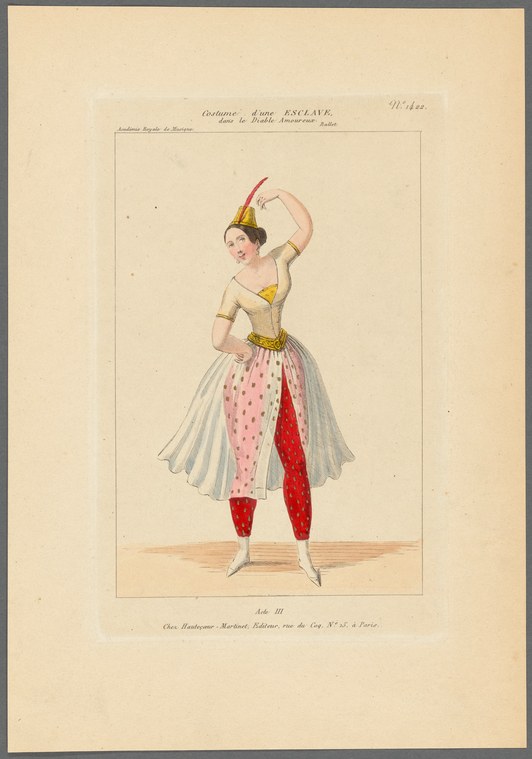
1422. Costume d'une esclave, dans Le diable amoureux, Acte III, Académie Royale de Musique, ballet
Unknown artist
- Collection:
- Prints depicting dance
- Source:
- New York Public Library
- Rights:
- Public domain — free to use, share and adapt.
- Recorded as:
- Public Domain
Theatrical costume prints like this are among the only visual records of how specific roles in now-forgotten ballets were performed and appeared on stage. The combination of named ballet, Act number, character, and costume evidence allows historians to reconstruct aspects of lost choreography and to understand how nineteenth-century dancers embodied fantasy and exotic characters. The print also documents the labour of unnamed dancers—here a woman performing a character role whose name survives in print while her own name does not.
What you are looking at
A female dancer in theatrical costume is caught mid-movement against a pale background, her body tilted in a pronounced contrapposto with her right arm raised above her head in an elegant arc. She wears a fitted yellow bodice with a jewelled belt, red silk stockings, and a voluminous skirt composed of layered pale silk and pink spotted gauze—the outer layers lift and splay around her legs in a frozen moment of motion, suggesting rapid turning or a jump. A red feathered headdress sits atop her head. She stands on the bare stage floor, her weight balanced on her left leg, her posture both relaxed and formally composed. The figure is rendered in hand-coloured engraving with delicate washes of colour that emphasize the theatrical richness of her costume.
The dancing
A single dancer, shown in three-quarter view, occupies the entire composition. Her frame is notably elongated and elegant, with the raised arm creating a graceful line through the torso. Her weight appears to rest primarily on her supporting left leg, suggesting the captured moment of a turnout or pirouette. The posture is characteristically balletic—controlled, lifted through the spine, with the body arranged to display the costume rather than convey strain. No technical footwork is clearly legible, but the raised arm and tilted torso suggest a moment of elevation or sustained turn.
The dance depicted
This is a costume study for a named role in *Le Diable amoureux* (The Enamoured Devil), a ballet performed at the Académie Royale de Musique (Paris Opéra). The character is identified in the title as an enslaved woman (esclave) in Act III. The print documents a specific theatrical costume and role rather than a particular dance step, and was likely part of a suite of costume prints circulated to publicize the production. The dancer's posture and the silhouette of her costume—a hallmark of Romantic-era ballet—suggest this dates to the mid-nineteenth century, when French Romantic ballet dominated European dance.
How it was made
This is a hand-coloured engraving, a reproductive print technique that allowed wide circulation of theatrical costume designs and performance imagery in the eighteenth and nineteenth centuries. The line work is fine and precise, the colour applied in delicate washes that emphasize texture—the gossamer quality of the gauze skirt, the sheen of the silk stockings, the glitter of the costume ornament. Such prints were sold individually and in series to audiences, collectors, and other theatres, functioning both as souvenirs of a performance and as design documents that could inform costume makers in other cities.
About this work
This is a hand-coloured engraving documenting a dancer's costume for a named role in a French operatic ballet of the nineteenth century. It is neither a portrait of an individual nor a generic 'dancer' figure, but rather a costume study for theatrical circulation—part of the machinery by which a spectacular Paris production could be publicized, remembered, and copied elsewhere. The print preserves a moment of choreographic practice and aesthetic convention: the pose chosen is one that displays the costume and the dancer's form with equal emphasis, a principle central to Romantic ballet performance. Such prints are rare surviving evidence of how dancers looked, moved, and dressed in roles now almost entirely lost to memory.
How to look at it
The pose is deliberately still and displayed rather than captured mid-movement: the dancer presents herself to the viewer almost as a statue, arms and torso arranged to show the costume to maximum advantage. Notice how the skirt has been drawn to billow and separate—this is not how fabric would fall at rest, but rather how it would appear in motion or when the dancer jumped or turned. The artist has chosen to freeze the moment of maximum display, when the costume and the dancer's form are both fully visible and balanced. This was the standard convention for theatrical costume prints: not documentary realism, but idealized theatrical glamour.
The artist
The artist is not recorded in the catalogue, but the style and publication information suggest this is a professional costume print from a Paris theatrical publishing house. The inscription indicates the print was sold by Martinet, a Paris-based publisher and seller of theatrical prints in the nineteenth century. Such prints were typically engraved by specialists in costume documentation rather than fine artists, and they circulated among theatres, dancers, and collectors of theatrical ephemera.
The period
This print dates to the era when the Académie Royale de Musique (later the Opéra) was the undisputed centre of European dance innovation, and when French Romantic ballet—with its emphasis on ethereal femininity, exotic fantasy, and technical virtuosity—was at its height. Theatrical prints were a major vehicle for disseminating images of performance across Europe and the Atlantic. A dancer or designer seeing this print in London, Berlin, or New York could commission or reconstruct a version of the costume and role, allowing successful Paris productions to have a second life elsewhere.
Where it lives
The print is held in the New York Public Library's collection of prints depicting dance, an archive of theatrical and performance imagery formed over decades. It was published in Paris by Martinet and is catalogued by its engraved title and role information rather than by artist signature or date.
Dance in this work
Questions about this work
Who was the dancer in this role?
The print does not identify the performer by name. Theatrical costume prints of this era typically documented roles and costumes rather than individuals. To find the original dancer, you would need to consult Opéra archives or period playbills for *Le Diable amoureux*.
When was *Le Diable amoureux* performed?
The catalogue record does not provide a date. The costume style, engraving technique, and publisher information (Martinet) suggest a date in the mid-nineteenth century (approximately 1840s–1860s), but without archival research this cannot be certain.
What does 'esclave' mean in this context?
In the context of European Romantic ballet, 'esclave' (enslaved woman) was a character type often associated with exotic fantasy narratives—tales set in imagined Oriental, Turkish, or African settings. Such roles allowed dancers to perform dramatic character work and to display costume and technical skill, but they also embedded racial and colonial stereotypes that were standard to the period.
How common were these costume prints?
Very common as ephemeral theatre merchandise, but fragile: most did not survive. Those that did are now valuable historical documents. They were sold cheaply at theatre exits and in print shops, and many were used and discarded. Any surviving example is fortunate.
More dance artwork





