49 works in this view — arrow keys or swipe to move between them.
Dance in Art
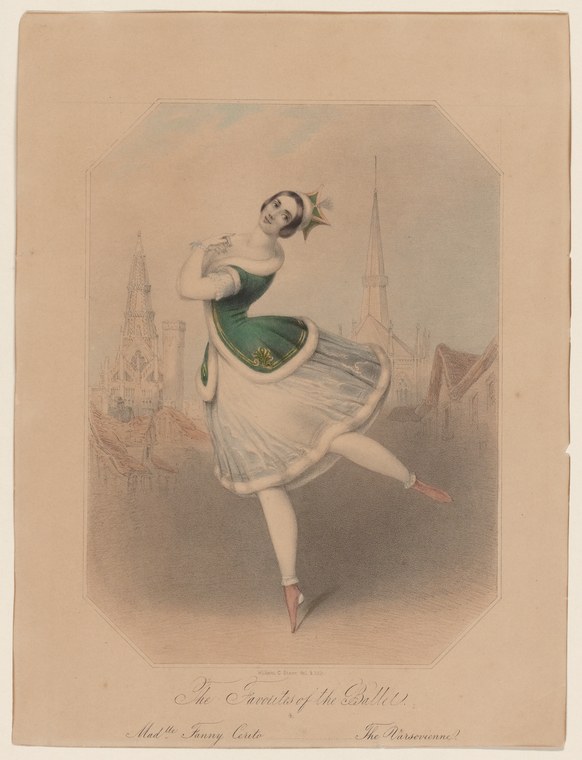
Madlle Fanny Cerito [sic]... The varsovienne
Unknown artist
- Collection:
- Prints depicting dance
- Source:
- New York Public Library
- Rights:
- Public domain — free to use, share and adapt.
- Recorded as:
- Public Domain
Fanny Cerito was a major star of Romantic ballet and a virtuoso of contemporary social dances; this image shows her in a form that bridged the ballroom and the stage, illustrating how professional dancers of the era were equally at home in both worlds. The varsovienne itself is a dance now largely forgotten, and documentary images like this are rare surviving evidence of how 19th-century fashionable music and movement were translated into spectacle.
What you are looking at
A soloist woman dancer in a romantic-era costume is captured mid-leap or mid-turn against an urban backdrop of tall church spires and Gothic architecture rendered in pale wash. She wears a fitted dark bodice with a white or pale gauzy skirt that floats around her in motion, and her pose—one leg extended, the body tilted—conveys both buoyancy and technical control. Her dark hair is styled in ringlets or loops. The composition is a three-quarter-length portrait figure study within an octagonal frame, set against a neutral tan ground. The architectural setting is sketched lightly and recedes into soft shadow, focusing all attention on the figure's movement and costume.
The dancing
The dancer's weight is evidently on one leg while the other extends in a développé or similar elevated position; the torso is upright and turned, with arms in a soft, rounded frame typical of the period. The pose suggests control and lift rather than explosive height. The figure's proportions and the treatment of fabric indicate this is a trained, professional dancer of some sophistication. The pose is held—not captured mid-fall—which suggests the artist worked from convention and training rather than snapshot documentation.
The dance depicted
The title identifies this as a varsovienne, a couple's dance of Polish origin that was fashionable in European ballrooms during the 1830s–1850s. The varsovienne is a promenade dance in 3/4 time, related to the mazurka and polka in its rhythmic character. However, the image shows a soloist woman in a ballet costume (tutu, fitted bodice, pointed shoes or similar), not a ballroom couple in street dress. This mismatch suggests either that the title refers to the *music* (possibly a solo variation or exhibition piece choreographed to a varsovienne melody) or that the print documents a theatrical or concert performance of the dance rather than a ballroom scene. The costume and setting strongly suggest a theatrical context—likely a ballet or dance entertainment of the period rather than social dance.
How it was made
This is a hand-colored engraving or lithograph, executed in the style typical of early 19th-century dance portraiture. The soft, diffused tones and the treatment of fabric drapery suggest hand-coloring over a printed base; the architectural background is rendered in very pale tones that emphasize atmospheric recession. This technique allowed wide distribution of fashionable performance imagery to the European middle-class market. The delicate handling of the figure and the focus on costume and posture suggest this was a commercial portrait print intended to document a notable dancer or performance, circulating as a souvenir or as advertising for an upcoming season.
About this work
This is a portrait of Fanny Cerito, one of the most celebrated ballet and dance performers of the Romantic era, shown in a costumed solo piece set to varsovienne music or inspired by that dance form. The work documents the intersection of social dance (the varsovienne, a fashionable ballroom form) with theatrical ballet, a common practice of the period in which popular social dances were adapted for concert performance and featured in the repertory of professional dancers. The image is valuable as a record of how a major performer of the 1840s–1850s was marketed and remembered: not as a classical ballet dancer in a fixed mythological role, but as a fashionable, accomplished performer of contemporary dance entertainment.
How to look at it
Observe the moment captured: the dancer is held in a controlled pose that demonstrates technical training (weight distribution, leg extension, upright carriage), not a moment of wild abandon. The floating, gossamer quality of the skirt and the precision of the posture are the visual signature of a trained professional. The pale architectural backdrop, with its Gothic verticality, echoes and emphasizes the dancer's own vertical lift and elongation. The octagonal frame and the isolation of the figure against neutral space are conventions of performer portraiture that assert the dancer's celebrity and individuality.
The period
This print dates to the 1840s–1850s, the height of the Romantic ballet era. During this period, Fanny Cerito was known not only for classical ballet roles (she danced with Marie Taglioni) but also for her command of contemporary social dances—mazurkas, polkas, varsoviennes—which she performed as concert solos or as interludes in theatrical productions. The varsovienne itself was at peak fashion in European ballrooms in the 1840s. The image reflects a moment when the boundaries between social and theatrical dance were fluid: popular social forms fed constantly into the ballet repertory, and celebrated performers moved easily between both worlds. The soft, romantic aesthetic of the hand-colored print matches the visual language of Romantic-era dance documentation—emphasizing grace, lightness, and fashionable femininity.
Where it lives
This work is held in the NYPL's collection of prints depicting dance. It is a commercial print, likely one of hundreds issued to document fashionable performers and entertainment of the period, and would have been available for purchase by the theatergoing public.
Dance in this work
Questions about this work
Who was Fanny Cerito?
Fanny Cerito (1817–1909) was an Italian-French ballet dancer and choreographer who was one of the major stars of Romantic ballet. She was known for her technical virtuosity, her ability as a choreographer, and her mastery of contemporary social dances. She partnered with other celebrated dancers of the era and performed across Europe.
What is a varsovienne?
The varsovienne is a couple's dance in 3/4 time that originated in Poland and became fashionable in European ballrooms during the 1830s–1850s. It is a promenade dance with a lilting, marchlike quality. By the mid-19th century, it was often incorporated into theatrical performances and concert programs, performed both in ballroom form and as solo variations by professional dancers.
Why is this a solo performance if the varsovienne is a couple's dance?
During the Romantic era, fashionable social dances were frequently adapted for theatrical performance. A solo dancer or a small ensemble might perform a variation on a popular ballroom dance as part of a concert or ballet program, dancing to the well-known music. This allowed audiences to see their favorite social dances executed by celebrated professionals in a theatrical setting.
What does the costume tell us?
The fitted bodice, the gossamer skirt, and the delicate slipper or pointed shoe are all markers of theatrical ballet costume of the 1840s–1850s, not ballroom dress. This confirms that the image documents a stage performance rather than a social dance. The costume would have allowed the dancer to move with the speed and freedom required by both ballet technique and the quick footwork of contemporary social dances.
More dance artwork





