49 works in this view — arrow keys or swipe to move between them.
Dance in Art
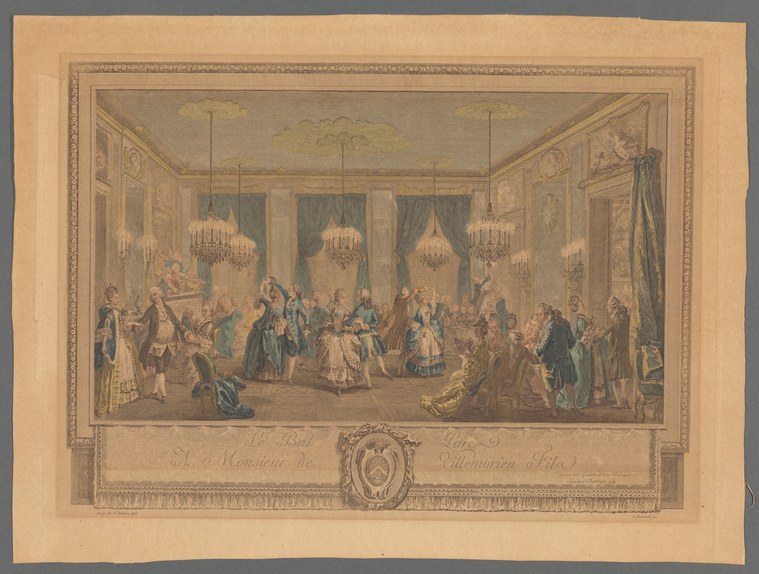
Le bal paré a Monsieur de Villemorien Fila [Fils?]
Unknown artist
- Collection:
- Prints depicting dance
- Source:
- New York Public Library
- Rights:
- Public domain — free to use, share and adapt.
- Recorded as:
- Public Domain
For historians of dance, this print is invaluable as a period record of how minuets, contredanses, and other court dances were actually arranged in space and performed in the body—information that movement notation alone cannot always convey. For art historians, it demonstrates the eighteenth-century use of engraving to commemorate and circulate knowledge of courtly occasions, and shows the conventions of perspective and composition used to record social spectacle. For anyone studying the visual culture of the Enlightenment, it offers evidence of how dancing functioned as a marker of class, refinement, and participation in aristocratic society.
What you are looking at
A grand formal ball in an elegant eighteenth-century salon, shown in a bird's-eye perspective that allows the viewer to see the entire floor plan and the architecture framing it. The room is symmetrical and richly decorated: the ceiling is coffered, the walls are paneled with ornamental details, and five large chandeliers hang at regular intervals, their candles creating pools of light. The figures—roughly thirty to forty courtiers in full formal dress—are distributed across the floor in small clusters and pairs. Some stand in conversation; others are actively dancing. The dancers visible in the center and foreground form loose couples and groups rather than rigid geometric formations. Women wear elaborate low-cut gowns with full skirts; men wear knee breeches, jackets, and heeled shoes. The color palette is muted—ochres, soft greens, pale blues—with gold accents from the chandeliers. The floor appears to be polished parquet. The entire scene is framed within an ornamental border, with a cartouche containing a coat of arms at the bottom center, below which runs a title in script. The print is hand-colored, with subtle washes creating atmosphere and depth.
The dancing
The dancers maintain the upright posture and composed deportment characteristic of courtly dance: spines straight, arms held moderately extended, and heads carried with formality. Couples are in close proximity but do not appear to use the tight closed holds of later ballroom styles. Several women have one arm raised or extended, suggesting the arm positions of minuets or contredanses. The weight distribution appears even and controlled rather than weighted into progressive steps; the figures seem poised rather than in active locomotion. Small groups of three to six people are scattered throughout, suggesting both paired dancing and group formations typical of French court balls, where minuets and contredanses would coexist in the same event.
The dance depicted
This depicts a formal court ball—likely French, given the inscription and style—of the mid-to-late eighteenth century. The gathering appears to show a mix of dance forms typical of such events: minuets in pairs, contredanses in sets, and possibly some quadrilles or cotillions. The architectural setting, the formality of dress, and the management of space all point to a professional dancing master's choreography rather than vernacular social dancing. The scale and expense of the event—the chandeliers, the paneling, the formal attire—suggests an aristocratic or court occasion, where dancing was a central entertainment and a display of education and grace. No single figure dominates; the interest is in the collective ritual rather than any individual's virtuosity.
How it was made
This is a hand-colored engraving or etching, recognizable by the fine line work, the regularity of the parallel lines (hatching) used for shading, and the characteristic warm tone of the paper. The hand coloring—applied in translucent washes after printing—shows the soft palette typical of eighteenth-century French decorative prints. As a print, this work would have circulated in multiple copies, making it an accessible record of court fashion and social practice rather than a unique artwork. The aerial perspective and the careful architectural framing suggest it was made for a patron who wished to commemorate a specific event or to preserve a record of how such occasions were conducted. The presence of the coat of arms and title cartouche indicates this was an engraving of some formality, likely commissioned or issued as a separate plate.
About this work
This is a documentary record of aristocratic social dancing in the French court tradition of the eighteenth century, rendered as a hand-colored engraving. It captures not the virtuosity of trained performers but the collective choreography of formal courtly society—the mingling, the prescribed patterns of minuets and contredanses, and the visible hierarchy of space and dress that governed such events. The print preserves both the visual spectacle of the occasion and implicit information about deportment, spatial arrangement, and the partnership between music, dance, and architecture in the culture of the court. It belongs in a gallery of dance art because it documents a moment when dancing was the primary language of social order and display, and shows how an artist could freeze that ephemeral social performance in a durable and reproducible medium.
How to look at it
The viewer should observe the distribution of figures across the floor: notice how clusters form and dissolve, and how the architecture of the room (the columns, the chandeliers, the symmetry) dictates the arrangement of bodies. Look at the posture and arm positions of the dancers: the way arms are held at a moderate height, the straightness of the spine, the restraint of gesture—all markers of courtly training. Compare the dancers in the foreground (more detailed, closer to the viewer) with those in the background, where the artist has suggested figures more sketchily; this hierarchy of detail creates depth and suggests the crowd as a collective body rather than individuals. Notice also the formal frame and cartouche: this is not a snapshot of a moment, but a commemorative document, presented as a record worthy of preservation.
The period
This print dates to the era when French court culture was at its height of influence across European aristocracy, and when the minuet was the central, most prestigious form of social dancing—a form that required training, a dancing master, and the economic resources to participate. The engraving itself reflects the explosion of decorative and documentary prints in the eighteenth century, particularly in France, where prints recorded both fashion and social occasions for a market of educated patrons who could not attend such events in person. The care taken with the architectural setting and the symbolic coat of arms suggests this was not a generic 'ball' scene but a commemoration of a particular occasion, possibly a royal or noble celebration. By the time this print was made, the minuet was already becoming codified and somewhat formalized—a marker of good breeding rather than cutting-edge fashion—and prints like this preserved an idealized vision of courtly grace and order.
Where it lives
Held in the New York Public Library's Prints collection, this work is part of a broader archive of eighteenth-century dance imagery. As a hand-colored print, it would have circulated in small numbers among educated patrons with an interest in court culture and fashion. Its presence in a major research collection suggests it was recognized early as a document of cultural significance rather than a mere decorative ephemera.
Dance in this work
Questions about this work
What dances are being performed in this ball?
Based on the date, setting, and the arrangement of figures, this is almost certainly depicting minuets (usually danced by one couple at a time while others watched from the side) and contredanses or quadrilles (group dances in which multiple couples participated in prescribed formations). Both forms would be present at a formal eighteenth-century court ball. The loose, varied positioning of the figures suggests both types of dance were occurring simultaneously in different parts of the room.
How do I know this is French and not Italian or English?
The script of the title and the overall style of the engraving point to French origin. The high degree of formality, the presence of a coat of arms, and the celebration of courtly dancing are consistent with French court culture of the ancien régime. French dancing masters had established the minuet and the vocabulary of courtly dance as the standard across Europe, so this aesthetic reflects French cultural dominance in the practice and documentation of social dancing.
Why is everyone standing or walking rather than in obvious movement?
Eighteenth-century court dances, especially the minuet, were highly controlled and measured in tempo. The steps were small, the timing was precise, and much of the dance consisted of walking in prescribed patterns rather than jumping or turning rapidly. The artist has chosen to capture the overall scene of the ball rather than a single dramatic moment of movement—the interest is in the social and spatial order of the occasion rather than in kinetic energy.
Who would have owned or displayed a print like this?
A person or family of aristocratic or upper-bourgeois status with an interest in court fashion, social accomplishment, and the visual documentation of prestigious occasions. Such prints were often kept as albums or bound into volumes as records of fashionable life. They could also serve as references for those learning to dance, as visual documentation of the correct posture and placement.
More dance artwork





