49 works in this view — arrow keys or swipe to move between them.
Dance in Art
Don Luigi's ball
Unknown artist
- Collection:
- Prints depicting dance
- Source:
- New York Public Library
- Rights:
- Public domain — free to use, share and adapt.
- Recorded as:
- Public Domain
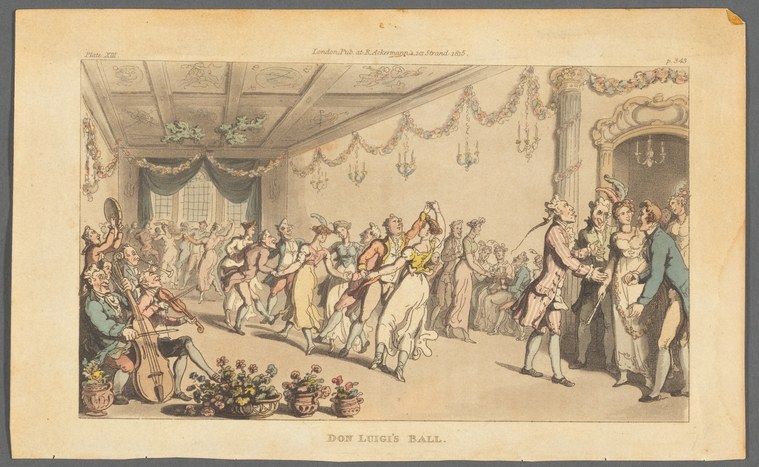
For dancers and historians, this image captures the material reality of 18th-century ballroom practice—the actual spacing, scale, dress, and mixed engagement that academic descriptions of minuets or cotillions do not convey. It shows that a ball was not a synchronized event but an overlapping sequence of social moments, and that music, dress, conversation, and movement were all equally part of the event.
What you are looking at
A grand ball held in an ornate interior, with draped garlands and hanging chandeliers adorning the ceiling and walls. The room is crowded with figures in 18th-century dress: men in breeches, coats, and tricorn hats, women in full-skirted gowns. The composition shows the ball in full swing, with numerous couples dancing or standing in conversation, arranged informally across the floor. In the foreground at left, a cellist performs seated on the ground among scattered instruments and flower pots. At right, a doorway opens onto an interior space where additional figures cluster. The atmosphere is lively and convivial—this is a fashionable gathering of some importance, captured in the moment of social and choreographic activity.
The dancing
Couples are positioned throughout in varied attitudes: some hold each other in the closed hold typical of period social dance, others stand in conversation or transition between figures. The dancers' weight appears centered and their frames relatively upright, though the engraver's line is not precise enough to read individual footwork. Women's skirts are full and extend to the ankle; men wear formal coats. The sheer number of figures and their casual spacing suggest this is a fashionable social gathering rather than a formal court performance, with simultaneous dancing and socializing rather than all dancers in synchronized patterns.
The dance depicted
This depicts a ball—a formal social dance gathering—most likely from the 18th century based on costume and setting. The specific dances are not identifiable from the composition, though the presence of couples and the period costume suggest minuets, cotillions, or country dances were danced. The presence of a live orchestra (evident from the cellist and other instruments visible) confirms this is an actual ball with musicians playing; the informal grouping suggests guests danced multiple numbers throughout the evening rather than all participating in a single figure. The title suggests this is a specific, identifiable event.
How it was made
This is a hand-colored engraving or aquatint, evident from the fine linear work defining figures and architectural detail, combined with applied watercolor or gouache wash for the flesh tones, clothing, and architectural detail. The technique allowed for relatively wide circulation as a print—this image could be reproduced in number and distributed to document a fashionable event. The precise architectural perspective and careful attention to dress and composition suggest this was made for an educated audience familiar with both current fashion and ballroom conventions.
About this work
This is a topographical social document: a record of a specific, named ball rendered as a crowded interior scene. It belongs in the gallery as evidence of how 18th-century formal dance was actually practiced—not in a courtly ritual lineup but as a mixed social activity where couples danced in rotation, musicians played continuously, and guests stood talking, watching, and waiting. The image captures the choreography of the event as a whole: the movement, the dress, the music, and the social hierarchy of the space. It is one kind of historical source: not a technical diagram of steps, but a record of dance as a lived social practice.
How to look at it
Attend first to the scale of the space and the number of simultaneous dancers: this is not a performance for an audience but a working ballroom with multiple couples in motion at once. Notice the orchestra at left—the presence of live musicians is essential to understanding this as a continuous event, not a staged moment. Observe the dress carefully: the men's formal coats and women's full skirts constrain the movement in specific ways. Finally, read the composition from left to right and foreground to background to see how the artist has organized the crowd to show both individual couples and the collective social event.
The period
The 18th century saw the codification and spread of formal social dances—the minuet, cotillion, and English country dance—among the European upper and rising merchant classes. Balls became essential social events where rank, wealth, fashion, and eligibility were on display. By the late 18th century, such events were popular enough and fashionable enough to be documented and circulated as prints, both as documentary records and as fashionable images for purchase by those who attended or aspired to attend. The presence of a named ball suggests this is a specific, celebrated event in the social calendar.
Where it lives
The holding collection is identified as 'Prints depicting dance' from NYPL. This is a print in a collection organized by subject, indicating it was valued specifically as a document of dance practice and ballroom culture rather than as art by a named master.
Dance in this work
Questions about this work
What dances are being performed?
The engraving does not make the specific dances clear. Based on period and costume, likely dances include the minuet, cotillion, or English country dances popular at formal balls in the 18th century. The irregular spacing and varied positions of couples suggest multiple dances in rotation rather than a single coordinated figure.
Is this a real ball or imagined?
The title 'Don Luigi's Ball' suggests this documents a specific, named event, though we cannot confirm from the image alone whether it depicts an actual occasion or a composite or fictionalized gathering. The architectural detail and costume specificity suggest the artist intended to document a real or at least plausible scene.
What do the instruments in the foreground tell us?
The visible cello and other instruments confirm that this was a live-music event with a working orchestra. The musicians are placed at the edge of the space, visible but not central, which was typical ballroom arrangement—the music enabled the dancing but the dancers and their social interaction were the focus.
How does the dress constrain the movement?
Women's full skirts required a particular carriage and footwork—movement had to be controlled and elegant, with the skirt contributing to the visual effect. Men's formal coats and breeches also enforced an upright posture. This constraint was not limitation but style: the difficulty of moving gracefully in such dress was part of the demonstration of status and training.
More dance artwork





