49 works in this view — arrow keys or swipe to move between them.
Dance in Art
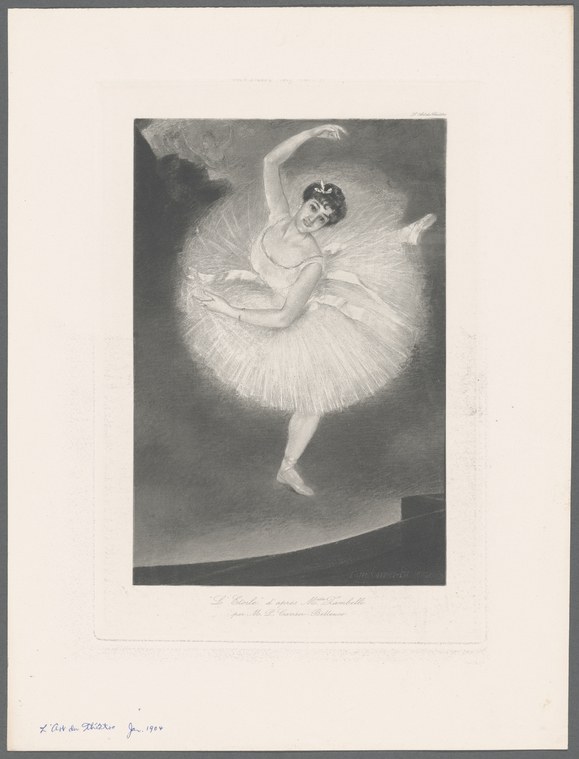
L'etoile, d'apres Melle Zambelli
Unknown artist
- Collection:
- Prints depicting dance
- Source:
- New York Public Library
- Rights:
- Public domain — free to use, share and adapt.
- Recorded as:
- Public Domain
Mademoiselle Zambelli was a celebrated Romantic-era ballerina, and this print preserves her in one of her signature roles. The image is a crucial document of how Romantic ballet was visualized and consumed in its own time—what audiences understood by 'the ethereal dancer,' and how performers were commemorated and celebrated through commercial prints. For historians of dance and performance culture, it reveals the gap between what was seen live and what was remembered: this print is what survived, and it shaped how future generations imagined Romantic ballet.
What you are looking at
A solo female dancer in a voluminous white tulle tutu, caught mid-leap or mid-arabesque against a dark background. She wears a fitted white bodice with short sleeves and has dark hair crowned with a tiara or diadem. Her body is lifted and elongated, one arm curved gracefully overhead while the other extends to the side; her legs are extended in classical ballet line. The composition is vertically oriented and intimate, focusing entirely on the soloist's form. The lighting isolates her figure against shadow, emphasizing the ethereal quality of the tulle and the delicacy of the pose. A dark geometric form—possibly a platform or architectural element—anchors the lower portion of the frame. The image is rendered in tones of gray and black, with highlights that make the tutu glow luminously.
The dancing
A single female dancer in a vertical lift or leap, with the weight carried through a fully extended supporting or working leg. Her upper body is held in an open, lifted frame typical of classical ballet—chest forward, shoulders relaxed, head held with aristocratic carriage. Both arms are in positions suggesting elevation: one arm raised and curved overhead (fifth position or à la couronne), the other extended to the side. The tutu is rendered as a broad, circular form around her hips, confirming the ballet vocabulary of the period. Her arabesque or attitude line shows the long leg extension and pointed foot characteristic of Romantic-era ballet technique.
The dance depicted
This is a Romantic ballet solo, most likely from the mid-nineteenth century. The inscription 'L'étoile, d'après Melle Zambelli' confirms the image depicts a specific dancer—Mademoiselle Zambelli—performing *L'Étoile* (The Star), a celebrated Romantic ballet role. The pose captures the ethereal, weightless quality that Romantic ballet prized: the dancer appears almost suspended, her tulle tutu defying gravity. The full, bell-shaped skirt and the emphasis on verticality and lightness are hallmarks of the Romantic style, as is the tiara marking her as a celestial or supernatural being. This is not a social dance but a theatrical virtuoso solo designed to showcase technical mastery combined with an illusion of effortless elevation.
How it was made
This is a lithographic or engraved print, rendered in grayscale. The technique allows for soft tonal gradations that create depth and emphasize the luminous quality of the tulle against shadow—an effect that line-engraving would have struggled to achieve as subtly. The print medium indicates this was a commercially produced reproduction for circulation beyond the theatre, likely for sale to the dance-going public or theater enthusiasts. Prints of celebrated dancers and roles were popular merchandise in the mid-nineteenth century, serving as souvenirs and as publicity for performers and works. The quality of the rendering suggests this was a professional commercial print, not a sketch or private study.
About this work
This is a mid-nineteenth-century theatrical print commemorating a celebrated performance by Mademoiselle Zambelli in the Romantic ballet *L'Étoile*. It captures the essence of Romantic ballet aesthetics: the solo female dancer as celestial or supernatural being, weightless and transcendent, lifted above the earthly realm suggested by the dark space below. The print preserves the moment and the performer in a form that could be widely circulated and consumed—a piece of ballet culture and theatrical memory made portable.
The work belongs in a gallery of dance in art because it documents both a specific performance and a whole aesthetic system. It shows us how a dancer and a role were perceived and marketed, how ballet virtuosity was visualized for a public that mostly experienced dance live and in the moment. The print is a historical witness to Romantic ballet at its height, and a record of how that ephemeral art was captured, packaged, and remembered.
How to look at it
Observe the moment the artist chose: not a step or turn, but a moment of suspension—an arabesque or attitude held in the air, defying the body's weight. This is a characteristically Romantic choice: the dancer is shown not in motion but in a state of achieved elevation, as if frozen at the precise instant of weightlessness. Notice how the tulle is rendered—not as a detailed garment but as a luminous, expanding form that seems to emit light. The tiara and the isolation against darkness mark this as a supernatural being, not a human woman. The print also shows the technical understanding of the artist: the line of the body is anatomically coherent, the extension is genuine, and the pose is one that a trained dancer could actually hold. The viewer is not looking at fantasy but at the documented reality of a dancer's achievement, presented in a style that emphasizes its dreamlike quality.
The artist
The artist is not recorded in the catalogue. However, the professional quality and commercial finish of this print suggest it was created by an established printmaker working for a theatrical or music publisher in Paris or another major European dance center. Mid-nineteenth-century ballet prints were often made by specialized engravers or lithographers who worked from live observation, sketches, or commissions from dancers and theater companies. Without attribution, we cannot detail the artist's practice, but the technical accomplishment visible here indicates training in the representation of fabric, figure, and theatrical lighting.
The period
This print dates to the height of Romantic ballet in Europe (roughly 1830–1860), when ballet had become the dominant theatrical dance form and female soloists were stars whose likenesses were as sought-after as those of opera singers. The aesthetic priorities visible here—weightlessness, verticality, the supernatural or exotic heroine, the emphasis on the skirt and leg line—were central to works like *La Sylphide* (1832) and *Giselle* (1841). The tutu itself, in its evolved Romantic form, had become the visual signature of ballet. In the same period, lithography and commercial engraving were making theatrical imagery widely available to a growing middle-class audience. This print is part of a culture in which dance was visible not only on stage but in sheet music covers, playbills, newspapers, and souvenir prints.
Where it lives
This print is held in the New York Public Library's collection of prints depicting dance. It is a commercially produced engraving or lithograph, the kind of object that would have been sold to the public in the nineteenth century and is now preserved in institutional collections as a record of theatrical history and performance culture.
Dance in this work
Questions about this work
Who was Mademoiselle Zambelli?
Mademoiselle Zambelli was a celebrated Romantic-era ballerina, though detailed biographical information is limited in readily available sources. This print commemorates her performance in *L'Étoile*, suggesting she was notable enough to warrant commercial reproduction of her image. She represents the generation of dancers who were stars of the Romantic ballet stage and whose likenesses were widely circulated.
What is 'L'Étoile' and where did it come from?
*L'Étoile* (The Star) was a Romantic ballet, though the exact date and choreographer are not confirmed from this image alone. The role depicted here—a celestial being in a gossamer tutu—is typical of Romantic ballet's interest in supernatural, ethereal heroines. The ballet was successful enough to be remembered through prints like this one.
Why is the tutu so big and fluffy?
The full, bell-shaped tutu was the visual signature of Romantic ballet (1830s–1860s). It was designed to emphasize the vertical line of the dancer's leg and to create an illusion of weightlessness and ethereality. The tulle skirt also allowed for greater visibility of footwork and the line of the body, and it became associated with the Romantic ideal of the supernatural, otherworldly female dancer.
How was this print made?
This appears to be a lithograph or engraving, techniques that allowed for soft tonal effects and fine detail. The print would have been created from a drawing or sketch (possibly made at or after a live performance) and then reproduced commercially for sale to the public. Prints like this were affordable souvenirs that allowed theatergoers to take home an image of the dancers and roles they admired.
More dance artwork





