49 works in this view — arrow keys or swipe to move between them.
Dance in Art
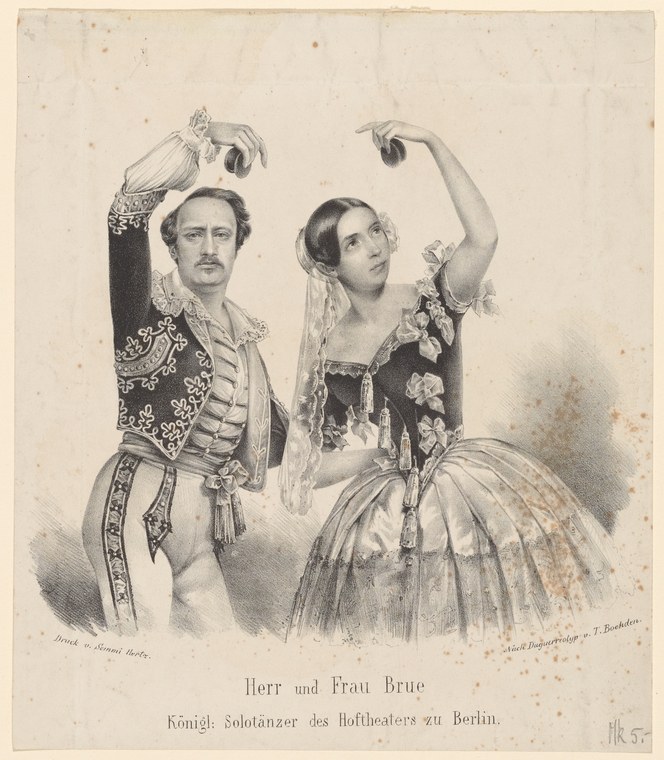
Herr und Frau Brue, Königl. Solotänzer des Hoftheaters zu Berlin
Unknown artist
- Collection:
- Prints depicting dance
- Source:
- New York Public Library
- Rights:
- Public domain — free to use, share and adapt.
- Recorded as:
- Public Domain
Named performers in historical dance are rarely documented this carefully and publicly; this engraving preserves both faces and names of mid-19th-century court ballet dancers whose work otherwise survives only in programs and reviews. The theatrical costume and formal pose exemplify the Romantic-era ballet aesthetic and the court entertainment context that shaped European dance practice at this moment.
What you are looking at
A man and woman in formal theatrical costume face the viewer in a frontal, posed arrangement against a plain background. The man stands at left in a richly decorated military or court jacket with ornate gold braid and embroidery, white breeches, and what appears to be a plumed headdress or turban held aloft in his raised left hand. His right arm is extended. The woman at right wears a full-skirted dress with a patterned bodice and a delicate lace head covering or veil; her right arm is raised and bent, her hand holding or gesturing toward something. Both figures are rendered in fine stippled engraving, with careful attention to fabric texture and shadow. The title and credit line appear below in German script.
The dancing
Both dancers face forward in an open, display-oriented stance rather than a closed partnered hold. The man's raised arm and the object he holds—possibly a prop or costume element—dominate the composition's upper half. The woman's raised arm mirrors this vertically but remains closer to her body. Neither figure shows the weight-shift or directional impulse typical of social partner dancing; instead, they present themselves as if for a portrait or curtain call, suggesting a theatrical moment of display rather than active movement through space.
The dance depicted
The German title identifies these as 'Herr und Frau Brue,' royal solo dancers ('Königl. Solotänzer') of the Berlin Court Theatre ('Hoftheaters zu Berlin'). The theatrical costume, frontal presentation, and formal stance suggest this documents performers of court or operatic ballet rather than social dance. The ornate military-style dress and the woman's classical theatrical gown point to a mid-19th-century court ballet tradition, likely a scene from a romantic ballet or courtly divertissement. Without additional documentation, the specific work cannot be identified, but the image preserves a record of these named performers in character costume.
How it was made
This is a fine engraving, likely a steel or copper engraving given the delicate parallel hatching and sharp detail of the textile patterns. The technique produces a small-scale, highly portable image suitable for theatrical programs, souvenir prints, or illustrated journals—typical distribution for documenting named performers of the period. The precision of the medium allowed the engraver to render the elaborate embroidery and lace textures with theatrical accuracy, making this both a portrait document and a record of costume design.
About this work
This engraved portrait documents two named performers of the Berlin Court Theatre in the mid-19th century, shown in full theatrical costume and posed in a formal, display-oriented arrangement. The title, text, and costume point to a work of court or romantic ballet tradition, though the specific ballet or scene is not identified. The image serves as both a performer portrait and a record of theatrical dress and presentation conventions of the period, and its circulation as a printed engraving made these dancers' likenesses and names accessible to a wider public beyond the theatre itself.
How to look at it
Notice the deliberate, frontal presentation: both dancers face the viewer directly, neither is in motion or partnership. This is a theatrical pose for portraiture, not a document of movement. The elaborate costume details—the embroidered jacket, the plumed headdress, the patterned bodice, the lace veil—are rendered with precision and would have been immediately recognizable to contemporary theatre-goers. The engraver has frozen a moment of formal display, the kind of posed photograph or print that announced a performer's status and role to the public.
The artist
The engraving is credited in script at lower left, but the artist's name is not legible in this reproduction. The work was likely produced by a Berlin-based theatrical print publisher, a common practice for documenting and promoting major performers of the court theatre.
The period
The mid-19th century (circa 1840–1870) was the height of Romantic ballet in Europe, when court theatres in cities like Berlin, Vienna, and Prague maintained resident ballet companies as part of their operatic and dramatic repertoire. The ornate military-style court dress worn by the male dancer reflects the formal social hierarchies of German court life, while the woman's full skirt and delicate veil are consistent with the Romantic tutu and aesthetic of the period. Theatrical engravings of named performers were a popular form of documentation and souvenir, circulating among theatre-goers and serving as a form of publicity.
Where it lives
The work is held in the New York Public Library's collection of prints depicting dance, a broad archival category that includes theatrical portraits, dance instruction prints, and genre scenes. The German text and theatrical context indicate this was produced for a Berlin or German-speaking audience.
Dance in this work
Questions about this work
Who were Herr and Frau Brue?
They are identified in the title as royal solo dancers of the Berlin Court Theatre, but biographical details beyond this engraving are not readily available. The formal title ('Königl. Solotänzer') indicates they held official positions in the court ballet, suggesting they were principal dancers of some standing, but no record of their specific roles or career span survives in widely accessible sources.
What ballet or scene does this show?
The specific work is not identified in the print. The costume and pose suggest a court ballet or Romantic-era theatrical piece from the mid-19th century, but without additional documentation (a program, caption, or inscription on the original print), the particular ballet cannot be determined.
Why are they posed like this rather than dancing?
This is a formal portrait engraving, not a document of choreography or movement. The frontal, display-oriented stance was standard for theatrical celebrity portraits of the period, allowing the engraver to showcase the performers' faces and costumes clearly. Such prints circulated as souvenirs and publicity, similar to photographs of theatre stars.
What does the object in his hand represent?
It appears to be a large plume or feathered headdress, likely part of the costume. Military or court ballets of the period frequently featured such elaborate headpieces as part of formal or ceremonial dress, but without knowing the specific work, its exact significance cannot be confirmed.
More dance artwork





