49 works in this view — arrow keys or swipe to move between them.
Dance in Art
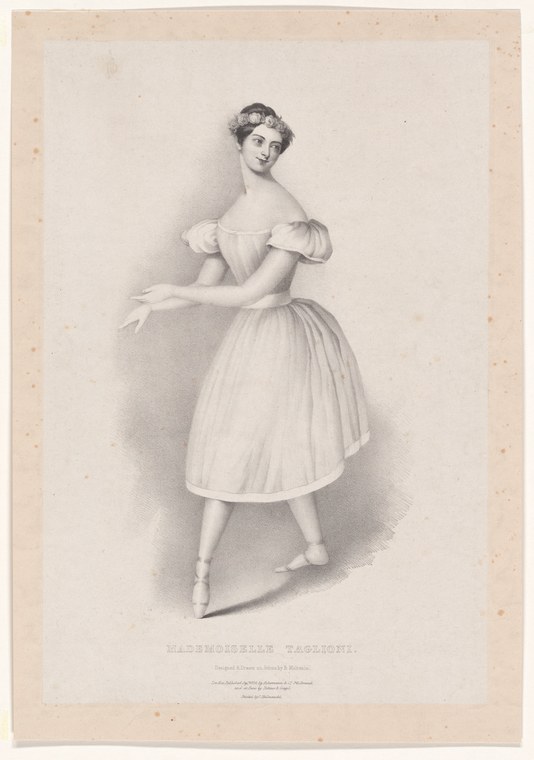
Mademoiselle Taglioni
Unknown artist
- Collection:
- Prints depicting dance
- Source:
- New York Public Library
- Rights:
- Public domain — free to use, share and adapt.
- Recorded as:
- Public Domain
This image is a primary source for understanding both the technique and the visual presentation of early Romantic ballet, and for recognizing how prints shaped the celebrity and international fame of dancers in the era before photography. For historians of dance costume, technique, and the gendered aesthetics of Romanticism, this work provides concrete evidence of how a leading performer was actually seen and represented to her public.
What you are looking at
A single female dancer is shown in a three-quarter pose against a plain background, her body angled to the right while her gaze turns back toward the viewer. She wears a white or pale muslin dress with a fitted bodice and deeply off-shoulder neckline, the skirt full and reaching mid-calf with vertical pleating that emphasizes its volume. Her feet are positioned in a refined, turned-out stance, and she wears pale pointe shoes. Her hair is arranged in an upswept style typical of the 1830s–40s, with what appears to be a small ornament or wreath. The engraving technique creates soft gradations of light and shadow across the figure, particularly emphasizing the sculptural quality of the drapery and the delicacy of her limbs. The composition is intimate and focused entirely on the dancer's form and bearing, with no narrative context, props, or setting beyond the neutral ground.
The dancing
The dancer's weight appears to rest evenly, with her body held in a composed, vertical line characteristic of early Romantic ballet training. Her arms are softly positioned, the visible arm extended gracefully downward with a relaxed, naturalistic quality. Both legs show clear turnout from the hip, and the placement of her feet suggests either a small movement or a held position between steps. The overall frame is one of elegant restraint—there is no dramatic extension or extreme épaulement, but rather a studiousness of posture and a lightness that suggests recent training in the Romantic idiom.
The dance depicted
This is a portrait of a professional ballet dancer at the height of the Romantic era, almost certainly representing a famous performer of the 1830s–40s. The costume, the pointe work, the body alignment, and the formal presentation all align precisely with early Romantic ballet as practiced in Paris and across Europe. The title names Mademoiselle Taglioni, the Italian-Swedish dancer who dominated European ballet stages during the 1830s and defined the Romantic aesthetic through her lightness, refinement, and technical command. This image likely commemorates a specific performance or represents her as a celebrated interpreter of Romantic roles, though the neutral setting prevents identification of a specific character or work.
How it was made
This is a steel or copper engraving, a reproductive print likely derived from a painting or drawing. The technique allows for fine detail and subtle modulation of tone through careful hatching and cross-hatching, visible especially in the rendering of fabric, skin, and the figure's volumetric presence. Engravings of this kind were the primary means of disseminating images of celebrated performers to a literate public before photography; they were produced in editions and sold individually or bound into periodicals and collections. This method placed the dancer's image in circulation across Europe, making her likeness widely known and contributing to her status as a celebrity and cultural icon.
About this work
This is a formal engraved portrait of a leading Romantic-era ballerina, created in the reproductive print tradition that made celebrity dancers visible to the public. The work is a visual document of early 19th-century ballet technique, training, and aesthetic ideals—the posture, the pointe work, the muslin dress, and the refined bearing all speak to a specific historical moment in dance and to the technical and artistic innovations that defined Romantic ballet. As a reproductive print, it also records the methods by which dance was commemorated and circulated as image before the photograph; it belongs to a visual culture that made dancers into public figures and created markets for their likenesses.
How to look at it
Attend to the dancer's posture and the refinement of her bearing—this is not a moment of dynamic movement, but rather a composed presentation of technique and presence. The engraver has frozen the dancer in a position of calm readiness, showing turnout, alignment, and the ideal proportions valued in early 19th-century ballet training. The soft modeling of the figure through fine engraving creates an effect of three-dimensionality and presence that emphasizes the dancer's physical accomplishment. The viewer is invited to admire both the discipline of her form and the elegance of her appearance—the image is as much about presenting the dancer as a refined and cultivated figure as it is about documenting her technical mastery.
The artist
The artist is not recorded. The engraving was likely produced by a commercial print workshop, possibly in Paris, London, or another European publishing center. Reproductive engravings of performing artists were created by specialist engravers working from paintings, drawings, or occasionally from life studies. These workshops operated at scale, producing multiple states and editions to serve markets for theatrical celebrity imagery.
The period
The 1830s and 1840s saw the full flourishing of Romantic ballet in Europe, with Marie Taglioni at its center. This was the era of pointe work becoming standard technique, of the ballerina as the dominant figure in ballet (often danced by women in travesti roles), and of ethereal, otherworldly aesthetics expressed through white tulle and an emphasis on lightness and verticality. Simultaneously, reproductive engraving was the dominant technology for circulating images of celebrities—theatrical prints were a major market, and famous dancers were among the most desirable subjects. This image sits at the intersection of those two cultural forces: the technical and aesthetic innovations of Romantic ballet, and the visual economy that made dancers into international celebrities.
Where it lives
This print is held in the New York Public Library's collection of prints depicting dance. It is a reproductive engraving of unknown date and maker, part of a body of 19th-century theatrical celebrity imagery that documented the major performers of the era.
Dance in this work
Questions about this work
Who was Mademoiselle Taglioni?
Marie Taglioni (1804–1884) was a Swedish-Italian ballet dancer who achieved international fame during the 1830s and 1840s as the most celebrated ballerina of the Romantic era. She was known for her ethereal lightness, technical refinement, and her creation of iconic roles including the title role in La Sylphide (1832). She essentially defined what Romantic ballet looked like and trained under her father Philippe Taglioni, a major choreographer and ballet master.
What does the dress tell us about the period?
The off-shoulder muslin gown with vertical pleating was the standard costume for female ballet dancers during the Romantic era. It was designed to suggest lightness, delicacy, and an ethereal quality aligned with Romantic aesthetics and narrative themes involving sylphs, spirits, and supernatural beings. The pointe shoes visible in the image were relatively new technology, becoming standard in the 1830s–40s.
How were dancers circulated as images before photography?
Reproductive engravings like this one were the primary medium. Publishers commissioned engravings from paintings or drawings of famous performers, printed them in editions, and sold them individually or in bound collections. They were distributed internationally and hung in homes, published in theatrical periodicals, and collected by fans. This made dancers into visual celebrities and helped establish their international fame.
What does her posture tell us about her training?
Her vertical alignment, turned-out legs, relaxed arm placement, and refined carriage all reflect the Romantic ballet training method of the period. The emphasis is on lightness, precision, and an appearance of effortless grace rather than on dramatic extremes of extension or line. This stance would have been taught and reinforced through daily practice in the ballet studios of Paris and other European centers.
More dance artwork





