49 works in this view — arrow keys or swipe to move between them.
Dance in Art
Faune
Unknown artist
- Collection:
- Prints depicting dance
- Source:
- New York Public Library
- Rights:
- Public domain — free to use, share and adapt.
- Recorded as:
- Public Domain
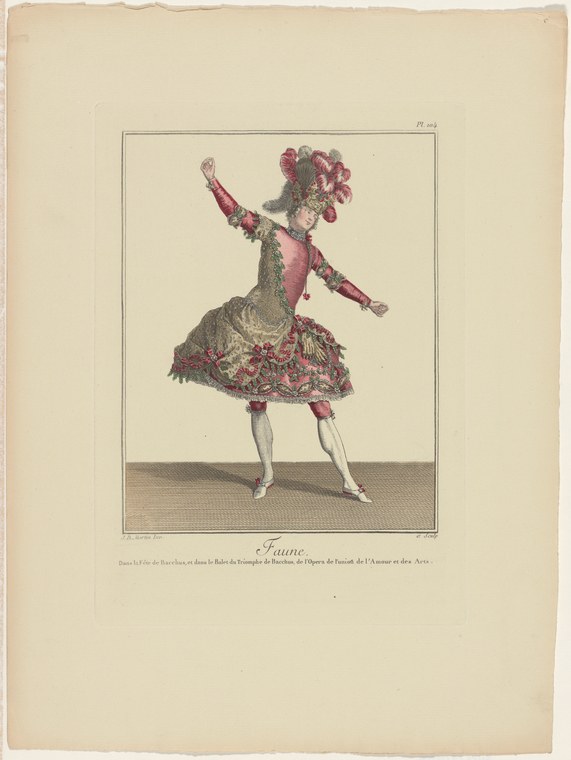
This image preserves the visual record of a specific role type and performance vocabulary that is now invisible—we cannot hear how the dancer moved or see the full sequence of steps, but we can see the silhouette, the costume hierarchy, and the narrative posture of early theatrical ballet. For historians of dance costume and iconography, it demonstrates the precision with which roles were differentiated and documented for a literate theatrical public.
What you are looking at
A single dancer in theatrical costume stands in a contrapposto pose against a plain ground. The figure wears a deep rose-pink silk dress with elaborate trimmings—the skirt features ornamental banding and scalloped edges—and matching pink silk sleeves or arm coverings. A tall, plumed headdress of coordinated pink and burgundy crowns the figure. The dancer's pose is balletic and statuesque: weight on one leg, the free leg extended, arms lifted in an open fifth position, the upper body tilted back in an attitude of release and display. The face is in profile, gazing upward. The composition is rigorously frontal and symmetrical. The work is a hand-colored engraving on cream paper, printed in a portrait format, with a simple ruled border and the title "Faune" centered below in italic script.
The dancing
The single figure displays the classical ballet frame and weight distribution of the late 18th century: one leg bearing weight, the other extended or lifted, the torso in a relaxed tilt. The arms are open and lifted, not held in the tight épaulement of Romantic ballet but in the more expansive, gesture-forward manner of court dance and early theatrical ballet. The head is raised and the gaze directed upward—a moment of rapt attention or reverie rather than grounded engagement. The costume suggests a role character rather than a classical nymph.
The dance depicted
This is a theatrical ballet figure, most likely representing the role of a faun—the title suggests Ovid's "Metamorphoses" or a pastoral allegory. The Faun was a standard role type in 18th-century ballet d'action, distinguishing itself from the corps de ballet through elaborate costume and the privilege of solo performance. The raised, open-armed pose and the lifted gaze suggest a moment of awakening or enchantment, the kind of narrative tableau favored in early theatrical ballet. The costume is too elaborate and the pose too balletic for folk dance or social dance; this is unambiguously a trained dancer in a formal theatrical role.
How it was made
This is a hand-colored engraving, a standard format for theatrical and court dance imagery of the 18th century. The medium allowed for rapid dissemination of costume and character designs, often circulated among theaters and wealthy collectors. The precision of line and the delicate hand coloring—applied in thin glazes—convey both the elegance of the garment and the formality of the theatrical convention. Such prints functioned as costume documentation, performance records, and souvenirs, reaching audiences who might never see the role performed.
About this work
This is a record of a named theatrical role—a Faun—as performed in French court ballet or early opera-ballet of the mid-to-late 18th century. The engraving captures the dancer's costume and pose with the formal precision of a fashion plate, but the uplifted body and the narrative title identify it as a scene from a story ballet, not a social dance or abstract composition. It is one of thousands of such character engravings produced in the century following Louis XIV's codification of ballet technique, documenting both the repertory and the visual culture of theatrical dance.
How to look at it
Attend to the precision of the costume—the coordination of color, texture, and trimmings—which speaks to the expense and deliberation of the theatrical wardrobe. The raised, open-armed pose is a moment of stillness or revelation rather than action; in the conventions of the time, this would have signaled a narrative point of importance: recognition, enchantment, or display. The profile view of the face and the upward gaze are typical of the engraving conventions for character prints, emphasizing dignity and the idealization of the role rather than the naturalism of the performance.
The period
By the mid-18th century, ballet had migrated from the court of Louis XIV to the commercial stage, and the role of the engraved costume print shifted with it. These works served as marketing, documentation, and archival records of the expanding repertory of character roles. The Faun—derived from classical literature—was a popular figure in ballet d'action, appearing in works such as Noverre's pantomime ballets and the later productions of Angiolini. The pose and costume in this print reflect the aesthetic of that moment: classical allusion, theatrical realism in dress, and the cultivation of the individual dancer as a celebrity whose image could be collected and owned.
Where it lives
This print is held in the New York Public Library's collection of prints depicting dance, a category that encompasses costume documentation, performance records, and theatrical ephemera from the 16th century onward. The holding is consistent with the print's function as a widely distributed, affordable record of a theatrical role.
Dance in this work
Questions about this work
What is a faun in ballet?
A faun is a classical mythological character—a wild, often mischievous forest spirit—adapted for the theatrical stage. In 18th-century ballet, faun roles were character parts that allowed for more dramatic, gestural movement than the abstract steps of the corps de ballet. The most famous faun in dance history is the title role of Nijinsky's "L'Après-midi d'un faune" (1912), but the figure appears in ballet from the 17th century onward.
How was this print made and distributed?
This is a hand-colored engraving, a technique in which a design is incised into a metal plate and then printed and colored by hand. This labor-intensive method made each print unique and allowed for fine detail and color variation. Such prints were sold to theater patrons, collected by wealthy amateurs, and used as costume references by theatrical companies, making them one of the primary visual records of 18th-century dance.
Is this a real dancer or an idealized figure?
Most likely both. The costume and pose are specific and detailed enough to record an actual role and possibly an actual dancer, but the formality of the engraving and the classical allusion suggest idealization—the image presents not documentary realism but the elevated, theatrical version of the role that the paying audience would recognize and remember.
More dance artwork





