49 works in this view — arrow keys or swipe to move between them.
Dance in Art
Pas de quatre
Unknown artist
- Collection:
- Prints depicting dance
- Source:
- New York Public Library
- Rights:
- Public domain — free to use, share and adapt.
- Recorded as:
- Public Domain
This is a primary historical document of nineteenth-century ballet practice: it records not only a major work but the visual and kinetic ideals of the Romantic era as understood by a popular commercial publisher. For dancers and historians, it shows how ballet was marketed and understood by the public at mid-century, and offers evidence of the pose, costumes, and formal compositional logic of a work that revolutionized ensemble ballet.
What you are looking at
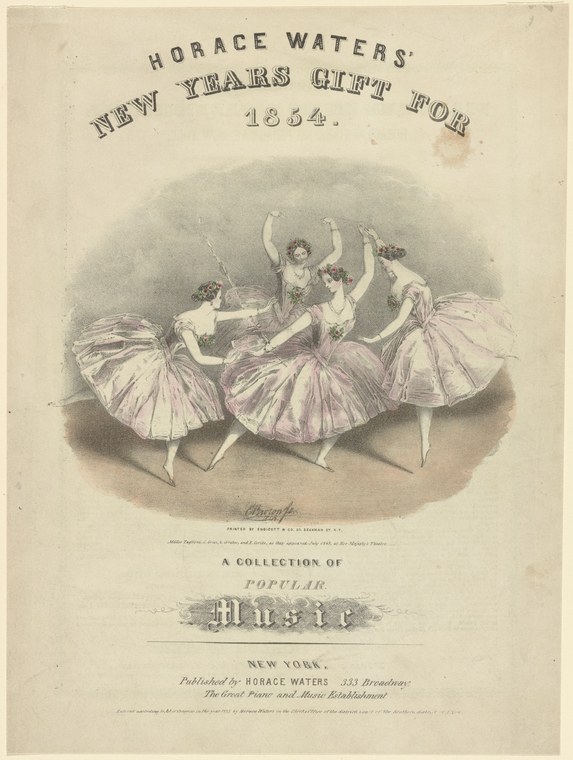
A lithograph showing four female dancers in a romantic theatrical moment, arranged in a loose diagonal across the composition. Each wears a pale tutu with a fitted bodice and pointe shoes; their tutus are rendered in delicate violet and lavender tones. The dancers occupy different spatial planes—one stands elevated on pointe at rear center with arms raised in an open fifth position, while the others surround her in poses of arabesques and attitudes, their bodies angled to create a sense of flowing, connected movement. The background is a neutral wash of soft gray tone that throws the figures forward; the lighting is even and studiofied, with no directional shadows. The composition has the freeze-frame quality typical of romantic ballet imagery—these are not snapshots but arranged poses meant to convey the essence of a particular dramatic moment or passage. The print is titled above the image, and publication details for Horace Waters appear below.
The dancing
All four dancers are en pointe in turned-out positions characteristic of classical ballet technique. The tallest figure at center-rear has her arms raised in what appears to be a fifth position en haut, her torso upright and formally extended. The dancers to her left and right display arabesques and other classical port de bras positions. Their poses are held and formal rather than caught mid-action; the bodies are aligned vertically and the weight clearly placed over the supporting legs. The tutus—which appear to be the shorter Romantic-era skirt length, ending near the knee—are positioned to show the full extension of the supporting leg and the line of the body.
The dance depicted
This is a theatrical ballet image, almost certainly representing a moment from *Pas de Quatre*, the legendary 1845 ballet created by Jules Perrot for the King's Theatre in London. The work featured the four greatest ballet dancers of its era—Marie Taglioni, Carlotta Grisi, Fanny Cerrito, and Lucile Grahn—in a single ensemble number, which was remarkable and historically significant. The image captures the formal, posed aesthetic of Romantic-era ensemble work: the ballet was structured around carefully arranged group formations interspersed with individual variations. The tutu length, the pointe work, the arm positions, and the overall compositional logic all support identification as Romantic ballet, specifically this canonical work.
How it was made
This is a hand-colored lithograph, a medium well-suited to disseminating dance imagery to a broad mid-nineteenth-century audience. The base printing would have been in black or sepia, with hand-applied watercolor or gouache adding the pale pink, lavender, and purple tones to the tutus. The soft, diffuse rendering of the background and the linear clarity of the figure outlines are characteristic of lithography as practiced for theatrical publicity. The technique allowed rapid reproduction and hand-finishing that preserved the delicacy of the ballet aesthetic while making the image affordable and collectible.
About this work
Horace Waters' *New Years Gift for 1854* was a commercial annual gathering theatrical imagery, dance notation, sheet music, and other entertainment material for a wide middle-class audience in New York. This hand-colored lithograph commemorates or celebrates *Pas de Quatre*, one of the most celebrated ballets of the nineteenth century and the only work of the Romantic era to remain in the classical ballet canon today. The image circulated long after the ballet's premiere in 1845, serving as a record of both a specific choreographic work and the ideal of Romantic ballet aesthetics—ethereal, ethereal, formally composed, and centered on the technical and dramatic powers of the ballerina.
How to look at it
Attend to the formal, almost heraldic arrangement of the four figures: Perrot's choreography was built around symmetry, balance, and clear spatial relationships. Each dancer is placed to display the classical line—the extended leg, the upright torso, the placement of the arms. Note the tutu length and silhouette: this is the iconic Romantic tutu, shorter and fuller than the classical tutu that would develop later. The pose is held and posed rather than dynamically energetic; the viewer is meant to contemplate line, form, and the grace of the body rather than to witness explosive movement. The violet wash of the tutus would have been hand-applied and varies slightly from figure to figure, reflecting the labor of the workshop.
The artist
The artist is not recorded. Horace Waters (1823–1893) was a New York music publisher and retailer known for *Waters' Musical Gazette* and various illustrated annuals and gift books. The lithographs in his publications were produced by commercial print shops, often with hand-coloring done by assistants. Waters' publications were aimed at a genteel middle-class readership interested in music, theater, and entertainment.
The period
The Romantic era in ballet (1830s–1850s) was defined by the dominance of the ballerina and the aesthetics of ethereality, otherworldliness, and supernatural narrative. *Pas de Quatre* premiered in 1845 and was immediately recognized as a historic moment—the only time the four greatest dancers of the day performed together. The ballet was created by Jules Perrot, a master of ensemble choreography, and it exemplified the formal, crystalline structure of Romantic ensemble work. By 1854, when this annual was published, the work was already regarded as a classic, and images of it circulated widely. This print testifies to the ballet's status as a major cultural event that extended well beyond the theater into the commercial visual culture of the urban middle class.
Where it lives
This is a page from Horace Waters' *New Years Gift for 1854*, a commercial annual published in New York. The NYPL holds it in its dance and theater print collection. The work is one of many similar periodical publications that disseminated theatrical imagery to middle-class readers in the nineteenth century.
Dance in this work
Questions about this work
How do we know this shows Pas de Quatre?
The title appears on the print itself. The work is inscribed as part of Waters' annual gift book, and *Pas de Quatre* was the most famous ensemble ballet of the era. The four-figure composition, the Romantic-era costuming, and the formal arrangement all align with historical accounts and other imagery of this ballet.
Could this image have been made from life or from the actual stage?
Unlikely in a direct sense. Commercial lithographs were typically composed in the studio, often drawing on descriptions, program notes, and earlier prints rather than direct observation. However, the artist would have had access to accounts of the ballet and possibly to earlier images or publications. The posed, formalized arrangement reflects theatrical convention rather than an attempt at documentary realism.
Why is the tutu this particular length and shape?
This is the characteristic Romantic tutu, which reached approximately to the knee or just below, allowing full visibility of the leg and the pointe work. Later classical tutus became progressively shorter and stiffer. The pale, flowing fabric was integral to the Romantic aesthetic—the tutu was meant to enhance the sense of weightlessness and otherworldliness.
Who were the four dancers in Pas de Quatre?
The ballet premiered in 1845 featuring Marie Taglioni, Carlotta Grisi, Fanny Cerrito, and Lucile Grahn, the four greatest ballet dancers of the Romantic era. The original choreography by Jules Perrot gave each dancer an individual variation and showcased them together in a finale. The ballet remained in the repertory and was restaged many times.
More dance artwork





