49 works in this view — arrow keys or swipe to move between them.
Dance in Art
Souvenir de ballet, polka mazurka de Faust
Unknown artist
- Collection:
- Prints depicting dance
- Source:
- New York Public Library
- Rights:
- Public domain — free to use, share and adapt.
- Recorded as:
- Public Domain
This image reveals the aesthetics and commercial machinery of theatrical dance in the 1860s–70s: how dances were interpolated into opera, how they were costumed and presented as spectacle, and how prints circulated costume and choreographic identity among audiences. The identical pairing and formal stillness also illuminate the shift in 19th-century theatrical practice from solo display to ensemble work and corps de ballet structure.
What you are looking at
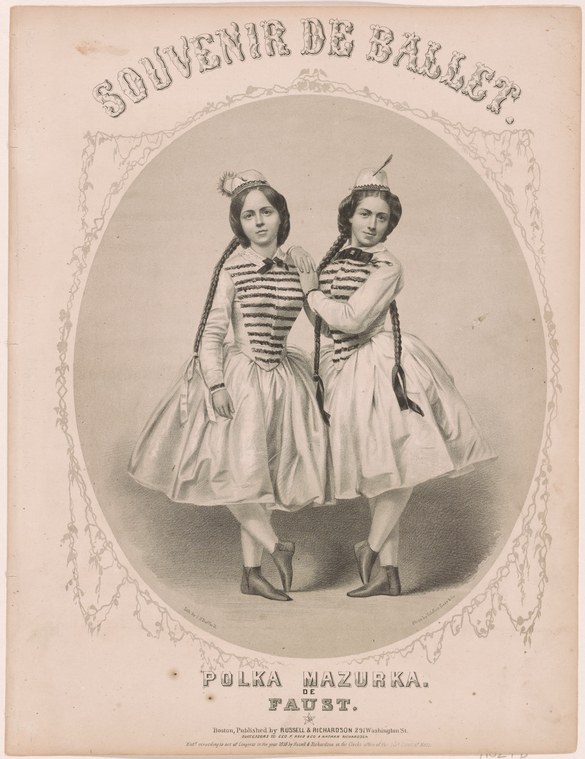
Two young women in identical costumes stand center stage against a plain background, framed by an ornamental oval border. Both wear short white skirts with voluminous folds, fitted striped bodices in black and white horizontal stripes, and feathered headdresses. Their posture is upright and formal, with one dancer positioned slightly forward and to the left, the other to the right, their bodies angled toward each other in a mirrored composition. The engraving employs subtle tonal gradation to suggest the weight and texture of the fabrics, particularly the gathered fullness of the skirts. The title "Souvenir de ballet" and "Polka Mazurka de Faust" frame the oval at top and bottom, with the artist's name and publication details in small type below.
The dancing
Both dancers stand with their weight evenly distributed, arms positioned naturally at their sides or slightly forward. Their alignment is vertical and composed rather than caught mid-movement. The mirrored positioning and identical dress suggest a coordinated pair or corps de ballet performers rather than soloists in dynamic interaction. The formal stillness of their stance implies a moment of pause or presentation rather than active movement—a convention typical of theatrical dance prints meant to display costume and line.
The dance depicted
The title identifies this as a polka mazurka from Faust, likely referring to a theatrical dance inserted into performances of Gounod's 1859 opera. The polka mazurka was a 19th-century ballroom hybrid that combined the lively tempo and bouncing character of the polka with the three-beat meter and national character of the Polish mazurka. This print documents theatrical costuming for that dance style rather than capturing active steps or footwork. The identical costumes and paired positioning suggest this was a corps de ballet or ensemble number, a common feature in mid-to-late 19th-century opera and ballet where specialty dances were interpolated into dramatic works.
How it was made
This is a steel or copper engraving, identifiable by the fine linear hatching used to model form and the precise, controlled line work throughout. The ornamental rococo border and formal composition suggest commercial theatrical imagery from the mid-19th century, likely a souvenir print sold to patrons or collectors interested in stage costume and design. The technique allowed for wide circulation and multiple printings, making such images accessible to audiences beyond those who saw the live performance.
About this work
This engraved souvenir commemorates a theatrical polka mazurka from a 19th-century production of Gounod's Faust, documenting the costumes and paired presentation of dancers performing a specialty number within the opera. The work sits within a rich tradition of theatrical dance prints that recorded costume, line, and formal stage composition rather than the dynamics of movement itself. It belongs in a dance archive both as evidence of how polka mazurka was staged and costumed in theaters, and as a document of the visual language by which 19th-century audiences encountered dance imagery.
How to look at it
Attend to the costume detail: the striped bodice speaks to the hybrid character of polka mazurka (the stripes echo military or folk-inspired dress common to "character" dances), while the short gathered skirt indicates theatrical adaptation and the need for visibility of footwork and leg line. The mirrored, formal stance tells you this was a moment of presentation rather than active dancing—likely the opening or closing tableaux of the number, when dancers were displayed to the audience before or after the actual choreography. The symmetry itself was a currency of 19th-century theatrical design, signaling order, precision, and the corps de ballet aesthetic.
The period
The polka mazurka enjoyed peak popularity in ballrooms and theaters between the 1840s and 1870s, embodying a taste for national character dances that populated mid-19th-century opera, ballet, and mixed entertainment. Gounod's Faust (1859) became one of the most performed operas of the era, and theatrical productions routinely inserted specialty dances—including polkas, mazurkas, waltzes, and character pieces—into acts to showcase dancers and accommodate audience taste for ballroom forms on stage. The souvenir print was a standard commercial product: theaters and print publishers sold such images to audiences as mementos of performances and to circulate knowledge of fashionable dance and costume.
Where it lives
This print is held in the New York Public Library's collection of theatrical prints and dance imagery. It appears to be a commercial souvenir print of the type sold by theaters and music publishers to audiences in the 1860s–70s, part of the widespread circulation of operatic and balletic imagery that characterized the mid-19th-century entertainment industry.
Dance in this work
Questions about this work
What is a polka mazurka?
A polka mazurka was a 19th-century ballroom dance that blended the energetic bounce and tempo of the polka with the three-beat meter and national character of the Polish mazurka. It was popular in both social and theatrical contexts from roughly the 1840s onward, and composers frequently included it in operas and ballets as a specialty number.
Why does this print show two identical dancers?
The mirrored pairing reflects corps de ballet practice and theatrical convention of the era. Specialty dances in opera were often performed by pairs or small ensembles of identically costumed dancers arranged in symmetrical formations. This both created visual spectacle and allowed lesser-skilled dancers to populate the stage while featured dancers took solo roles.
How do we know this is from Gounod's Faust?
The title printed on the engraving reads 'Polka Mazurka de Faust.' Gounod's opera Faust premiered in 1859 and became one of the most performed operas of the 19th century. Productions routinely interpolated specialty dances, and this print documents the costume and staging of one such number.
What was a theatrical souvenir print?
In the 19th century, theaters and music publishers sold prints of costumes, scenes, and performers to audiences as mementos and marketing. These prints, usually engravings or lithographs, circulated knowledge of what successful productions looked like and served as collectible records of famous performances and dancers.
More dance artwork





