49 works in this view — arrow keys or swipe to move between them.
Dance in Art
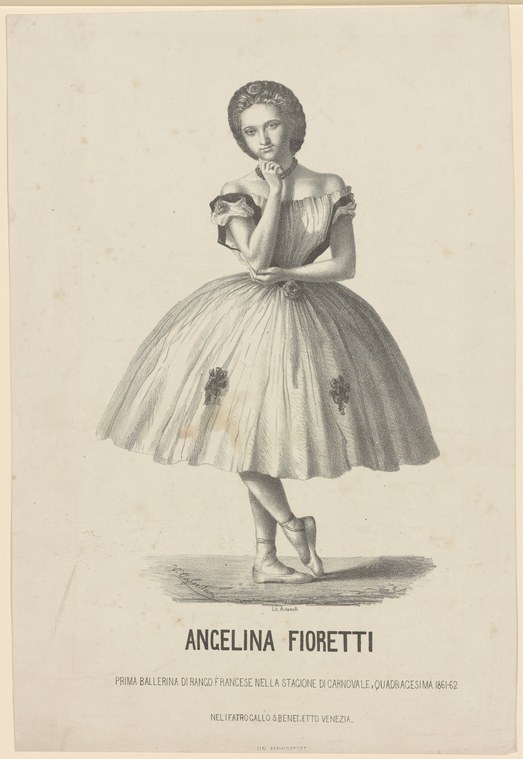
Angelina Fioretti, prima ballerina di rango francese nella stagione di carnovale e quadragesima 1861-62 nel Teatro Gallo S. Benedetto, Venezia
Unknown artist
- Collection:
- Prints depicting dance
- Source:
- New York Public Library
- Rights:
- Public domain — free to use, share and adapt.
- Recorded as:
- Public Domain
This portrait documents the visual identity and professional status of a named dancer performing at a specific theatre in a specific season—evidence that allows theatre historians and dancers to reconstruct the reality of ballet practice in mid-nineteenth-century Italy beyond the canonical Paris–Milan axis. The work is also valuable as a record of Romantic-era ballet costume and the physical ideal of the period's prima ballerina.
What you are looking at
A young woman in Romantic-era theatrical dress stands in a formal frontal pose against a plain background. She wears a white or pale silk dress with a low, off-shoulder neckline and short puffed sleeves—characteristic of 1860s ball gown fashion. The skirt is voluminous and reaches mid-calf, constructed in the full, bell-shaped silhouette typical of the period, with darker decorative elements (possibly floral sprigs or embellishments) scattered across the skirt's surface. Her dark hair is arranged in the center-parted style of the era, pinned up and adorned with what appears to be a crown or tiara. She stands with her weight centered, one arm bent and raised to her chin in a contemplative pose, the other at her side. She wears soft ballet pointe shoes. Her posture and gaze are composed and dignified, presenting the formal theatrical image expected of a prima ballerina in mid-nineteenth-century Venice. This is a portrait of a named performer rather than a scene of active dance.
The dancing
A single dancer, standing in a classical contrapposto-influenced pose with weight balanced evenly, suggesting the trained uprightness required in ballet. Her raised arm frames her face in a gesture of modest grace rather than dramatic expression. The pointe shoes are clearly visible, indicating mastery of this fundamental ballet technique. Her posture shows the elongated line and controlled stillness characteristic of ballet training; there is no sense of movement frozen, but rather a formal presentation stance, the kind used for theatrical portraiture.
The dance depicted
This is a portrait of Angelina Fioretti, identified in the inscription as prima ballerina (first-rank dancer) performing in the Carnival and Lenten seasons of 1861–62 at Venice's Teatro Gallo S. Benedetto. The image does not depict her dancing, but rather presents her in the formal dress and idealized pose expected of a ballet prima ballerina of the Romantic era. Her costume—the white tutu-like skirt and pointe shoes—was standard theatrical dress for classical ballet in the 1860s. The contemplative pose and centered, dignified bearing reflect the aesthetic ideals of Romantic ballet, in which dancers embodied grace and refinement even in stillness.
How it was made
This is a lithographic print (established from the image's visual characteristics: the tonal gradations, the medium's capacity for fine detail in fabric rendering, and the style of inscription). The technique allowed for relatively inexpensive mass production compared to engraving, making it ideal for distributing theatrical portraits to the opera-going public of Venice. The quality of the lithography is accomplished: the artist has rendered the texture of the silk dress, the softness of shadow, and the individualized features of Fioretti's face with considerable refinement. This indicates a professional hand and a print produced for a cultured urban audience.
About this work
This is a mid-nineteenth-century lithographic portrait of a named Italian ballet dancer, Angelina Fioretti, documented as performing in Venice in the 1861–62 Carnival season. It belongs to the tradition of theatrical portraiture that circulated in Europe during the Romantic era, when dancers were celebrities and their likenesses were both souvenirs and promotional images. The work documents the visual culture surrounding ballet performance in a regional Italian opera house, capturing the aesthetic ideals of the period: the idealized femininity, the virtuosic costume, the formal dignity of the prima ballerina.
The print is valuable as historical evidence. It records the actual dress and appearance of a professional dancer whose work would otherwise be known only through librettos and playbills. Fioretti's status as prima ballerina in a major Venetian theatre confirms that ballet had established itself in Italian regional opera houses by mid-century, not only in Milan or Rome. The lithographic medium and the professional execution suggest an audience of educated, affluent theatre patrons for whom such prints were collected.
How to look at it
Note the artist's choice to present Fioretti not in a moment of dancing, but in formal repose—a convention of theatrical portraiture that emphasizes the dancer's status and refinement rather than virtuosity. The pointe shoes are deliberately visible, signaling her as a classically trained dancer. Observe how the costume is rendered with precision: the delicate off-shoulder cut, the gathered sleeves, the decorative details on the skirt. This is not merely fashion illustration, but a portrait of a person, with individualized features and a contemplative expression. The lithographic technique allows for subtle tonal gradations that model the face and suggest the lustre of silk.
The artist
The artist is not recorded in the available documentation. The print was produced by or for the Teatro Gallo S. Benedetto in Venice, suggesting it was a house production, possibly by a theatre workshop or a local Venetian lithographer. The professional quality and accomplished rendering indicate a trained hand, but without signatures or attributions in the record, the maker remains unidentified.
The period
The 1860s were the twilight of the Romantic ballet era in Europe. By this date, Paris was still dominant—Degas was beginning to paint dancers, and the Opéra was the reference point—but ballet was also flourishing in regional Italian theatres, particularly in Milan, Venice, and Rome. The Carnival season in Venice was an important performance calendar, and a theatre like the Gallo S. Benedetto would have competed for celebrated dancers. Fioretti's title as 'prima ballerina di rango francese' (first-rank dancer of French standing) indicates that the French ballet vocabulary and aesthetic, by then decades old, remained the standard of excellence. The mid-century saw the expansion of lithographic printing in Italy, making theatrical portraiture accessible to a broader public than engraving had allowed.
Where it lives
The print is held in the New York Public Library's collection of prints depicting dance. It appears to be a theatrical souvenir or publicity image produced by or for the Teatro Gallo S. Benedetto in Venice during or shortly after the 1861–62 season.
Dance in this work
Questions about this work
Was Angelina Fioretti a famous dancer?
She is documented as a prima ballerina performing in Venice in 1861–62, which indicates she held a high rank in the Italian ballet world of her time. However, very little biographical information survives. The title 'prima ballerina di rango francese' suggests she trained in or followed the French method, which was prestigious. Beyond this portrait and the theatre records, her career is largely unknown.
Why is she not dancing in this portrait?
This is a theatrical portrait, not a scene of performance. The convention of the era was to present dancers in formal dress and dignified repose, emphasizing their status and elegance. Such portraits were produced as souvenirs for theatre patrons and as promotional images for the dancer and theatre. Showing the dancer in stillness and refinement, rather than in exertion, aligned with Romantic ideals of feminine grace.
What does 'prima ballerina di rango francese' mean?
It translates as 'first-rank ballerina of French standing.' This indicates that Fioretti held the highest rank of female dancer and that her training followed the French ballet method and aesthetic. By 1861, the French method (codified earlier in the century through the Paris Opéra) was the international standard. The inscription emphasizes Fioretti's credentials and her place within a recognized hierarchy.
Why was this printed as a lithograph?
Lithography, developed earlier in the nineteenth century, was faster and cheaper to produce than engraving or etching, while still capable of fine detail. This made theatrical portraits accessible to a broader paying audience. A theatre could commission multiple prints to sell to patrons or distribute as promotional material. The medium was well-suited to the subtle tonal work required to render flesh, fabric, and the delicate features of a theatrical portrait.
More dance artwork





