49 works in this view — arrow keys or swipe to move between them.
Dance in Art
Il mondo artistico
Unknown artist
- Collection:
- Prints depicting dance
- Source:
- New York Public Library
- Rights:
- Public domain — free to use, share and adapt.
- Recorded as:
- Public Domain
This print documents how ballet was understood and valued within mid-nineteenth-century Italian artistic culture—not as a narrative spectacle but as an abstract embodiment of grace and artistic principle, fit to be honored alongside composers and painters. It reveals the class status and symbolic weight ballet held in European cultural imagination at the moment when the ballet vocabulary itself was becoming institutionalized and codified.
What you are looking at
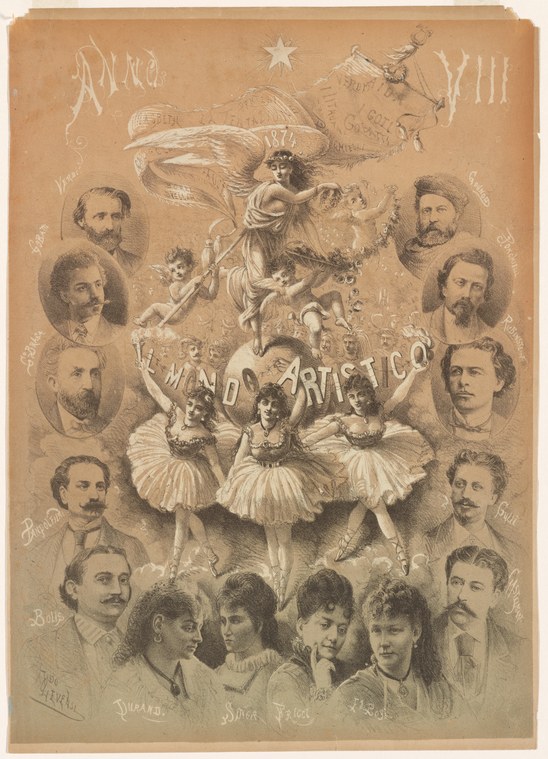
This is a composite theatrical print celebrating Italian artistic life, arranged around a central allegorical figure of Art or Victory in flowing robes who floats above three female dancers in ballet costume. The composition is densely populated with portrait medallions of male figures—likely notable artists, musicians, and cultural figures of the era—arranged in concentric rings around the dancing figures. The three ballerinas occupy the center foreground, posed in classical ballet positions with their bodies oriented toward the viewer; they wear short tutus and pointe shoes, their limbs extended in attitudes and arabesques. Above them, the allegorical female figure gestures expansively, one arm raised, her drapery billowing. The entire composition is set against a warm, aged paper background with "Il mondo artistico" (The Artistic World) lettered across the center. At the top are zodiac symbols and a radiant star, suggesting this may commemorate a calendar year or festive season.
The dancing
The three ballerinas are arranged in a triangular formation, each holding a classical ballet pose: the two outer dancers are in profile attitudes or arabesques with arms in port de bras, while the central dancer faces forward. All three stand en pointe on one leg with the other extended behind or to the side, displaying the turnout and elongated line characteristic of mid-to-late nineteenth-century ballet practice. Their arms are softly curved, following the épaulement of the period. The portrait heads surrounding them—approximately sixteen male faces arranged in oval frames—are rendered in finer detail than the dancers, suggesting they are the primary subjects of commemoration; the dancers serve as a symbolic rather than documentary element.
The dance depicted
This is theatrical ballet of the Romantic or late Classical period, identifiable by the tutus, pointe work, and the characteristic poses and arm positions of mid-nineteenth-century ballet vocabulary. The three figures are not engaged in narrative or mime but stand in idealized attitudes—the visual language of the ballet vocabulary itself becomes the subject. The image does not document an actual choreography but uses ballet as an emblem of art and refinement within a broader cultural pantheon. The dancers are generic representatives of the ballet world rather than portraits of specific performers.
How it was made
This is a lithograph or engraving on aged paper, likely hand-colored or printed on toned stock; the warm tan background and the quality of line suggest a mid-nineteenth-century reproductive print. The combination of portraiture with allegorical figuration and the decorative arrangement of heads in circular frames is characteristic of commemorative lithography from the 1850s–1880s, a technique suited to theatrical and artistic celebration. The medium allowed for fine detail in the portrait heads while maintaining the overall ornamental structure, making it suitable for distribution to a cultured, urban audience interested in the arts.
About this work
This is a commemorative print celebrating the world of Italian theatrical and artistic life, with ballet as one symbolic element within a larger pantheon of cultural achievement. The three tutted ballerinas in the center are not individual dancers but allegorical representatives of the ballet art form itself, framed by the portrait heads of (presumably) celebrated artists, composers, and cultural figures. The work belongs to a tradition of printed artistic almanacs and theatrical memorials common in Italy and France during the mid-nineteenth century, where dance served as a visual marker of refinement and cultural aspiration.
How to look at it
The viewer should first take in the overall ornamental structure—the way the portrait heads and allegorical figure create a formal, heraldic design—before attending to the dancers themselves. Notice that the ballerinas are rendered in a more generalized, idealized manner than the portrait heads above them; the artist is not capturing individual dancers but the abstract vocabulary of ballet itself. The poses—the extended line, the turned-out legs, the raised arms—are meant to be recognized as the language of ballet rather than the documentation of a specific choreography or performance moment. The viewer should also consider the composition's purpose: this is a work meant to demonstrate that ballet is an art worthy of commemoration alongside the great male cultural figures whose portraits surround it.
The artist
The artist is not recorded. The work appears to be a commercial or institutional print, possibly commissioned to commemorate a theatrical season, almanac, or artistic society. The quality of execution and the ornamental sophistication suggest a professional lithographer working within the mid-nineteenth-century European print industry.
The period
This print belongs to the period of high Romanticism in ballet (c. 1830–1880), when the art form was at the height of its cultural prestige in Europe and ballet became a symbol of refined, urban taste. At this time, ballet was being codified into a formal vocabulary and professionalized through institutional schools and state theaters. In the visual arts, commemorative lithography was a major medium for celebrating cultural achievement and creating artistic hierarchies; the combination of allegorical figuration with portrait documentation was a standard format for artistic almanacs, theater programs, and gallery prints.
Where it lives
This print is held in the NYPL's collection of prints depicting dance, a thematic collection rather than a collection organized by medium or artist. The work's title and subject matter are recorded, but neither the artist, the date of creation, nor the specific lithographic technique are documented in the current record.
Dance in this work
Questions about this work
Who were these dancers?
The record does not identify them, and their rendering as generalized figures rather than portraits suggests they were not meant to be specific named dancers. They function symbolically as representatives of the ballet art form itself within a broader artistic pantheon.
What is this print commemorating?
The title *Il mondo artistico* (The Artistic World) suggests it may celebrate Italian artistic life more broadly, or possibly commemorate a specific theatrical season or artistic society. The zodiac symbols at top hint at a calendar function, but without more information we cannot be certain of the original occasion.
Is this a record of an actual ballet?
No. The dancers are posed in idealized attitudes rather than engaged in a specific choreography or narrative. The work uses ballet imagery symbolically to represent the art of dance within a larger celebration of cultural achievement.
What dance style is this?
This depicts the theatrical ballet of the Romantic period (roughly 1830–1880), identifiable by the pointe work, short tutus, and the classical vocabulary of arm and leg positions characteristic of nineteenth-century ballet training and performance.
More dance artwork





