49 works in this view — arrow keys or swipe to move between them.
Dance in Art
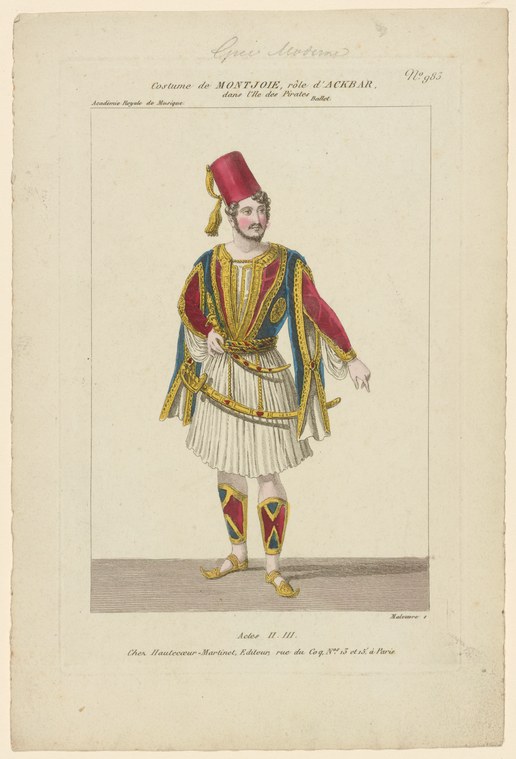
Costume de Montjoie, rôle d'Ackbar, dans L'île des pirates, ballet, Académie royale de musique, actes II, III
Unknown artist
- Collection:
- Prints depicting dance
- Source:
- New York Public Library
- Rights:
- Public domain — free to use, share and adapt.
- Recorded as:
- Public Domain
This image documents a crucial moment in ballet history: the rise of the character role and the importance of exotic costume in French theatrical dance. It shows that 18th-century ballet was a visual art as much as a kinetic one, and that a dancer's identity in role depended heavily on the costume design. For costume historians and scholars of ballet d'action, it is direct evidence of what was actually worn and how characters were visually distinguished.
What you are looking at
A single male dancer stands in formal contrapposto against a plain ground, occupying the full height of the composition. He wears an elaborate theatrical costume of the mid-18th century: a deep crimson velvet coat with gold braid trim, a short pleated skirt (likely linen) falling to mid-thigh, white stockings with decorative gold and red patterning at the calf, and red shoes with gold buckles. A matching crimson cap with gold tassel completes the ensemble. His posture is upright and dignified, with his weight slightly shifted, one arm extended in a gesture of presentation or address. The figure is rendered in hand-colored engraving with careful attention to the textile patterns and the play of light across the fabrics. The plain ground and formal isolation of the figure suggest this is a costume study or role portrait rather than a narrative scene.
The dancing
The single figure stands in an open, balanced stance with weight favoring one leg; the opposite arm is extended in a natural gesture of address or introduction, palm visible. The body is erect and composed rather than captured mid-movement. The posture and arm carriage suggest a formal theatrical presence—neither the turnout and extension of ballet nor the fluid movement of social dance, but the controlled deportment expected of an actor-dancer in dramatic roles. No partner or ensemble is present.
The dance depicted
The catalogue identifies this as the costume for the role of Ackbar in 'L'île des pirates' (The Island of Pirates), a ballet performed at the Académie royale de musique (the Paris Opéra), showing Acts II and III. The costume and pose suggest a character role within theatrical ballet or ballet d'action rather than pure dance spectacle. Ackbar appears to be a named character of authority or exoticism, suggested by the orientalizing elements in the costume—the high cap, the jeweled and gold-trimmed coat. The image documents the dancer's appearance in role rather than capturing movement, so it tells us about costume convention and character presentation in mid-18th-century French ballet more than about technique.
How it was made
This is a hand-colored engraving, identifiable by the fine parallel line work visible in the shading and the precise outline of forms. The inscription indicates publication by the Académie royale de musique. Hand-coloring has been applied to render the rich reds, golds, and whites of the costume with accuracy; the technique allowed rapid reproduction and distribution of costume documentation to a literate, urban audience. The precision and expense of the process indicate this was an official record of the production, made for the archive of the Opéra or for public sale to patrons.
About this work
This is a costume study engraving documenting a named character role from a mid-18th-century French ballet at the Paris Opéra. It records not choreography or movement but the visual apparatus of theatrical identity—the fabrics, trims, and formal presentation through which a character was recognized by the audience. The work belongs in a gallery of dance imagery because it shows us how dance was framed by costume, hierarchy, and character type in the period when ballet was transitioning from courtly entertainment toward more elaborate scenic spectacle. It is evidence of the actor-dancer as a figure constructed through dress and formal presentation.
How to look at it
Attend to the care lavished on the textile details: the pattern of the gold braid, the specific coloring of the stockings, the shape and decoration of the cap. These are not incidental; they are the means by which a character was made legible to an audience at distance. The formal, frontal pose is not a dance position but a presentation stance—the costume is being offered for inspection and memory, as if the dancer were a figure in an engraved directory of characters. The engraver has prioritized clarity and completeness of costume over any suggestion of movement or performance energy.
The artist
The artist is not recorded. The work is a publication of the Académie royale de musique (Opéra) itself, suggesting it was produced in-house or commissioned by the institution to document and publicize its productions. The style and technique are consistent with French theatrical print production of the 1740s–1760s.
The period
This engraving dates to the era when French ballet was expanding beyond courtly dances and divertissements toward more elaborate narrative ballets (ballets d'action). The mid-18th century saw the rise of the character role as a dramatic tool, and the increasing importance of costume, scenery, and music to create atmosphere and narrative. Jean-Georges Noverre's *Lettres sur la danse* (1760) would soon codify the principles of ballet d'action; this image documents practice a few years before that theoretical statement. The 'exotic' costume—whether meant to evoke Turkish, African, or pirate-island imagery—reflects the Enlightenment fascination with orientalism and the Other, often expressed through theatrical spectacle.
Where it lives
The work is held in the New York Public Library's collection of prints depicting dance. The inscription indicates it was published by or for the Académie royale de musique (the Paris Opéra) as a documented record of the production.
Dance in this work
Questions about this work
What was 'L'île des pirates' and did it still exist after the 18th century?
The catalogue lists this as a ballet performed at the Académie royale de musique (Paris Opéra), but beyond the costume documentation shown here, little is known of the work. Most ballet d'action from this era have left no other trace; they were not published, and the choreography was not recorded. This engraving may be among the only surviving evidence that the work existed.
Why is the figure in a costume study pose rather than mid-dance?
Costume documentation engravings of this period were made to record what the role looked like, not how it moved. The formal presentation pose allowed the engraver to show all details of the costume clearly and from a flattering angle. These were published as souvenirs of the production and as records for the theater's archives.
What does the costume tell us about the character Ackbar?
The crimson and gold color scheme, the high cap, and the overall design suggest authority and exoticism—likely coding the character as a foreign ruler or exotic Other. The richness of materials and trim indicate high status. Such costumes were a visual shorthand for character type in 18th-century theater.
More dance artwork





