49 works in this view — arrow keys or swipe to move between them.
Dance in Art
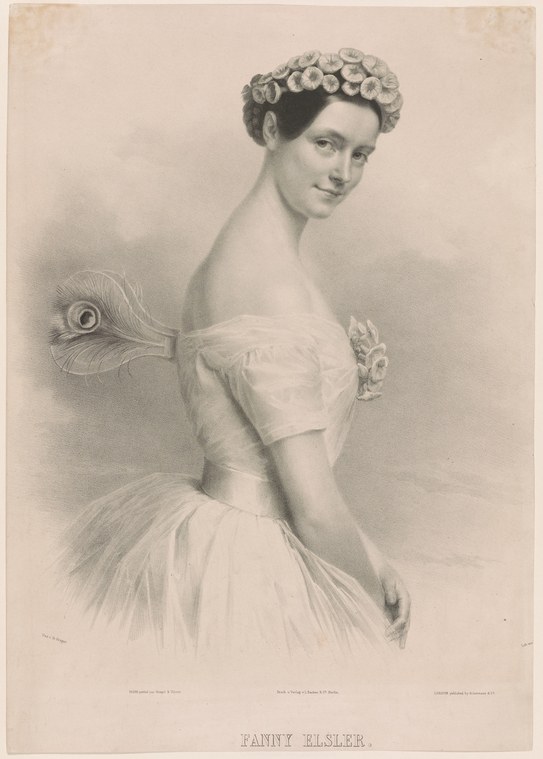
Fanny Elsler [sic]
Unknown artist
- Collection:
- Prints depicting dance
- Source:
- New York Public Library
- Rights:
- Public domain — free to use, share and adapt.
- Recorded as:
- Public Domain
Fanny Elssler was one of the two greatest dancers of the Romantic era; this portrait is direct visual evidence of how she presented herself and was presented to the public. The print documents a crucial moment in dance history when lithography and engraving made dancer imagery widely accessible, establishing the modern star system in ballet. For anyone studying Romantic ballet, the costume, coiffure, and pose are primary historical sources.
What you are looking at
A three-quarter-length portrait of a young woman in Romantic-era theatrical dress, posed in a moment of graceful repose. She wears a white off-shoulder dress with a fitted bodice and voluminous skirt gathered at the waist, the fabric suggesting the gossamer tulle characteristic of early 19th-century ballet costume. Her hair is arranged in an elaborate coiffure adorned with flowers or decorative elements. Most striking is the large peacock feather she holds in her right hand, extending across her lap—a deliberate theatrical prop. She gazes toward the viewer with a serene, composed expression, her body angled gracefully as if caught between moments of stillness. The composition is set against a neutral, softly modulated background that emphasizes the figure. This is a formal portrait print of a professional dancer, likely created for circulation among the theatre-going public.
The dancing
The dancer is portrayed in a standing or seated pose of perfect composure, her shoulders relaxed and turned slightly to reveal the décolletage typical of Romantic ballet costume. Her left arm rests naturally while her right arm extends to display the peacock feather as both ornament and attribute of performance. There is no visible action or step work—this is a presentational pose rather than a captured moment of dance—but the ease and elongation of the figure, the tilt of the head, and the play of the skirt all convey the aesthetic ideal of the ballet dancer of her era: ethereal, graceful, and controlled.
The dance depicted
This is a portrait of a professional Romantic-era ballet dancer, almost certainly Fanny Elssler, one of the leading ballerinas of the 1830s and 1840s. The peacock feather and the theatrical white dress are both associated with Elssler's celebrated roles, particularly in orientalist or fantastical ballets. The print preserves the image of a dancer at the height of her fame during the Romantic period, when Elssler and her rival Marie Taglioni dominated European ballet. The pose and costume suggest a specific celebrated role rather than a generic portrait, though the exact ballet cannot be determined from the image alone. The work documents both the visual conventions of Romantic ballet and the star system that elevated certain dancers to celebrity status.
How it was made
This is a lithograph or engraving on paper, rendered in black and white with careful attention to tonal gradation and the play of light across fabric. The technique allows for fine detail in the rendering of the dancer's face and the delicate folds of the dress, while the background is left broad and atmospheric. The soft modeling and the absence of harsh lines suggest a lithograph rather than a line engraving, a medium well suited to the elegant, atmospheric effects the artist has pursued. The print was produced for public distribution—portraits of celebrated dancers were a significant market in the 19th century, collected by theatre patrons and dance enthusiasts.
About this work
This is a celebrity portrait of Fanny Elssler, a dominant figure of 1830s–1840s Romantic ballet, rendered in a theatrical presentation pose that emphasizes her status as a professional dancer and public figure. The image preserves the visual language of Romantic ballet: the white tulle skirt, the graceful posture, the refined facial expression, and the theatrical prop—all codes understood by her contemporary audience. The work sits at the intersection of dance history and print culture, a document of how the era understood and circulated images of its dance stars. For dancers and historians, it is primary evidence of Romantic-era costuming, the visual aesthetics of early 19th-century ballet, and the commercial circulation of dance imagery.
How to look at it
Notice the deliberate theatricality of the pose: the peacock feather is not incidental but a statement of performance and exoticism. The off-shoulder dress and the tilt of the head follow an established visual formula for ballet celebrity portraiture, one that emphasizes elegance and allure. The soft modeling of the face and the careful rendering of the dress fabric reveal the print medium's capacity for atmospheric effect. Observe the economy of the composition—Elssler's power lies in stillness and refinement, not movement, yet her status as a dancer suffuses the entire image.
The artist
The artist is not recorded in the catalogue. The quality and finish of the print suggest a professional theatrical portrait workshop, likely French or Austrian, working in the 1830s–1840s. The naming of Elssler in the inscription indicates this was an authorized, commercially produced image, probably published by a print house that specialized in theatrical celebrities. Such prints were often created by studio practitioners rather than independently established artists; they were commercial products rather than unique artworks.
The period
This portrait dates to the height of the Romantic ballet era, when Marie Taglioni and Fanny Elssler dominated European dance and inspired intense public devotion. Lithography and theatrical portraiture created an unprecedented market for images of celebrated dancers—these prints circulated among theatre patrons, were collected in albums, and were essential to the construction of dancer celebrity. The Romantic period elevated ballet to a major art form and its stars to genuine celebrity status; this image is a product of that cultural moment. Concurrently, Romantic art privileged grace, beauty, and an idealized femininity that ballet embodied and theatrical portraiture reinforced.
Where it lives
The print is held in the New York Public Library's collection of prints depicting dance. It is a published theatrical portrait, likely one of a series, and represents the commercial circulation of dancer imagery in the 19th century.
Dance in this work
Questions about this work
Who was Fanny Elssler?
Fanny Elssler (1810–1884) was an Austrian ballet dancer and one of the two greatest stars of the Romantic era, rivaling the Swedish dancer Marie Taglioni. She was celebrated for her dramatic presence, her technical virtuosity, and her performance of character dances and national dances. She enjoyed an international career and was a cultural icon of her time.
What is the peacock feather?
The peacock feather likely references one of Elssler's celebrated roles, possibly in an orientalist or fantasy ballet. Peacock imagery was associated with exoticism and Eastern themes, which were fashionable in Romantic ballet. The feather marks this as a portrait of a specific stage character rather than a generic portrait of the dancer.
Why were lithographs of dancers so common in the 19th century?
Lithography made high-quality portraits affordable and relatively easy to produce in multiple copies, creating a mass market for images of celebrated performers. Dancers were celebrities, and these prints allowed fans to own affordable mementos and for theatres to capitalize on star power through merchandise.
How accurate is this as a historical document of ballet costume?
Very accurate for the period. The white tulle skirt, the off-shoulder bodice, and the delicate slipper visible at the hem are all authentic to 1830s–1840s ballet costume. The hairstyle and the refined posture reflect contemporary ideals of Romantic ballet aesthetics. This is reliable evidence of how ballet dancers dressed and presented themselves on stage.
More dance artwork





