49 works in this view — arrow keys or swipe to move between them.
Dance in Art
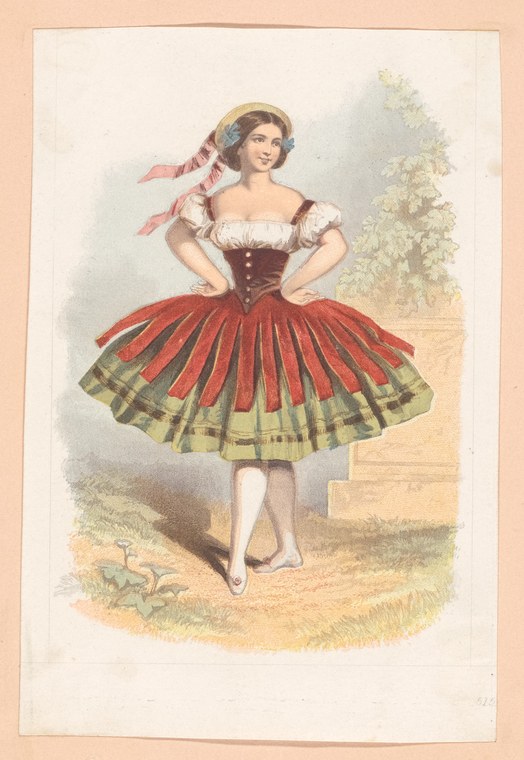
A ballerina in a folk costume
Unknown artist
- Collection:
- Prints depicting dance
- Source:
- New York Public Library
- Rights:
- Public domain — free to use, share and adapt.
- Recorded as:
- Public Domain
This image is a primary document of how 19th-century ballet incorporated and performed ideas of national or regional identity through costume. The sharp, artificial pleating of the skirt and the romanticized styling reveal how theatrical 'folk' costume was constructed as a fantasy rather than an ethnographic record. For dance historians, it shows what audiences saw and bought as souvenirs, making visible the visual and commercial apparatus of Romantic ballet outside the theatre itself.
What you are looking at
A young woman in theatrical costume stands barefoot in a sunlit garden or courtyard setting, posed in a moment of arrested movement. She wears a white cotton chemise with short puffed sleeves and a fitted burgundy corset, topped by an elaborate skirt of striking construction: the upper portion is deep red wool or silk, sharply pleated into a fan or sunburst pattern that radiates from the waist, while the lower half transitions to pale yellow-green or gold, crossed by dark horizontal stripes or bands. A pale pink ribbon is tied at the crown of her head and trails down her back. The background suggests classical architecture—a pale stone column or pilaster—and climbing vines or ivy, rendered in soft greens and warm yellows, creating a romantic garden atmosphere. The print technique and hand-colouring suggest mid-19th-century production.
The dancing
The dancer stands in a vertical, open pose with her weight balanced evenly on both feet, hips level, shoulders relaxed and slightly back. Her arms are positioned at the sides with gentle bend in the elbows, palms forward or semi-open—a posture of ease and display rather than active engagement. The body is shown frontally, allowing full view of the costume construction. Her barefoot stance and the lightness of her frame suggest trained balletic carriage, though the pose itself is a portrait stance rather than a step mid-execution.
The dance depicted
This image depicts a theatrical dancer in Romantic-era ballet costume, most likely from the 1840s–1850s. The ensemble—the chemise, corset, and sharply pleated skirt—matches the costume vocabulary of mid-19th-century European ballet, particularly the character or folk-style dances that became popular in Romantic ballet as exotic or regional variants. The title references 'folk costume,' suggesting this figure represents a peasant, village, or national character type rather than a classical ballerina. The patterned skirt, in particular, resembles the layered folk costumes of Central or Eastern Europe that appeared in ballets of the Romantic period. However, the image presents a static costume study rather than documenting a specific step or movement.
How it was made
This is a hand-coloured lithographic print or engraving, characteristic of 19th-century theatrical souvenir production. The pale cream paper, the precision of the line work, and the delicate watercolour or gouache tinting—applied selectively to highlight costume detail while leaving the background lightly washed—are all consistent with commercial chromolithography or the hand-colouring of lithographed outlines. The technique allowed affordable mass production for theatre-goers and collectors; the colouring varies slightly in intensity, suggesting hand application rather than chromolithographic printing. This production method was standard for circulating images of popular dancers and roles from 1830 onwards.
About this work
This is a portrait print of a theatrical dancer in Romantic-era ballet costume, likely from the 1840s–1850s, presented as a souvenir or collectable image for the theatre-going public. It documents a moment of theatrical fashion and performance identity rather than capturing a dance in motion. The work belongs to the commercial image culture of 19th-century European opera and ballet, when lithographic prints of popular performers—particularly in character or 'national' roles—were collected and traded as keepsakes. The image is a valuable record of how Romantic-period choreographers and costume designers created the illusion of folkloric authenticity through dress, and how that costume was marketed to audiences.
How to look at it
Attend to the construction of the skirt: the sharp, geometric pleating is not an ethnographic detail but a theatrical device that creates visual drama and aids movement visibility on stage. The high waist and low neckline are classical ballet conventions, not folk clothing. Note the barefoot stance—balletic, not authentic to any actual folk tradition. The pose is frontal and static, designed for clarity in reproduction and to display costume detail rather than to capture a moment of choreographed action. This is a fashion plate as much as a dance document.
The period
This print dates to the mid-19th century, when the Romantic ballet was at its height in Western Europe. Choreographers including Jean Coralli, Jules Perrot, and Marius Petipa were incorporating character dances—stylized versions of national or regional forms—into full-length narrative ballets. Works such as Giselle (1841) and La Corsaire (1856) included such divertissements, with dancers performing roles as peasants, odalisques, or maidens from distant lands. Lithographic printing technology had democratized the production of theatrical imagery, allowing theatres and publishers to flood the market with portraits of celebrated dancers in their most celebrated roles. These prints served as advertising, souvenirs, and objects of fan culture, particularly among young male theatre-goers.
Where it lives
This work is held in the New York Public Library's collection of prints depicting dance, a major American archive of 19th and early 20th-century theatrical and dance imagery. Such prints were typically produced in runs of hundreds or thousands and distributed through theatrical box offices, print sellers, and collectors' networks across Europe and America.
Dance in this work
Questions about this work
What is the folk costume in the picture?
The costume is a theatrical interpretation rather than a faithful reproduction. The sharply pleated skirt, corset, and short chemise are 1840s-1850s ballet wear arranged to suggest a peasant or regional identity. The burgundy-to-gold colour gradation and bold striping are likely choreographic choices for visibility and drama on stage. No specific region is documented by the catalogue, so the character type—if named in the original ballet—is now unknown.
How do you know this is from the Romantic ballet era?
The costume, pose, and print technique all point to the 1840s–1850s. The high-waisted chemise and corset are signature Romantic ballet silhouettes; the barefoot stance signals classical ballet training; and the hand-coloured lithography on cream paper is characteristic of commercial theatrical prints from that period. The style of rendering and colouring matches other surviving souvenirs from that market.
Is this a famous dancer?
The catalogue record does not identify the dancer or the original artist. The image may be a generic costume study, a portrait of a lesser-known performer, or a reproduction after a celebrated dancer's image. Without a signature, inscription, or archival context, her identity cannot be established from the print alone.
What does the setting tell us?
The pale stone column and climbing ivy suggest a romantic garden or pastoral setting—a common backdrop in Romantic ballet narratives and in the studio or atelier settings where theatrical portraiture was produced. It is likely painted as a neutral or idealized stage setting rather than a naturalistic location.
More dance artwork





