49 works in this view — arrow keys or swipe to move between them.
Dance in Art
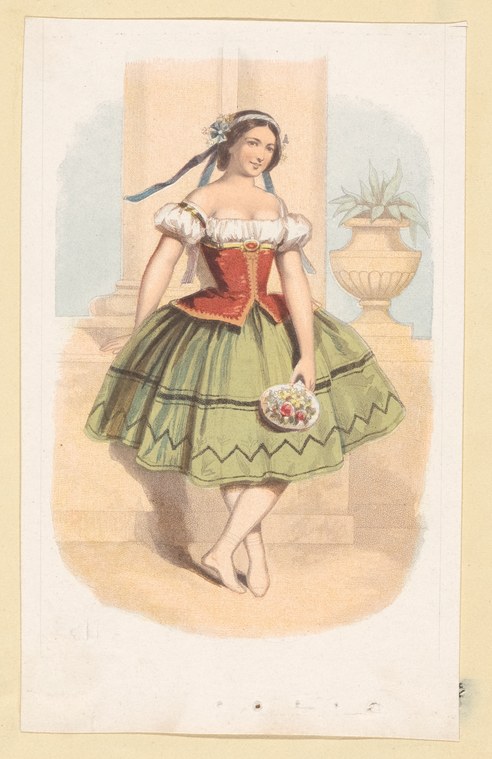
A ballerina in a folk costume
Unknown artist
- Collection:
- Prints depicting dance
- Source:
- New York Public Library
- Rights:
- Public domain — free to use, share and adapt.
- Recorded as:
- Public Domain
This image is a primary document of how European folk dance entered the theatrical and commercial mainstream during the 19th century—a process that transformed both ballet and popular culture. It shows the moment when folk identity became a costume, a style, and a marketable aesthetic, and reveals the balletic training underlying even performers of 'folk' dances. For historians of 19th-century theater and dance, this is evidence of what audiences expected to see when they paid for folk spectacle.
What you are looking at
A young woman in theatrical folk costume stands alone in a classicizing interior, posed as if mid-performance or awaiting an audience. She wears a white off-shoulder peasant blouse with puffed sleeves and a fitted red velvet bodice, paired with a full green skirt trimmed with black ribbon at the hem in a scalloped pattern. A dark blue ribbon is bound around her hair. She holds a small posy of pink flowers in her left hand and stands with her weight on one leg in a balletic posture. The setting is minimal but suggests a stage or salon: behind her, a pale curtain or doorway, and to the right, a classical pedestal urn with a potted plant. The composition uses soft watercolor washes in ochre and pale blue to suggest space and shadow, with the figure rendered in finer detail than the architectural background.
The dancing
The dancer stands in a relaxed three-quarter pose with her body turned slightly toward the viewer, weight shifted onto the supporting leg in a manner that suggests training in ballet or ballroom technique. Her free leg is extended but not lifted high; her arms hang naturally, one holding flowers. The posture is elegant but not strenuous—this is a moment of repose or display rather than dynamic movement. There is no partner; she occupies the space alone. Her frame and the ease of her stance suggest the poise expected of a trained dancer or performer.
The dance depicted
The costume places this figure within a 19th-century theatrical tradition of romanticized folk dance spectacle, particularly the Alpine or Central European peasant dances that gained currency in European ballet and popular entertainment from the 1830s onward. The red bodice, white blouse, green skirt, and decorative ribbon suggest a stylized 'folk' identity rather than ethnographic accuracy—this is folk costume as theatrical convention, not as worn dress. The pose itself—the balletic weight distribution and lifted posture—indicates that whatever folk tradition is being referenced, it has been filtered through ballroom and theatrical training. Without more specific markers (particular footwork, regional headdress style, or instrumental accompaniment), it is difficult to identify a single dance form; this appears to be a generic 'folk dancer' type common to mid-to-late 19th-century entertainment and balletic pastiche.
How it was made
This is a hand-colored lithograph or watercolor-and-lithograph print, executed with soft washes of color over line work. The technique is characteristic of mid-19th-century theatrical costume studies and commercial prints produced for the entertainment trade. The fine detail of the figure—the facial features, the texture of fabric—contrasts with the loosely suggested architectural setting, a compositional choice that focuses attention on the costume and the performer's body. This method of production and presentation suggests circulation as a souvenir, theatrical advertisement, or fashion plate; such prints were inexpensive to produce in quantity and widely distributed in urban centers across Europe and North America.
About this work
This is a character study of a theatrical performer in folk costume, likely from the mid-19th century, presenting the figure in a moment of balletic repose. It documents a specific moment in European dance history when folk traditions were being absorbed into theatrical spectacle and ballroom entertainment—a practice that shaped both ballet and popular dance performance for generations. The work belongs in a dance gallery because it records not only a performer but a whole apparatus of how folk dance was commercialized, feminized, and adapted for urban entertainment. The costume and pose tell us as much about 19th-century taste and ideology as about any actual folk practice.
How to look at it
Notice the tension between the figure's balletic posture and her 'folk' costume—this is not a peasant at rest, but a trained performer dressed as one. The hand with the flowers is an ornamental gesture, not a functional one; it is part of her presentation. The scalloped edges of the skirt, the ribbons, the off-shoulder drape: these are all theatrical exaggerations of folk dress, designed to be visually striking from a distance. The artist has frozen the figure at a moment of stillness and display, not action, which is itself revealing: folk dance in the theater was often a pretext for presenting the female body in a glamorous, idealized form.
The period
The 19th century saw a widespread romantic enthusiasm for folk culture, peasant life, and 'national' character, fed by Romantic literature, nationalism, and the European concert hall and theatrical boom. Ballets such as *La Sylphide* (1832) and *Giselle* (1841) had familiarized urban audiences with the aesthetic of rural innocence and feminine delicacy; by mid-century, folk-themed divertissements and specialty dances were common features of theatrical entertainment, opera, and ballroom performance. At the same time, lithography and color-printing technology had made theatrical costume prints affordable and collectible, creating a mass market for images of performers and performance styles. This print sits within that culture of theatrical documentation and souvenir production.
Where it lives
This work is held in the New York Public Library's collection of prints depicting dance, a collection assembled from donations and acquisitions over time. Such prints were inexpensive and widely circulated in the 19th century, making individual provenance difficult to establish, but their preservation in institutional collections reflects their recognized value as historical documents of performance and costume.
Dance in this work
Questions about this work
What country's folk dance is this?
The costume suggests Central or Alpine Europe—the red bodice and white blouse are characteristic of German, Austrian, or Swiss folk dress—but this is a theatrical interpretation, not an ethnographic record. The 'folk' identity here is a theatrical convention, not a claim about actual practice. The pose and posture suggest balletic training rather than vernacular movement.
Is this a ballet dancer or a folk dancer?
She is a trained performer in a folk costume. The balletic weight distribution, the lifted posture, and the refined presentation all indicate theatrical training. In the 19th-century entertainment world, folk dance and ballet were closely connected; speciality dancers often moved between both forms, and folk-themed dances were choreographed and performed within ballet and theatrical contexts.
When was this made?
The style of the lithograph, the costume aesthetic, and the theatrical conventions on display are consistent with the mid-to-late 19th century (roughly 1840–1890), but the catalogue record does not provide a specific date. The technique, materials, and fashion suggest this range, but confirmation would require archival research or comparison with dated prints from known publishers.
Why are there no other dancers in the picture?
This is a costume study or promotional print, designed to showcase the performer and the garment rather than to document a group performance or social context. The solitary figure against a minimal stage setting is characteristic of theatrical portraiture and costume plates of the period, which often presented performers alone in order to make the details of dress and body clearly visible.
More dance artwork





