49 works in this view — arrow keys or swipe to move between them.
Dance in Art
La dance
Unknown artist
- Collection:
- Prints depicting dance
- Source:
- New York Public Library
- Rights:
- Public domain — free to use, share and adapt.
- Recorded as:
- Public Domain
This image is one of very few surviving visual records of how a woman of the Renaissance court was expected to stand and move, and it captures the ideal of stationary elegance central to early modern courtly dance—a tradition now known primarily through written descriptions. For dancers and historians, it offers rare material evidence of the body posture, arm carriage, and fashion context that shaped how court dances like the basse danse were performed and understood.
What you are looking at
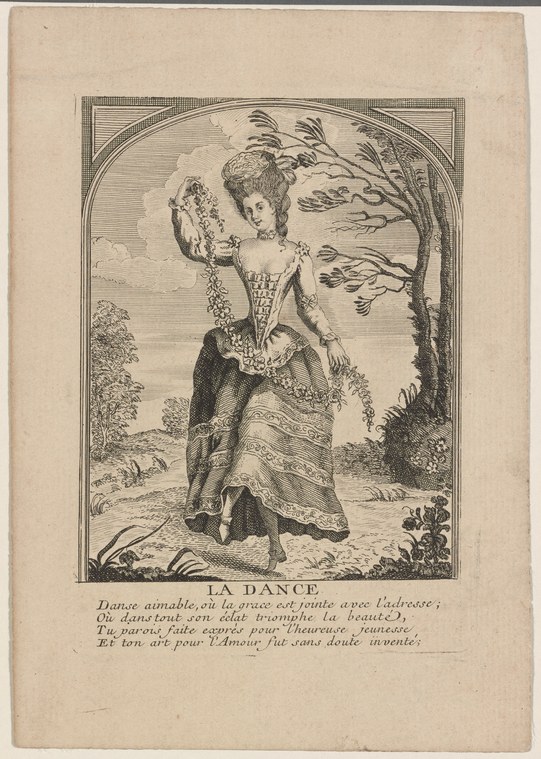
A woman in elaborate early modern dress stands alone in a landscape, captured in a moment of dance or graceful movement. She wears a dark bodice with jeweled decoration, a white chemise with prominent puffed sleeves, and a full skirt with intricate patterning and layered construction. A large feathered headdress crowns her upswept hair. Her left arm is raised with the hand near her face in a gesture of refined elegance, while her right arm extends downward. The setting is sparse—bare trees and shrubs frame the figure against an open sky with light clouds, giving the composition an allegorical or emblematic quality. The engraving uses fine parallel lines and cross-hatching to create volume and shadow, emphasizing the richness of the fabrics and the delicacy of the pose.
The dancing
A single female figure stands in a three-quarter pose, weight settled on both feet with a slight contrapposto suggestion. The raised left arm curves gracefully with fingers extended near the face—a gesture of refinement and self-regard common to court dance of the period. The right arm hangs with relaxed elegance. The body is upright and elongated, the spine gently curved. There is no clear evidence of active footwork or the dynamic line-of-body of theatrical dance; instead, the posture reads as a pause or attitude, a moment of composed display.
The dance depicted
This is likely a *basse danse* or similar courtly processional dance from the Renaissance or early Baroque period, though the image could equally represent an allegorical figure of Dance itself rather than a moment from any specific choreography. The pose—stationary, elegant, self-aware—is consistent with the slow, gliding quality of Renaissance court dances in which the body remained largely upright and the pleasure lay in dignity and decoration rather than large movement. The refined gesture and ornate costume suggest a court or aristocratic context. The accompanying French verse (visible but not fully transcribed here) may clarify the subject, but the image alone shows a woman embodying an ideal of courtly grace rather than executing a recognizable step sequence.
How it was made
This is an engraving, identifiable by the fine parallel hatching lines used to create tone and volume throughout the composition. The technique is characteristic of 16th- or early 17th-century printmaking, suggesting broad circulation among educated readers and collectors. The careful rendering of textile detail—the puffed sleeves, the jeweled bodice, the patterned skirt—shows the engraver's investment in displaying wealth and fashion. The decorative frame and the inclusion of verse below indicate this was a finished print intended for an album or collection rather than a preliminary study.
About this work
This engraving depicts a single elegantly posed woman in Renaissance or early Baroque court dress, likely intended to represent Dance itself or an ideal courtly dancer. The figure's refined gesture, upright posture, and elaborate costume—particularly the feathered headdress and jeweled bodice—align with the aesthetic and values of 16th- or early 17th-century aristocratic dance. The engraving's careful attention to textile and ornament, combined with the allegorical pose and accompanying verse, suggests this was a print designed for educated viewers interested in courtly manners, fashion, and the virtues embodied by refined movement. The work belongs to a tradition of emblem prints and fashion engravings that circulated widely in early modern Europe, teaching through visual example what grace and proper deportment looked like.
How to look at it
Note the stillness and self-containment of the pose: this is not a figure in motion but rather one displaying herself. The raised arm and tilted head suggest a moment of self-awareness or salutation, a social gesture embedded in courtly dance rather than an athletic step. Observe the weight distribution—both feet appear to bear weight equally, consistent with the smooth, gliding quality of Renaissance court dances rather than the turned-out frame of later ballet. The elaborate costume is not incidental; in Renaissance court culture, the display of fabric, jewels, and feathers *was* part of the dance itself.
The period
The Renaissance and early Baroque periods (roughly 1500–1650) saw the emergence of the basse danse and pavane as the dominant forms of courtly dance across Europe. These dances were characterized by upright carriage, smooth gliding steps, and an emphasis on dignity and decorum over athletic display. Prints like this one served as visual instruction and aspiration; they circulated among aristocratic and wealthy merchant households as models of proper behavior and fashion. The costume and pose here reflect court taste in the early 17th century, when Spanish and Italian influences shaped the silhouette (notably the pronounced puffed sleeves and rigid bodice) and feathered ornaments were markers of wealth and status.
Where it lives
This engraving is held in the New York Public Library's Prints collection under the catalog heading 'Prints depicting dance.' The work is cataloged only with the title *La danse* (The Dance), with no recorded artist, date, or medium specification, suggesting it may have been part of a larger album or series of emblem or fashion prints.
Dance in this work
Questions about this work
Is this woman actually dancing?
She is posed in a moment of courtly refinement that is part of dance—a pause or attitude rather than an active step. Renaissance court dances like the basse danse and pavane valued stillness, upright posture, and elegant bearing over vigorous movement. This image likely shows what courtly 'dancing' looked like: a woman displaying grace, dignity, and the beauty of her dress through controlled, economical movement and refined deportment.
What are those puffed sleeves?
Puffed sleeves (called *slashing* or *pinking* when slitted to show fabric beneath) were a hallmark of Renaissance and early Baroque fashion, especially from the 1590s onward. They required significant fabric and careful construction, making them a display of wealth. In the context of court dance, the movement of these sleeves—catching light, fluttering slightly with the dancer's steps—would have been visually important and deliberately composed.
What is the feathered thing on her head?
That is a feathered headdress, a sign of rank and fashion in early 17th-century court dress. Such ornaments were expensive and were often worn at formal dances and ceremonies. The upright posture required to support such a headdress (and the jeweled bodice) was itself part of courtly dance training and the display of control and elegance.
What does the verse say?
The verse below the engraving is in French and refers to Dance and its pleasures. While not fully transcribed here, it typically would have praised the beauty and virtue of dance, or described the figure as an allegorical representation of Dance itself. Such verses were common in Renaissance emblem prints and served to instruct the viewer in the moral or aesthetic lesson of the image.
More dance artwork





