49 works in this view — arrow keys or swipe to move between them.
Dance in Art
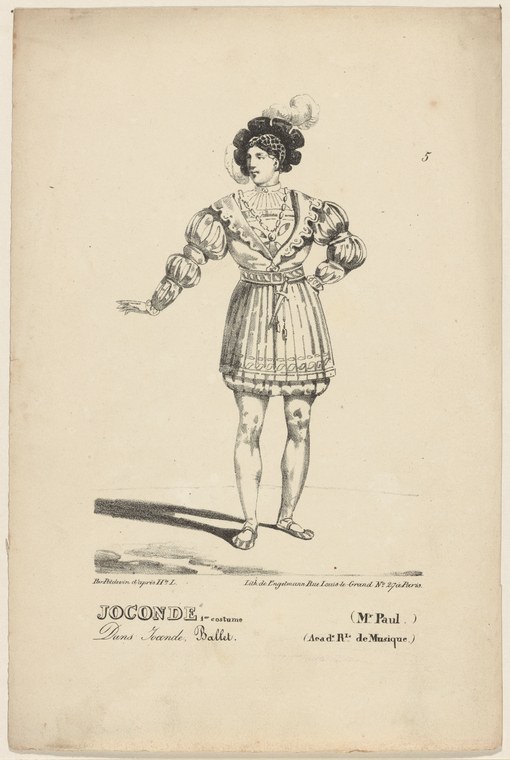
Joconde 1er costume (Mr. Paul.) Dans Joconde, ballet. (Acade. Rle. de Musique)
Unknown artist
- Collection:
- Prints depicting dance
- Source:
- New York Public Library
- Rights:
- Public domain — free to use, share and adapt.
- Recorded as:
- Public Domain
Costume plates like this are among the most direct surviving evidence of how 19th-century ballet dancers actually looked and carried themselves on stage—their physical deportment, the luxury of their dress, and the visual language of nobility and refinement that surrounded the male dancer. For historians of Romantic ballet and theatrical fashion, such prints are primary documents; for dancers, they illustrate the aesthetic ideals and physical culture of their craft in a period that shaped modern ballet.
What you are looking at
A single male dancer stands in a three-quarter pose against a plain background, dressed in an ornate early 19th-century theatrical costume. He wears a richly decorated jacket with puffed sleeves, a short skirt or tunic with horizontal pleating, and stockings; a feathered headdress crowns the ensemble. His stance is elegant and composed: one leg supports his weight while the other extends slightly forward, and his left arm gestures outward in a gesture of address or presentation. The pose suggests a moment of formal introduction or dramatic monologue rather than active dancing. The engraving technique renders fine detail in the fabric textures and provides sharp definition to the figure against the unadorned background, focusing all attention on the costume and posture. A text block at the bottom identifies the character and production.
The dancing
A single dancer in a standing pose, weight clearly on one leg with the other foot extended lightly forward—a posture of ease and elegance rather than strenuous movement. The upper body is upright and open; his left arm extends outward in a gesture that reads as theatrical address rather than dance mechanics. The right arm hangs naturally. The pose emphasises line and carriage over footwork, consistent with early 19th-century academic ballet's concern with noble bearing and visual spectacle. The overall frame is symmetrical and formal, designed to display the costume and the dancer's deportment equally.
The dance depicted
This is a costume plate for the Romantic-era ballet *Joconde*, depicting the first costume worn by the character Mr. Paul. The pose and presentation are typical of ballet costume documentation from the 1830s–1840s: the dancer is shown in a formal, non-narrative stance that displays the richness of the costume rather than capturing him mid-movement. The ornate dress—with its feathered headdress, puffed sleeves, and decorated tunic—places this firmly in the masculine vocabulary of Romantic ballet, where such finery distinguished noble or heroic male roles. The stance itself suggests the *aplomb* and turned-out carriage of classical ballet training, though the image offers no information about the actual choreography or the role's dramatic function within the ballet.
How it was made
The work is an engraving (established from the image; the catalogue record does not specify medium). The fine lines, clear definition of folds and textures, and crisp tonal gradations from light to shadow are characteristic of intaglio engraving. This was the standard medium for theatrical costume documentation in the early 19th century, allowing for mass production and wide circulation among theatregoers, subscribers, and collectors. The text beneath—identifying the costume, character, and ballet by name—confirms this as a commercial print, likely part of a series documenting the production. Such prints were sold at theatres and through print publishers, making them accessible records of major productions.
About this work
This is a costume plate from a Romantic-era ballet production, showing the first costume of the male character Mr. Paul in *Joconde*. It documents both the theatrical fashion and the physical demeanour of early 19th-century male ballet dancers—their emphasis on upright carriage, noble bearing, and the visual spectacle of ornate dress. As an engraved print, it is a commercial product of theatrical culture, designed to preserve and publicise the production for audiences who had attended the opera house or desired a memento. It belongs in a gallery of dance imagery because it captures a pivotal moment in ballet history: the Romantic era, when ballet was shifting toward storytelling and spectacular staging, and when the male dancer's role, though diminished compared to the Baroque, still commanded considerable theatrical investment in costume and presence.
How to look at it
Examine the weight distribution and line of the body—the ease of the stance and the upright carriage tell you this is a formal presentation pose, not a moment of action. Notice the richness of the costume: the feathered headdress, the decorated jacket, the pleated skirt all signal status and spectacle. The left arm's gesture is theatrical and communicative rather than balletic; it is an actor's pose dressed in a dancer's vocabulary. The engraver has chosen clarity and linearity over movement—the purpose is to document the costume and the dancer's bearing, not to suggest the dynamism of choreography.
The artist
The artist is not recorded in the catalogue. The engraving bears a publication line at the bottom, indicating it was issued by a Parisian print publisher. Such theatrical costume plates were often engraved by journeyman printers and draughtsmen working in the commercial theatre print trade; attribution was frequently omitted. The level of finish and detail suggests a competent theatrical engraver of the period, though without a signature or publisher's records, identification is not possible.
The period
This print dates to the era of Romantic ballet (c. 1830–1850), when Paris's Académie Royale de Musique (the Opéra) was the principal theatrical institution in France and the centre of ballet innovation. The elaborate, jewelled costume visible here reflects the period's taste for Oriental and exotic spectacle, influenced by French Romanticism's fascination with the Near East and Spain. Male ballet dancers of this era, though gradually eclipsed by the rise of the ballerina, were still costumed as princes, warriors, and noble suitors in sumptuous dress. The engraved costume plate was a standard commercial format for documenting and promoting major productions to the theatre-going public.
Where it lives
This print is held by the New York Public Library in its collection of prints depicting dance. It is a commercial theatrical print, one of an unknown number of impressions struck from the engraved plate, designed for sale and circulation.
Dance in this work
Questions about this work
What is Joconde?
*Joconde* (or *La Joconde*) was a ballet produced at the Paris Opéra in the Romantic era; it drew on the fame of the Mona Lisa and likely incorporated exotic themes and spectacular costumes. The ballet is not well documented in modern sources, making prints like this valuable evidence of its visual appearance and the roles within it.
Why does a male dancer need such an ornate costume?
In Romantic-era ballet, male dancers often played princes, warriors, and noble characters; elaborate costume signalled their rank and status within the narrative. Richly decorated dress was also a mark of theatrical prestige and a draw for audiences, so productions invested heavily in male costume. By the late 19th century, male ballet costume would become less ornate, shifting the visual focus to the ballerina.
How is this different from a modern cast costume photo?
This is a posed, formal documentation designed for sale and display; it prioritises the costume and the dancer's noble bearing over narrative context. A modern cast photo would typically show dancers in a scene with others or in a moment of action. The engraved format also allowed for wider circulation and longer shelf-life than a photograph, making it a form of theatrical publicity and commemoration.
More dance artwork





