49 works in this view — arrow keys or swipe to move between them.
Dance in Art
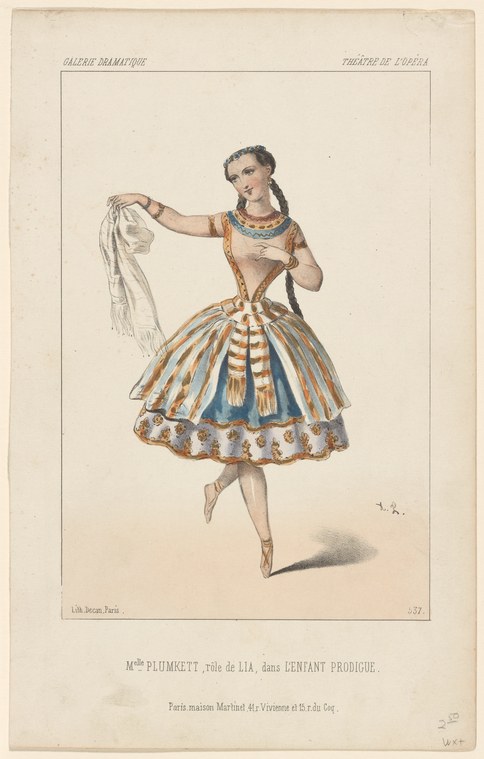
Melle. Plumkett [sic], rôle de Lia, dans L'enfant prodigue, Théâtre de l'Opéra
Unknown artist
- Collection:
- Prints depicting dance
- Source:
- New York Public Library
- Rights:
- Public domain — free to use, share and adapt.
- Recorded as:
- Public Domain
This print is evidence of how a specific dancer and a specific production instantiated a choreographic role in the early 20th century. It documents the costume choices—including the innovative, non-naturalistic striped skirt—and shows us a moment the choreographer or designer deemed important enough to immortalize in theatrical portraiture. For historians of Fokine's ballet work and for anyone studying how Romantic and neoclassical ballet vocabularies evolved in the interwar period, this image provides a concrete visual reference point.
What you are looking at
A young female dancer in theatrical costume stands alone against a plain background, caught in a moment of balletic poise. She wears an elaborately decorated dress with a fitted bodice trimmed in gold braid and a full skirt composed of vertical striped panels in blue and gold, each panel decorated with a gold border and small ornamental designs. The skirt is relatively short, reaching to mid-calf, and reveals her legs and ballet slippers. She wears a decorative necklace or collar at her throat and has her hair arranged with a braid. Her left arm is extended outward and downward, holding what appears to be a gossamer veil or scarf in pale cream fabric, creating a graceful line. Her right hand rests near her body. The pose suggests a moment of stillness or preparation rather than dynamic movement—the weight appears evenly distributed, the body upright and formal.
The dancing
The dancer stands in a classical upright posture with legs straight and turned out, weight centered. The extended left arm and hand holding the veil create an asymmetrical frame; the arm is not fully extended but gently curved, the hand open and relaxed. The pose has the formal, presentational quality of a theatrical portrait rather than an action photograph—there is no sense of weight shifting or mid-leap momentum. The single figure dominates the composition, positioned frontally, and the veil creates a secondary line of interest.
The dance depicted
This is a portrait of a theatrical dancer performing a role in what the inscription identifies as *L'Enfant Prodigue* (The Prodigal Child), a four-act opera-ballet choreographed by Michel Fokine with music by Sergei Prokofiev, premiered at the Théâtre de l'Opéra in Paris in 1929. The dancer is identified as Mlle. Plumkett (note the spelling variant in the inscription), who performed the role of Lia. The costume and pose suggest a classical ballet vocabulary—the turned-out legs, upright carriage, and graceful arm placement are consistent with Romantic and early 20th-century ballet technique. The veil as a prop and the solemnity of the pose suggest a narrative or emotional moment rather than a technical display.
How it was made
This is a hand-colored lithograph or engraving, identifiable from the fine linear work, the delicate tonal modeling visible in the shadow beneath the figure, and the applied watercolor or gouache tinting (particularly the blues, golds, and flesh tones). The technique is characteristic of theatrical portraiture from the 1920s–1930s—a medium that allowed rapid, inexpensive production of souvenir prints for distribution at the theatre and sale to ballet enthusiasts. The bold outlines and flat color areas indicate this was a commercial print, likely from a series documenting the cast of the production.
About this work
This is a commemorative theatrical print of a dancer in a named role in a significant 20th-century ballet. It documents both the costume design and the dancer's interpretation of a character role in Fokine's *L'Enfant Prodigue*, one of the Ballets Russes era's most ambitious works. The image belongs in a dance archive because it captures not only the physical appearance of the performer but also the aesthetic vocabulary of interwar European ballet—the marriage of classical technique with modernist visual design. The print circulated among audiences at the Opéra and collectors of ballet memorabilia, making it a primary document of how dancers and choreographers presented the work to the public.
How to look at it
The artist has chosen to show the dancer in a moment of stillness and formal presentation rather than in mid-movement. This choice is typical of theatrical portraiture of the period, which prioritized legibility of costume and an idealized, posed image over the capture of dynamic action. Attend to the costume details—the specific patterning of the skirt, the ornamental collar, the veil—as these are the designer's statement, and the dancer's body is arranged to display them. The lifted arm and extended veil also create a narrative suggestion: this is not a technical exercise but a moment in a story. The pale veil against the patterned skirt demonstrates the artist's understanding of how silhouette and color work in theatrical space.
The artist
The print is unsigned and the artist is not recorded. The style and execution are consistent with commercial theatrical lithography produced by Parisian publishers in the 1920s–1930s, a period when photographic reproduction of theatrical moments was not yet standard practice and hand-drawn, hand-colored prints remained the primary medium for ballet publicity and souvenir distribution. The quality of draftsmanship suggests a professional theatre studio rather than a generic commercial printer.
The period
This print dates to the era of the Ballets Russes and its immediate aftermath, when European ballet was absorbing modernist visual language while maintaining classical technique. Michel Fokine, the choreographer of *L'Enfant Prodigue*, was a central figure in this synthesis: his ballets drew on pantomime, ethnographic movement vocabularies, and contemporary visual art while remaining grounded in classical ballet training. The costume visible here—with its geometric striping and applied ornament rather than classical tulle—reflects the influence of artists like Natalia Goncharova and Leon Bakst, who designed costumes for the Ballets Russes. By the late 1920s, ballet had become a popular entertainment for Parisian audiences, and the mass production of souvenir prints was a significant industry.
Where it lives
This is a print from the New York Public Library's collection of dance-related prints and engravings, a collection formed chiefly from acquisitions of theatrical ephemera and souvenir materials circulated at performances during the 20th century. The printing credit line at the bottom indicates publication by a Paris-based printer, consistent with it being a professional theatre souvenir.
Dance in this work
Questions about this work
What opera-ballet is this from?
*L'Enfant Prodigue* (The Prodigal Child), an opera-ballet choreographed by Michel Fokine with a score by Sergei Prokofiev. It premiered at the Théâtre de l'Opéra in Paris. The narrative concerns a young man who abandons his home and family and must be reconciled with them. Lia is a character in the drama, likely a member of the court or a woman the protagonist encounters.
Why is the skirt striped like that?
The vertical striping and applied gold borders were part of the modernist costume design vocabulary of the 1920s–1930s. Rather than the soft, undyed tulle of 19th-century Romantic ballet, this costume uses geometric patterning and deliberate color to create visual interest and to signal that this is a contemporary work. The choice also makes the dancer's silhouette and movement more legible to an audience.
Who choreographed L'Enfant Prodigue?
Michel Fokine, a Russian-born choreographer who was a central figure in the Ballets Russes and modernized ballet vocabulary in the early 20th century. Fokine insisted that movement should be motivated by the dramatic narrative rather than existing only for technical display, and that corps de ballet should be treated as dramatically significant. The ballet was one of his last major works.
Is this a photograph or a drawing?
This is a hand-colored lithograph or engraving, a common format for theatrical portraits before the widespread use of photography in theatre. The fine line work and applied watercolor indicate a professional print made for sale to theatre audiences and collectors. It is not a photograph but a carefully composed and executed portrait drawing.
More dance artwork





