49 works in this view — arrow keys or swipe to move between them.
Dance in Art
Mademoiselle Taglioni
Unknown artist
- Collection:
- Prints depicting dance
- Source:
- New York Public Library
- Rights:
- Public domain — free to use, share and adapt.
- Recorded as:
- Public Domain
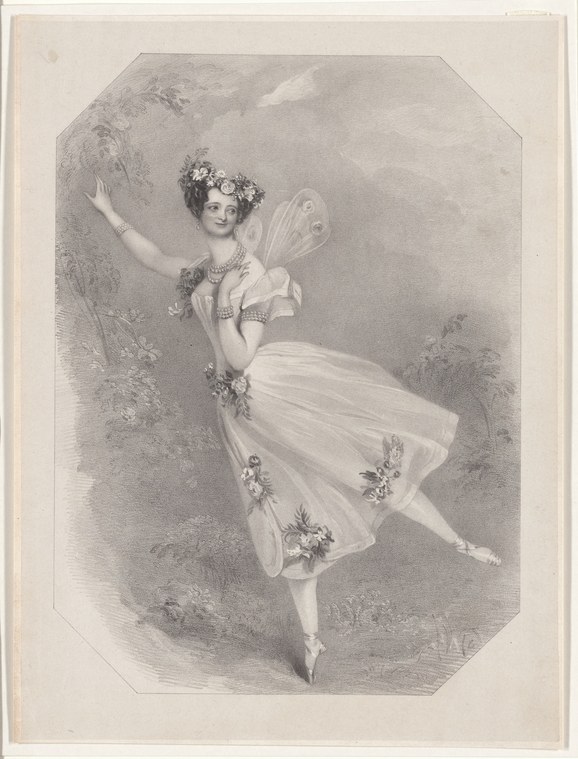
This image is among the primary visual documents of how Romantic ballet dancers were seen and marketed to the public. It records not a choreographic moment but an ideal of the dancer's body and presence—the off-stage visual mythology that made ballet culturally powerful in the 1830s–1840s. For historians of dance representation, costume, and the gendering of physical grace, such engravings are essential evidence.
What you are looking at
A young female dancer in an off-shoulder white tulle dress stands in a graceful contrapposto pose against a softly shaded background suggesting a garden or romantic landscape. Her body is angled three-quarters to the left, with her right leg extended in an elegant line and her left arm raised and extended, while her right arm is drawn across her body. She wears a floral wreath in her hair and carries flowers at her waist, while additional floral garlands decorate her skirt. The composition is enclosed in a octagonal frame. Her pose and presentation suggest the height of Romantic era ballet, with an ethereal, almost supernatural quality to her stillness—she appears captured mid-movement yet suspended, as if barely touching the ground.
The dancing
A single dancer is depicted in a vertical axis with asymmetrical weight distribution. Her weight appears to rest on the left leg while the right leg extends in a long, pointed line—characteristic of ballet's épaulement and the turned-out hip alignment of classical technique. Her raised left arm curves softly upward, while her torso faces subtly stage-right, creating the diagonal line typical of Romantic ballet positioning. The pose suggests a moment of apparent stillness within movement: she is neither weight-bearing on both legs nor captured mid-jump, but rather in that distinctive Romantic attitude—grounded yet weightless.
The dance depicted
This is almost certainly a Romantic ballet dancer, most likely Marie Taglioni or a dancer performing in her iconic roles, given the title and the aesthetic conventions of the 1830s–1840s. The off-shoulder tulle dress, floral crown, and emphasis on elevation and grace are hallmarks of the Romantic ballet idiom. The pose itself—neither explicitly on pointe (though the extended leg suggests the possibility) nor in any balletic step, but rather in a graceful extension—exemplifies how Romantic ballet represented the dancer's art: as ethereal, weightless, and otherworldly. The image captures the period's obsession with the illusion of effortless flight.
How it was made
This is a black-and-white engraving or steel engraving, a mass-produced reproductive medium that allowed wide circulation of images of celebrated dancers to audiences who could not attend performances. The delicate cross-hatching and tonal gradations create volume and atmosphere, particularly in the softly rendered background and the fine detail of the tulle skirt. The octagonal frame—a popular framing device in prints of the era—gives the work an intimate, precious quality. Engravings such as this were the primary means by which visual culture of dance circulated to the broader public in the 1830s–1840s.
About this work
This engraved portrait of a Romantic era ballet dancer presents a single figure in an elegant, characteristically weightless pose. The work exemplifies how 19th-century printmaking captured the visual ideal of Romantic ballet—the ethereal, delicate, otherworldly feminine dancer in her iconic costume. The octagonal frame, refined technique, and circulation as a reproductive print suggest this was aimed at a middle-class audience with access to prints but not necessarily to the opera house itself. It is a visual record not just of a dancer or a role, but of an entire aesthetic ideology: the Romantic ballet body as an object of spiritual and artistic transcendence.
How to look at it
Observe the specific weight distribution: the dancer is not in a pose of active balance or mid-step, but in a state of apparent suspension. Notice how the artist has rendered the tulle—not as heavy fabric, but as nearly weightless layers of gathered textile, almost like wings. The floral elements (crown, garlands) are not decorative accident but part of the visual language: flowers signified the Romantic association of the dancer with nature, youth, and the supernatural. The pose itself—what dancers might call an attitude or arabesque preparation—shows the artist understood the turned-out hip alignment and vertical alignment of ballet training.
The period
This print dates to the height of the Romantic ballet era in Europe, when ballet became the dominant theatrical dance form and the dancer—particularly the female dancer—became a cultural obsession. The 1830s saw the premieres of *La Sylphide* (1832) and *Giselle* (1841), works that defined Romantic ballet's aesthetic. In visual culture, engravings and lithographs of celebrated dancers like Marie Taglioni, Fanny Elssler, and Carlotta Grisi were mass-produced and collected. These prints served a function similar to modern photograph posters or film stills: they circulated the dancer's image, reinforced her stardom, and allowed audiences to own a memento of performance. The medium of engraving itself was entering its last period of dominance before photography began to displace it in the 1850s.
Where it lives
This engraving is held in the New York Public Library's collection of prints depicting dance. It is an example of the mass-produced reproductive prints that were primary visual media for disseminating images of celebrated performers in the 19th century, before photography became widespread.
Dance in this work
Questions about this work
Who was Mademoiselle Taglioni?
Marie Taglioni (1804–1884) was a Swedish-born dancer who became the defining figure of Romantic ballet and a major international star. She originated the role of the Sylphide in *La Sylphide* (1832) and is often credited with popularizing dancing *en pointe*. She was the first major ballet superstar and her image was reproduced in prints like this one throughout Europe.
What is the off-shoulder dress in this image?
This is a romantic tutu or ballet dress of the 1830s–1840s style—made of gathered white tulle with a low off-shoulder neckline. The design emphasizes the neck and upper body while allowing freedom of movement. The floral garlands were part of the costume for many Romantic roles, signifying connection to nature and the supernatural.
Why were prints of dancers so popular in this period?
Before photography, engravings and lithographs were the primary visual media for circulating images. Fans and theater-goers collected prints of their favorite performers as souvenirs, much as they collect photographs and digital images today. These prints were affordable enough for middle-class homes and created a public image and fan culture around celebrated dancers.
Is this dancer en pointe?
The image is ambiguous on this point. The extended leg and the overall aesthetic suggest pointe work, which was becoming standard in Romantic ballet during the 1830s–1840s, but the engraving technique does not provide clear enough detail of the foot to say definitively. The artist may have been emphasizing the leg line over the technical specificity of footwear.
More dance artwork





