49 works in this view — arrow keys or swipe to move between them.
Dance in Art
Man with two women
Unknown artist
- Collection:
- Prints depicting dance
- Source:
- New York Public Library
- Rights:
- Public domain — free to use, share and adapt.
- Recorded as:
- Public Domain
This image is invaluable evidence of how the mid-19th-century ballroom was experienced and remembered—not primarily as a site of technical virtuosity but as an arena of social display, courtship, and the aesthetic appreciation of elegant bearing and dress. It shows a dancer's world in which the relationship between partners, the formality of introduction, and the visual spectacle of movement were inseparable from the dance itself.
What you are looking at
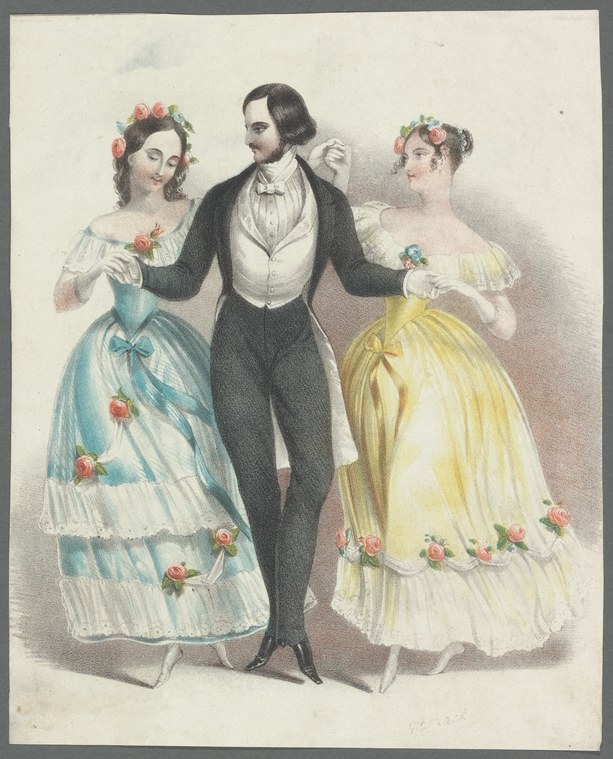
A hand-colored engraving showing three fashionably dressed figures in a moment of social dance or courtship. A man in formal black tailcoat and white shirt stands at center, his arms extended to hold the hands of two women in elaborate ball gowns. The woman on the left wears a pale blue dress with teal ribbon detail and floral garland in her hair; the woman on the right wears pale yellow with similar floral ornamentation. Both women's skirts are voluminous, layered with white underskirting and decorated with scattered rose garlands. The composition is frontal and symmetrical, with soft modeling of the figures against a neutral background. The print bears the delicate coloring and fine line work characteristic of 19th-century hand-tinted engravings, with particular attention to the luminosity of the fabrics and the gentle shading of faces and skin.
The dancing
The three figures stand upright in a balanced, symmetrical arrangement. The man holds both women's hands at roughly waist height, his body open and engaging. Both women face forward with slight contrapposto, their weight settled, arms extended in a graceful reception of his touch. Their posture suggests trained deportment—the straight spines and gentle curves of the arms typical of ballroom practice. The moment captures the formality of introduction or the opening of a set dance rather than active movement; all three figures are poised but still, showing the elegant stasis that preceded actual dancing.
The dance depicted
This depicts the formal social dance culture of the mid-19th century, likely a Waltz, Quadrille, or similar ballroom form common in European drawing rooms and public balls. The equal attention to the man and two women suggests a figure from a set dance or a moment of choice before pairing—possibly the opening tableau of a Quadrille or the partner-selection phase of a Waltz. The elaborate dress, the formal presentation, and the evident social hierarchy (the single man attended by multiple women) are consistent with Romantic-era ballroom culture. The image celebrates not the technical execution of steps but the social choreography of courtship and elite leisure.
How it was made
A hand-colored engraving, likely from the 1840s–1860s. The underlying print is a fine steel or copper engraving with delicate parallel line work establishing form and shadow; the color has been applied by hand in transparent washes of relatively restrained palette—pale blues, yellows, pinks, and greens. This technique was standard for fashion and society prints of the period and implies a work of moderate cost, aimed at the middle to upper-middle classes as a memento of fashionable taste and social aspiration. The precision of the engraving and the care of the coloring suggest professional production, likely for a publisher of fashion or entertainment prints.
About this work
A mid-19th-century engraving celebrating the formal social rituals of ballroom dancing. The work freezes a moment of social choreography—the moment of introduction, partnership, or the opening tableau of a set dance—emphasizing the elegant bearing, elaborate dress, and romantic attention that framed such encounters. The image offers no hint of movement; instead it documents the performative stillness and mutual regard that preceded the actual dance. The print belongs to a large contemporary market for fashion and society prints, which served both as documentary record of taste and as aspirational objects for viewers who may never have entered a grand ballroom themselves.
How to look at it
Observe the careful symmetry of the composition and the passivity of the pose—this is not the captured energy of movement but the formal presentation of ready bodies. Notice how the artist has rendered the fabrics: the sheen and volume of the skirts, the translucency of the white underskirting, the precision of the ribbon detail. The floral garlands are not merely decorative but signal the occasion as festive and romantic. The man's face and posture—his slight smile, his open stance—convey attentiveness and control, the social authority expected of the leading partner. This is a document of manners as much as of dance.
The period
The print dates to the height of the Romantic era in ballroom dancing, when the Waltz and Quadrille dominated European and American social life. This was a period of intense fashion consciousness and a flourishing market for prints documenting social rituals, manners, and taste. The elegant, symmetrical composition and the emphasis on dress reflect the aesthetics of mid-19th-century lithography and engraving, a medium perfectly suited to the reproduction and circulation of images of fashionable life. Such prints served as models of behavior and aspiration for an expanding middle class.
Where it lives
The work is held in the Prints depicting dance collection at the New York Public Library, indicating its significance as both a historical record of dance practice and a work of popular visual culture.
Dance in this work
Questions about this work
What dance are they doing?
The image does not show active steps. It depicts the formal moment before a set dance begins—likely the opening of a Waltz, Quadrille, or similar ballroom form. The man's hold of both women's hands and the symmetrical composition suggest either a moment of introduction or a figure from a set dance in which couples are being formed or displayed.
Why is there one man and two women?
The unequal pairing reflects either a moment in a set dance (such as a Quadrille) in which men and women are arranged in particular formations, or it may represent a social fantasy—the man as the object of attention and choice. Alternatively, it could depict the opening of an evening, before partners have paired off for the dance.
What does the dress tell us?
The elaborate ball gowns with layered skirts, ribbon detail, and floral garlands, paired with the man's formal tailcoat and white shirt, signal a grand ball or significant social occasion. The style and execution date the work to the mid-19th century and indicate an upper-middle-class audience. The quality of the garments and their fashionability would have been a primary interest of contemporary viewers.
Is this a real moment or a fantasy?
It is likely a stylized or idealized representation rather than a candid record. The perfect symmetry, the formal poses, and the absence of any suggestion of actual movement suggest an artistic composition designed to represent the ideal of ballroom etiquette and beauty rather than a specific observed event.
More dance artwork





