49 works in this view — arrow keys or swipe to move between them.
Dance in Art
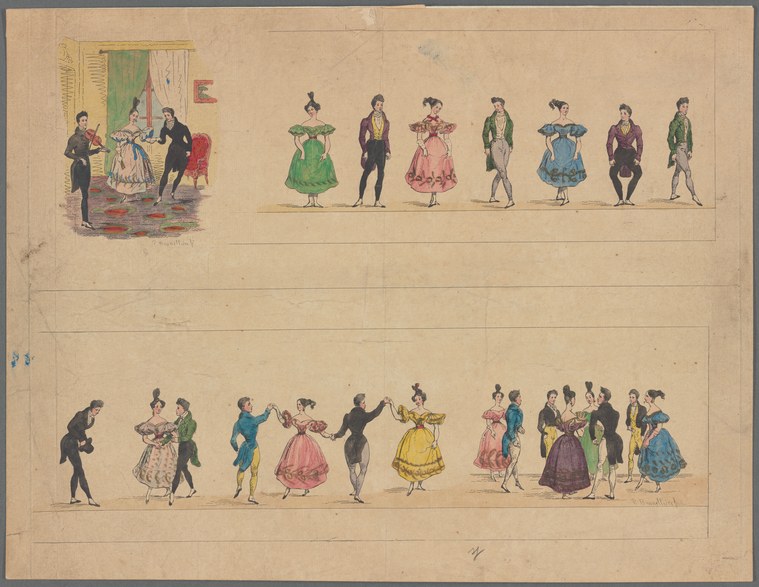
Two rows of dancers
Unknown artist
- Collection:
- Prints depicting dance
- Source:
- New York Public Library
- Rights:
- Public domain — free to use, share and adapt.
- Recorded as:
- Public Domain
This image is a rare document of how Gilded Age society managed the presentation and performance of formal dance: the careful line-up of participants, the strict dress codes, and the prescribed choreography of interaction. For historians of dance and costume, it shows the integration of fashion and social movement—the way a woman's gown and a man's tailcoat were not merely worn but danced, and the way the dance itself was a form of conspicuous, regulated leisure.
What you are looking at
This is a line-up sheet or theatrical costume study sheet rather than a narrative scene. The upper section shows a small vignette on the left: three figures in dark formal dress (two men and a woman in a white gown with a blue sash) arranged in an interior with a doorway, apparently a moment of greeting or social interaction. To the right of this vignette stand nine isolated figures arranged in a horizontal line, each rendered in full color: alternating male and female dancers in formal evening dress—the men in tailcoats and dark suits, the women in gowns of green, pink, and blue, each with distinctive silhouettes and trim. The lower section presents a second line of approximately thirteen figures in a more active, engaged arrangement: mixed-gender pairs and small groups, again in formal dress, some appearing to dance, others to socialize or promenade. The entire composition is rendered in watercolor or hand-colored print on aged tan paper, with delicate line work and soft washes of color.
The dancing
The figures are rendered in elegant profile and three-quarter views, with careful attention to the silhouette of each costume. In the upper line-up, dancers stand in relatively neutral, presentational poses—neither in closed holds nor in clear dance frames, suggesting a display of costume or personnel. In the lower section, some pairs show closer proximity and tentative connection—one central couple appears to be in waltz or ballroom contact, while others stand freely or seem to be in social conversation. The women's skirts are full and bell-shaped, typical of mid-to-late 19th-century evening wear, and the men are uniformly in formal tailcoats. The overall tone is one of propriety and formal social arrangement rather than dynamic movement.
The dance depicted
This appears to document a ballroom or formal dance event of the Victorian or Gilded Age, most likely a quadrille, cotillion, or general formal dance gathering. The arrangement—a line-up followed by a social configuration—suggests the formal protocols of such events, where couples would be presented and then move through figures. The closed or near-closed holds visible in some pairs, the evening dress, and the formal interior setting (suggested by the vignette) all point to elite social dancing of approximately 1860–1880. The artist has chosen to show both the presentational and interactive aspects of the event, suggesting a program or design document for a theatrical or social production rather than a spontaneous scene.
How it was made
The work is executed in watercolor or hand-colored print (likely a lithograph or wood engraving that has been hand-tinted), on wove paper. The delicate line work establishing the figures suggests professional engraving or lithography; the soft, even washes of color in the costumes are characteristic of hand-coloring applied after printing. This technique allowed for multiple impressions to be colored uniformly, making it suitable for circulation as a souvenir, costume documentation, or theatrical program material. The level of finish and clarity suggests this was a professional production, not a sketch.
About this work
This is a costume and choreographic documentation sheet for a formal ballroom dance event of the Gilded Age, presented as a line-up of dancers with their costumes, followed by a scene showing how those dancers would interact in the actual event. The work functions simultaneously as a theatrical or social record and as a fashion plate, celebrating both the elegance of formal dress and the propriety of Victorian social dancing. It belongs in a gallery of dance art because it captures not the spontaneity of dance but its orchestration—the careful arrangement of bodies, costumes, and social roles that defined ballroom culture for the elite.
How to look at it
Notice the shift in energy between the upper and lower sections: the line-up is a display, almost heraldic, while the lower scene shows the same dancers in action. Look at how the artist positions the couples and groups—some are parallel and distant, others close in a waltz position, suggesting the variety of figures within a single dance event. The consistency of costume and the formality of pose throughout tell you this is a highly controlled, choreographed occasion, not a wild revel. The hand-coloring and the quality of the line work show this was a valuable document, worth preserving and circulating.
The period
This sheet dates to the era of high Victorian ballroom culture (c. 1850–1890), when formal dancing was a central ritual of elite social life. The quadrille, cotillion, and formal waltz dominated the ballroom, and the choreography and costume of such events were subjects of intense cultural attention. Ballroom dancing manuals, fashion plates, and theatrical programs all documented the appearance and etiquette of formal dance. This sheet sits at the intersection of theatrical practice and social documentation, a mode common in the mid-19th century when ballroom scenes were popular subjects in both fine art and popular prints.
Where it lives
The work is held in the New York Public Library's collection of prints depicting dance, and is catalogued as a generic line drawing with hand coloring. It is a period artifact of dance documentation and theatrical or social practice.
Dance in this work
Questions about this work
Is this a record of an actual ball or a theatrical production?
Both are plausible. The sheet could document a specific society event or be a design for a theatrical ballroom scene. The vignette on the left and the careful line-up suggest theatrical planning, but it could equally be a souvenir of a major social event. Without more provenance, both readings stand.
Why are the dancers posed rather than shown in dynamic motion?
This is a costume and choreographic display, not a narrative scene. It shows the dancers who will perform and hints at how they will interact, but the primary purpose is to document dress and role. The upper line-up is especially presentational—more like a cast list than a dance scene.
What dances are being shown?
The formal dress, the indoor setting, the pairs and group configurations, and the overall tone suggest a ballroom event centered on the quadrille or cotillion, possibly with waltzes. The close proximity of some pairs and the formal arrangement of others is consistent with the choreography of such events.
What is the small scene on the left?
It is likely a vignette introducing or framing the main document—possibly showing the moment of arrival at the ball or a key social ritual. The three figures (two men and a woman) may represent patrons or hosts, or may be a narrative frame for the dancers shown in the line-up to the right.
More dance artwork





