49 works in this view — arrow keys or swipe to move between them.
Dance in Art
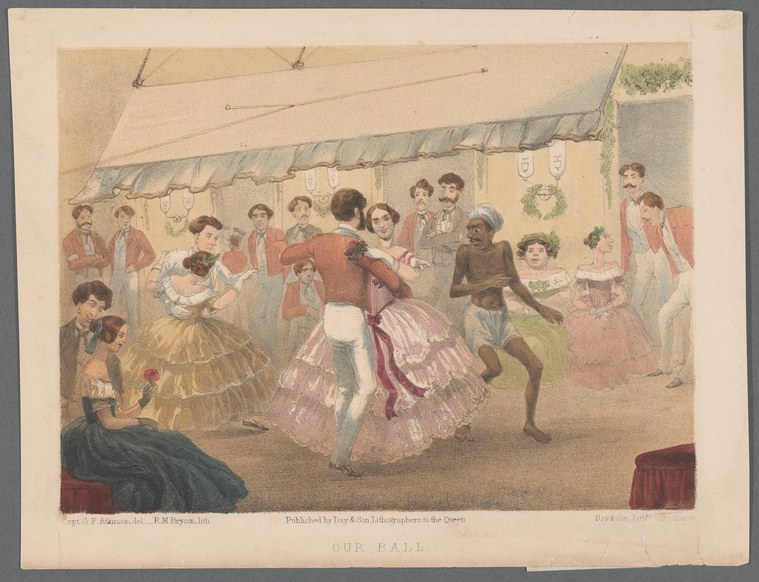
Our ball
Unknown artist
- Collection:
- Prints depicting dance
- Source:
- New York Public Library
- Rights:
- Public domain — free to use, share and adapt.
- Recorded as:
- Public Domain
This work documents the physical reality of ballroom dancing in the mid-nineteenth century: the dress, the open frames, the social mixing, and the vigor of movement that formal histories often miss. The inclusion of a Black male dancer as an active, central participant, rather than servant or musician, makes this a rare and historically significant image for understanding race and dance during this period.
What you are looking at
A crowded indoor ball or dance assembly, viewed from within the throng. A striped awning or tent fabric fills the upper portion, with hanging greenery and decorative wreaths visible. The floor is populated with dozens of figures in nineteenth-century dress: women in full skirts—some yellow, some pink with purple ribbons—and men in dark coats and light trousers. In the center foreground, a woman in a pink dress with a white undergarment dances, her skirt lifted in a wide arc, while a Black male dancer in brown stands opposite, both in animated motion. To the left, a woman in a yellow dress with a full skirt is also captured mid-dance. The crowd presses close around the dancers: some clap, some converse, some watch intently from the margins. The composition is dense and energetic, with overlapping figures creating depth. The palette is soft—creams, pale blues, browns, and touches of red—typical of colored print work of the mid-to-late nineteenth century.
The dancing
The central dancers occupy an open position in the throng, with no formal closed hold visible. The woman's body is animated: her skirt swings outward, her posture upright but relaxed. The male dancer faces her with active stance, suggesting quick, responsive movement. The yellow-dressed woman to the left also displays a lifted skirt and turning motion. Around them, onlookers stand upright, many with arms raised in applause or gesture. The bodies are rendered with naturalistic proportions and weight distribution; the artist demonstrates understanding of how fabric moves with vigorous social dancing.
The dance depicted
This depicts a social ball or assembly, most likely an American or European occasion from the mid-nineteenth century. The mixed-race couple at the center suggests either an integrated ballroom (unusual for the era in America) or an imagined, perhaps satirical or theatrical scene. The open, vigorous postures and lifted skirts point toward country dances, quadrilles, or cotillions rather than the more restrained waltz. The crowd composition—with dancers in the center and spectators in close proximity—is typical of period ball imagery. Without inscription or title visible in the image itself, the specific dance cannot be pinpointed, but the informality and energy suggest contra or square-dance family rather than classical ballroom.
How it was made
This is a hand-colored lithograph or engraving, as suggested by the linear hatching visible in shadows, the controlled tonal range, and the characteristic soft blending of colors. The technique allowed for broad distribution to a mass audience; the notation at the bottom indicates publication. Hand-coloring over a printed base was standard for popular prints of the 1850s–1870s. The soft palette and careful composition suggest a commercial print aimed at a middle-class market interested in genre scenes of contemporary leisure and social life.
About this work
"Our Ball" is a mid-nineteenth-century colored print capturing the energy and social dynamics of a public or semi-public dance assembly. The work is valuable for its documentation of ballroom dress, setting, and the physicality of social dancing during an era when such scenes were popular subjects for commercially reproduced prints. The inclusion of a mixed-race dancing couple at the center—unusual in printed imagery of the period—adds historical and social complexity, whether the intention was documentary, satirical, or purely theatrical. The dense, crowded composition and naturalistic rendering of motion show the artist's familiarity with how bodies actually move in social dance. As a print, it would have reached hundreds or thousands of viewers, making it a window into what middle-class audiences understood about their own dance practices and anxieties.
How to look at it
Pay attention to the moment the artist chose: not a formal pose, but active, mid-movement. The woman's skirt is caught in the arc of a turn, the man's body responds. Notice how the crowd presses in, some clapping, some absorbed in the spectacle. The central couple's open frame and upright posture suggest quick, responsive footwork rather than the waltz's smooth gliding. The artist's choice to place a mixed-race couple at the center, lit and visible, invites the viewer to look directly at them—a compositional decision worth considering.
The period
The mid-nineteenth century saw a flourishing of dance prints aimed at the middle class, coinciding with the rise of public assemblies, commercial dance halls, and the quadrille and cotillion as dominant social dances. In America and Europe, lithography and hand-colored engraving were the primary vehicles for distributing dance imagery. This period also saw the emergence of the waltz and the slow decline of older country-dance forms, though they remained popular in public spaces. The subject matter—a lively, integrated social scene—reflects both the optimism of the era and, in some cases, the anxieties it provoked.
Where it lives
This work is part of the New York Public Library's collection of prints depicting dance. It is a commercial print, likely issued in a series or as a separate publication. The notation at the bottom identifies the publisher and printmaker, though the information is not clearly legible in the image.
Dance in this work
Questions about this work
Who are the dancers in the center?
The catalogue record does not identify them. The image shows a woman in pink and a Black male dancer in brown at the heart of the scene, surrounded by a crowd of onlookers in nineteenth-century dress. Whether they are specific individuals, generic types, or characters in a theatrical piece cannot be determined from the image alone.
What dance is this?
The open frame, vigorous movement, and lifted skirts suggest a cotillion, quadrille, or country dance rather than a waltz. The exact title or type is not recorded, and no inscription naming the dance is visible in the print.
Is this a real event or imagined?
It is almost certainly an imagined, generic scene of a fashionable ball, created for popular circulation. The composition and crowd suggest a commercial print aimed at middle-class buyers interested in scenes of leisure and fashion rather than documentation of an actual occasion.
More dance artwork





