49 works in this view — arrow keys or swipe to move between them.
Dance in Art
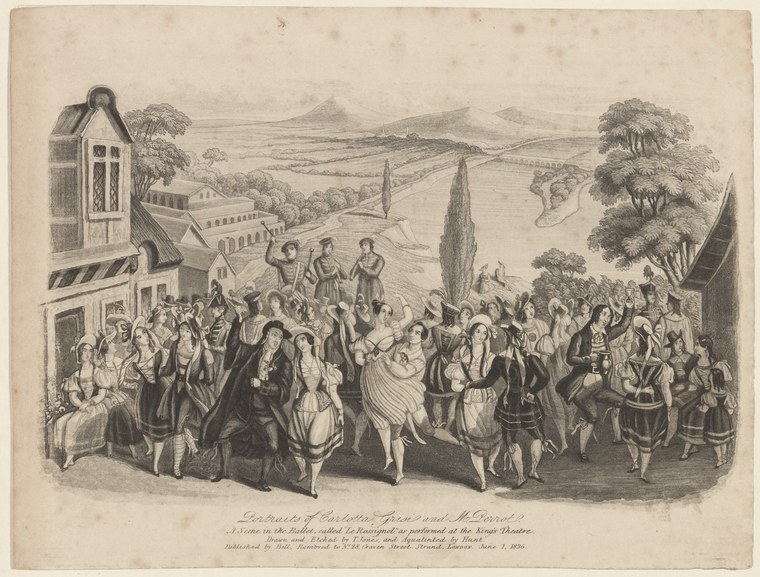
Portraits of Carlotta Grisi and M. Perrot: A scene in the ballet, called "Le rossignol," as performed at the King's Theatre
Unknown artist
- Collection:
- Prints depicting dance
- Source:
- New York Public Library
- Rights:
- Public domain — free to use, share and adapt.
- Recorded as:
- Public Domain
Carlotta Grisi was one of the dominant figures of Romantic ballet in the 1840s–1850s, and Marie Perrot (her partner and fellow performer) was both dancer and choreographer; this print documents their work in a now-lost ballet. The image is also rare evidence of how ballet scenes—particularly ensemble and narrative sequences—were actually staged and dressed in the mid-19th century, including the participation of corps dancers and the integration of dance into theatrical spectacle.
What you are looking at
A crowded outdoor scene set before a classical temple or pavilion, with mountains visible in the distance. Dozens of figures in 19th-century dress—men in dark coats and women in full-skirted gowns—cluster on a terraced courtyard. Several couples occupy the foreground in dancing postures, while the crowd extends back through an arcade of columns. The composition suggests a formal ball or reception at a grand estate. The engraving captures a specific dramatic moment: some figures are in active dance, others gesture and converse, and the overall effect is of animated social movement—the particular scene from "Le Rossignol" (The Nightingale) that the title promises. Trees frame both sides of the composition; the light is even and descriptive, typical of theatrical publicity prints of the period.
The dancing
The dancers visible in the foreground stand in upright, formal positions with extended arms and legs—the carriage and frame expected of Romantic-era ballet. Several couples appear to be in a closed or semi-closed hold, characteristic of social and theatrical dance of the 1840s–1850s. The women's skirts are full and voluminous, constraining leg movement and emphasizing torso and arm gesture. The men are in tailcoats and formal evening dress. The crowd behind includes standing figures, some with arms raised or gesturing, suggesting either ensemble movement or audience reaction within the ballet's narrative. The density and overlap of figures suggests a corps de ballet or an ensemble scene.
The dance depicted
This engraving documents a scene from "Le Rossignol," a Romantic ballet performed at London's King's Theatre, and features the celebrated dancer Carlotta Grisi and the choreographer/dancer Marie Perrot. Grisi was one of the foremost ballerinas of the 1840s, celebrated for roles in Giselle and La Péri. The image captures an act or scene that involves a formal ballroom or festival gathering, with multiple dancers in period dress participating in or witnessing a central dramatic moment. The title's mention of Perrot—who was both performing and choreographing at this time—suggests this may document a pas or ensemble sequence he either danced in or created. The Romantic ballet was characterized by narrative pantomime, corps work, and the display of the ballerina's technique; this scene appears to show the theatrical deployment of many bodies in a unified social setting.
How it was made
This is a wood engraving (or possibly a steel engraving), a reproductive print technique that allowed theatrical imagery to circulate widely in 19th-century print culture. The fine cross-hatching and the legibility of small figures at a distance are consistent with wood-block engraving for high-volume reproduction. The print would have been produced as theatrical publicity—to advertise the performance, memorialize a celebrated production, or serve as a keepsake for audiences. Such prints were sold at theaters and through print sellers, making them accessible to the theatre-going public. The technique's capability to render fine detail and atmospheric distance is deployed here to show the grandeur of the ballroom set and the number of performers involved.
About this work
This is a theatrical publicity print documenting a scene from the Romantic ballet "Le Rossignol," performed at London's King's Theatre and featuring the celebrated dancer Carlotta Grisi and choreographer Marie Perrot. The engraving captures a formal ballroom or festival scene with multiple figures in Romantic-era dress, combining documentary record with the aesthetic conventions of 19th-century ballet imagery. It belongs in a gallery of dance as visual evidence of how Romantic ballet was performed, costumed, and staged—and how those performances were marketed and remembered through popular prints.
The work is significant because it preserves a specific scene from a now-lost production, showing not just the stars (Grisi and Perrot) but the corps and ensemble work that made the Romantic ballet spectacular. The print's existence and circulation tell us that ballet was a major public entertainment, and that audiences wanted portable images of the dancers and dances they admired.
How to look at it
The composition follows the tradition of theatrical prints in privileging the stars—Grisi and Perrot would occupy a prominent place in the crowd, though identifying them precisely requires knowledge of the ballet's choreography. The viewer should attend to the variety of poses and gestures: some figures are in active dance or mime, others are spectatorial, and the overall scene suggests a narrative moment rather than an abstract display of technique. The formal dress and architectural setting place this as a 'society' scene within the ballet's story. The engraving's fine detail allows the viewer to read individual bodies and expressions across a crowded space—a key effect of Romantic ballet was the coordination and legibility of many performers at once.
The artist
The artist is not recorded. The print was published by J. Pitman, a London print seller active in the mid-19th century. Such theatrical prints were typically produced by teams of engravers working from designs by theatre artists, painters, or lithographers who attended performances or worked from theatre archives. The anonymity of the engraver was common; the focus was on the performance and the stars, not the printmaker.
The period
The Romantic ballet emerged in the 1830s–1840s, characterized by ethereal, otherworldly narratives (sylphs, spirits, enchanted maidens), pointe work, pale tutus, and the elevation of the ballerina as a ethereal figure. Marie Taglioni, Carlotta Grisi, Fanny Cerrito, and others dominated the period. At the same time, Romantic ballet integrated pantomime and social scenes—balls, weddings, village festivals—into its narratives, allowing for ensemble work and dramatic interaction. London's King's Theatre was a major venue for European ballet in this period, hosting seasons by the leading dancers and choreographers. Prints like this one were part of the machinery of celebrity and theatrical publicity that grew with industrialization and the expansion of literate, urban audiences for the arts.
Where it lives
The print is held in the Prints collection at the New York Public Library, part of their extensive holdings of 19th-century theatrical prints and ephemera. Such prints were mass-produced theatrical merchandise and appear frequently in institutional collections focused on performance history.
Dance in this work
Questions about this work
Who were Carlotta Grisi and Marie Perrot?
Carlotta Grisi (1819–1899) was an Italian ballerina and one of the greatest dancers of the Romantic era, celebrated for roles in Giselle and La Péri. Marie Perrot (1797–1855) was a French ballet dancer, choreographer, and partner to Grisi; he created many roles for her and was a major figure in bringing European ballet to London. Both were stars of the King's Theatre in London during the 1840s–1850s.
What is 'Le Rossignol' and when was it performed?
Le Rossignol (The Nightingale) was a Romantic-era ballet performed at the King's Theatre in London. The print does not bear a date, so the exact premiere is uncertain, but Grisi and Perrot were actively performing together at the King's Theatre in the mid-1840s. The ballet is now lost—no score or choreographic notation survives—so this print is part of the historical record of what was performed and how.
How do we know what is happening in the scene?
The title tells us it is a scene from Le Rossignol and that Grisi and Perrot are featured. The formal dress, the architecture, and the crowd suggest a ballroom or social gathering—a common narrative setting in Romantic ballet. However, without access to the original libretto or choreographic notes, we cannot identify specific characters or plot points. The print is a record of spectacle and costume rather than a narrative diagram.
Why are there so many figures in the image?
Romantic ballet featured large corps de ballet—ensemble dancers who created visual effects and participated in narrative scenes. A ballroom scene would naturally involve multiple dancers, and the effect of scale and coordination was central to 19th-century theatrical spectacle. The crowding also reflects the social nature of the scene—a ball or festival gathering within the ballet's story.
More dance artwork





