49 works in this view — arrow keys or swipe to move between them.
Dance in Art
Augusta Maywood
Unknown artist
- Collection:
- Prints depicting dance
- Source:
- New York Public Library
- Rights:
- Public domain — free to use, share and adapt.
- Recorded as:
- Public Domain
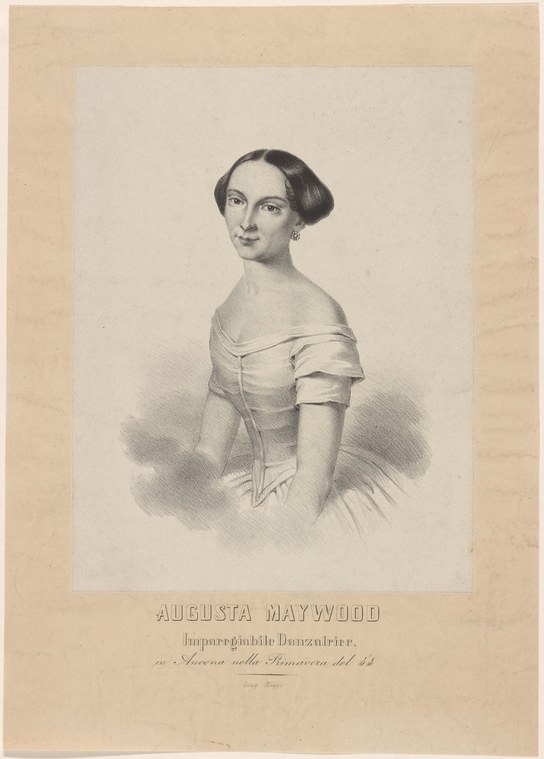
Maywood was a pioneering American ballerina who achieved international prominence in an era when the profession was dominated by European dancers, and she is comparatively understudied. This engraving is one of the primary historical records of her image and celebrity. For historians of dance and print culture, it illustrates the machinery through which 19th-century theatrical dancers were promoted and remembered, and it offers visual evidence of how the Romantic ballet dancer was idealized and presented to the public.
What you are looking at
A three-quarter-length portrait of a young woman set against a plain background, rendered in the refined linear style of 19th-century engraving or lithography. She is shown in elegant profile-turned posture, gazing toward the viewer with a composed expression. Her dark hair is arranged in the fashionable style of the 1830s–1840s, swept back from her face and gathered at the crown. She wears an off-shoulder gown typical of Romantic-era ballroom dress, with fitted bodice and short puffed sleeves that expose her shoulders and upper arms. The gown's fabric appears delicately rendered through fine parallel lines that suggest the texture of silk. Below the bodice, the dress gathers into a voluminous skirt suggested by light shading and soft modeling. Her posture is upright but natural, with her body angled slightly away while her head turns toward the viewer—a convention of portrait composition that conveys both grace and an awareness of being observed. The inscription at the base reads "AUGUSTA MAYWOOD" in capital letters, with additional text below in smaller italic script identifying her as "Imparzabile Danzatrice" (incomparable dancer) and what appears to be a title or date reference.
The dancing
A single standing figure shown in a pose that combines stillness with implied potential for movement. Her weight appears evenly distributed, her frame upright and composed. Her arms are not prominently featured—one appears to rest at her side while the pose does not demand the technical precision or lifted frame associated with trained ballet technique. Her shoulders are relaxed and open, aligned with her torso rather than rotated or held in the pulled-back carriage of a classical dancer. The overall bearing suggests social grace and refined presence rather than the mechanical display of physical technique.
The dance depicted
The inscription "Imparzabile Danzatrice" (incomparable dancer) and the subject's documented identity as Augusta Maywood, a celebrated American ballerina of the Romantic era, establish this as a portrait of a professional theatrical dancer. Maywood was known for performing in the full-length Romantic ballets that dominated European and American stages in the 1830s–1840s, particularly in roles in works by Filippo Taglioni. The portrait's formal and reserved presentation—emphasizing elegance and beauty over technical display—is consistent with how professional dancers of the Romantic ballet period were marketed and understood by the public: as idealized figures of grace and refinement rather than as athletes or virtuosos. The image captures her as she would have appeared off-stage, in her role as a celebrated public personality.
How it was made
This is a fine-line engraving or possibly a lithograph, rendered in black ink on paper with a cream-toned mount. The technique is evident in the precise parallel lines (hatching and cross-hatching) used to create modeling, shadow, and the texture of fabrics—particularly visible in the treatment of the gown's bodice and skirt. The fineness of the line work and the refined tonal control indicate a skilled hand trained in printmaking. Such prints were the primary medium for distributing theatrical portraits during the 19th century: they were reproducible, affordable, and circulated widely as souvenirs, collectibles, and promotional materials, making them instrumental in creating and sustaining the celebrity of ballet dancers among the theater-going public.
About this work
This is a formal portrait engraving of Augusta Maywood, one of the most celebrated American ballerinas of the Romantic ballet era. It was created during her peak years of fame in Europe and America, likely in the 1830s–1840s. The work is a document of both dance history and the material culture of theatrical celebrity: it shows how professional dancers were presented and remembered by the public in the pre-photographic age, and it testifies to Maywood's international renown. The portrait emphasizes her as a figure of elegance and distinction rather than as a technical virtuoso, reflecting the aesthetic values and marketing practices of Romantic-era ballet.
How to look at it
Observe the artist's choice not to depict her in a pose of theatrical display—there are no turned-out legs, lifted extensions, or the demonstrative arm positions associated with stage performance. Instead, she is presented as she might appear off-stage, composed and elegant. The refinement of the line work throughout, particularly in the rendering of the dress and the modeling of her face, invites close looking: this is a work made for a viewer who would spend time with it, not a quick theatrical announcement. The inscription tells you she was considered incomparable in her craft; the image itself tells you how that incomparability was being marketed—not as technical spectacle, but as the grace and beauty of a celebrated public figure.
The artist
The artist is not recorded in the catalogue. The execution and style suggest a professional printmaker trained in the conventions of theatrical portraiture as practiced in Europe (possibly Paris or London, where Maywood performed). Maywood's prominence would have warranted reproduction by a skilled hand; the fineness and finish of this print indicate it was not a rapid or minor work.
The period
This portrait dates to the height of Romantic ballet, approximately 1830–1845, when the aesthetic of the ethereal female dancer was at its cultural apex. The style reflects the commercial expansion of theatrical marketing through printed images, which allowed dancers to circulate their image far beyond those who could attend performances. Maywood's career exemplified the internationalism of Romantic ballet: she trained in America, achieved fame in Europe (particularly Paris and London), and returned to perform in the United States. The engraving's composition and style are consistent with the formal portrait conventions of the period, which treated celebrated dancers as equivalent in cultural status to opera singers and aristocratic subjects.
Where it lives
The work is held in the New York Public Library as part of their collection of prints depicting dance. It appears to be a commercial theatrical portrait, produced and distributed during or shortly after Maywood's performing career. Such prints were commonly collected by theater enthusiasts and dancers themselves.
Dance in this work
Questions about this work
Who was Augusta Maywood?
Augusta Maywood (1825–1876) was an American dancer who became one of the most celebrated ballerinas of the Romantic era. She trained in Philadelphia, achieved international fame in Europe (performing in major roles at the Paris Opéra and London theaters), and returned to perform and teach in America. She was known for her technical skill, grace, and success in the major Romantic ballets of the period, particularly those choreographed by Filippo Taglioni.
What does 'Imparzabile Danzatrice' mean?
It is Italian for 'incomparable dancer.' This was a common form of tribute in theatrical prints and programs of the period, asserting the extraordinary skill and renown of the dancer whose portrait is shown.
Why is she shown standing still rather than dancing?
This reflects the conventions of Romantic-era theatrical portraiture and marketing. Professional dancers were typically presented off-stage, in formal dress, as idealized figures of beauty and elegance. These portraits were sold as souvenirs and collectibles, and they emphasized the dancer's status as a celebrated public figure rather than the technical display of her craft.
What is the technique of this print?
This is an engraving or lithograph rendered in fine black lines and controlled hatching to create tone and modeling. The technique allowed for detailed, reproducible images that could be printed and distributed widely, making such prints the primary medium for circulating the likenesses of celebrated performers before photography.
More dance artwork





