49 works in this view — arrow keys or swipe to move between them.
Dance in Art
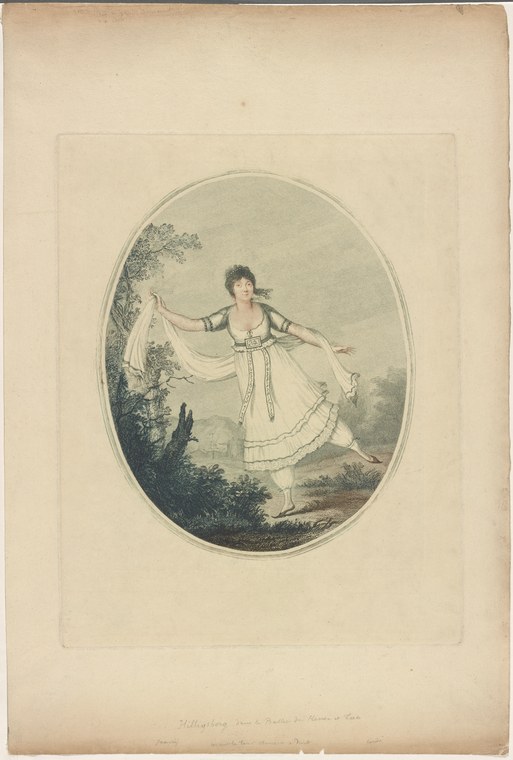
Mde. Hilligsberg in the ballet of Ken-si & Tao, performed for her Benefit the 14th of May 1801
Unknown artist
- Collection:
- Prints depicting dance
- Source:
- New York Public Library
- Rights:
- Public domain — free to use, share and adapt.
- Recorded as:
- Public Domain
This engraving records the look and technique of ballet in England in 1801—before Romantic ballet became codified, but already showing the extended lines and ethereal quality it would become famous for. For historians of dance, it is direct evidence of how a professional dancer moved and was seen by her public. For performers, it documents a specific moment in the evolution of classical ballet technique.
What you are looking at
A woman in classical dress stands in an oval-framed landscape, her body caught in a moment of lyrical extension. She wears a high-waisted white muslin gown with a draped overskirt or shawl that floats around her—the fabric reads as weightless, caught mid-motion. Her dark hair is styled close to the head in the Regency fashion. She stands on one leg, the supporting foot pointed, her free leg extended to the side in a clear arabesque or attitude derrière position. Both arms are extended—one raised and back, the other reaching forward—creating an open, expansive line across her body. The background is a misty, romantically rendered landscape with distant foliage and sky, rendered in soft tones that emphasize the figure's isolation and grace. The engraving technique creates a luminous quality, with the background darker and the figure's dress caught in highlight.
The dancing
A single female figure dominates the composition. Her weight is supported on one pointed foot; the other leg is extended in a classical ballet line—likely an arabesque or attitude. Her arms frame the body in an open position: one raised behind and upward, the other extended forward at roughly shoulder height, neither arm in a strict classical ballet frame but suggesting the romantic style of the period. Her torso is upright, her head turned in profile, her carriage aristocratic. The pose reads as a moment of suspension or traveling movement—balletic, theatrical, and intentional.
The dance depicted
This is almost certainly a depiction of Romantic-era ballet, circa 1801, probably a scene from a comic or pastoral ballet of the early 19th century. The title references 'Ken-si & Tao,' which appears to be an Oriental or chinoiserie-themed ballet—such subjects were popular in London and Paris during this period. The dancer, Mme. Hilligsberg, performed this as a benefit performance on 14 May 1801, a common practice for established dancers. The pose and the lightness of the rendering suggest the ethereal, weightless quality that became the hallmark of Romantic ballet in the decades following—this image documents an early instance of that aesthetic. The extended leg and arm positions show the classical technique already in place, though the costume (muslin gown rather than a tutu) and the softness of the image suggest a transitional moment before the full codification of Romantic ballet vocabulary.
How it was made
This is an engraving, printed in the soft, tonal manner that allowed for atmospheric effect and the illusion of light. The technique—likely stippled or toned engraving—creates the hazy background and the luminous quality of the figure's dress. Such engravings were produced for the London market and circulated among theatregoers and print collectors who wanted to remember specific performances or dancers. The oval format was conventional for theatrical portraiture of this period, framing the figure as a singular, elevated subject. The soft rendering suggests this was created as a theatrical souvenir or record, not as a detailed anatomical study.
About this work
This engraving documents a moment from a 1801 benefit performance by Mme. Hilligsberg in a ballet called 'Ken-si & Tao' performed at a London theatre. It captures a single figure in an extended balletic pose—one leg pointed and extended, arms open to the frame—rendered in the soft, luminous style of Regency-era theatrical engravings. The work is a record of early 19th-century ballet practice and costume, showing the classical technique and ethereal aesthetic that would define Romantic ballet in the coming decades.
The image is valuable precisely because it freezes a moment of live performance into a portable, collectible object. Engravings like this were how theatre-goers documented what they had seen and how dancers promoted themselves. The pose itself—balletic, extended, weightless—shows that the technique and vocabulary of classical ballet were already established by 1801, even before the Romantic era crystallized its aesthetic. This is an early document of that transition.
How to look at it
Notice the extended line of the supporting leg and the lift of the free leg—the artist has chosen to freeze a moment of high extension, not weight-bearing or traveling. Look at the arms: they are open, expansive, not held in the tight frames of earlier court dance, but not yet the articulate port de bras of later ballet. The costume and hairstyle place the work firmly in 1801; the pose and technique place it in ballet, not social dance. The oval frame and soft rendering create an intimate, portrait-like effect, despite the dance pose—this is a record of a person and a performance, not a narrative scene.
The period
In 1801, classical ballet was fully formed and taught across Europe. The technique codified by Noverre and his successors was standard in London theatres. However, the Romantic movement in dance—emphasizing weightlessness, nature, the exotic, and the female dancer as an ethereal being—was only just beginning. This image sits at that threshold. The costume—a simple muslin gown, not yet a tutu—shows the transition in progress. Chinoiserie and oriental subjects were fashionable in both theatre and visual art of the Regency period, making 'Ken-si & Tao' a typical choice for a London benefit. Theatrical benefit performances were common occasions for dancers to showcase themselves and raise money; engravings were often commissioned to commemorate and publicize them.
Where it lives
This engraving is held in the New York Public Library's collection of prints depicting dance, catalogued from the Library's extensive theatrical print and iconography holdings. It is a surviving example of the ephemeral promotional and documentary engravings that theatres and dancers commissioned to record and publicize performances.
Dance in this work
Questions about this work
What is 'Ken-si & Tao'?
A ballet with a Chinese or Oriental theme, performed for the dancer's benefit in May 1801. The title suggests either a romanticized or comic treatment of Eastern subject matter, which was fashionable in Regency theatre. No detailed record of the ballet's plot or music survives in standard dance histories, making this image a valuable document of what was actually staged.
How do we know this is a ballet and not another form of dance?
The pose, costume, and technique all point to theatrical ballet. The extended arabesque or attitude, the pointed foot, the upright carriage, and the ethereal rendering are specific to ballet training and practice of this period. The context—a benefit performance at a London theatre by a named dancer—also supports this identification.
Was Mme. Hilligsberg famous?
She was established enough to command a benefit performance, which was a privilege granted to senior or popular dancers. The commission of an engraving to commemorate the event further suggests she was a recognized figure in London theatre. However, detailed biographical records for dancers of this period are sparse, and she may not appear in standard dance histories.
How does this compare to Romantic ballet?
This image shows the technique and some of the aesthetic of Romantic ballet—the extended lines, the weightlessness, the emphasis on the female dancer—but the costume is not yet the full Romantic dress (tutu, flowers, pointe shoes may not yet be in use). This is a work from the threshold of the Romantic era, showing the classical foundation on which Romanticism would build.
More dance artwork





