49 works in this view — arrow keys or swipe to move between them.
Dance in Art
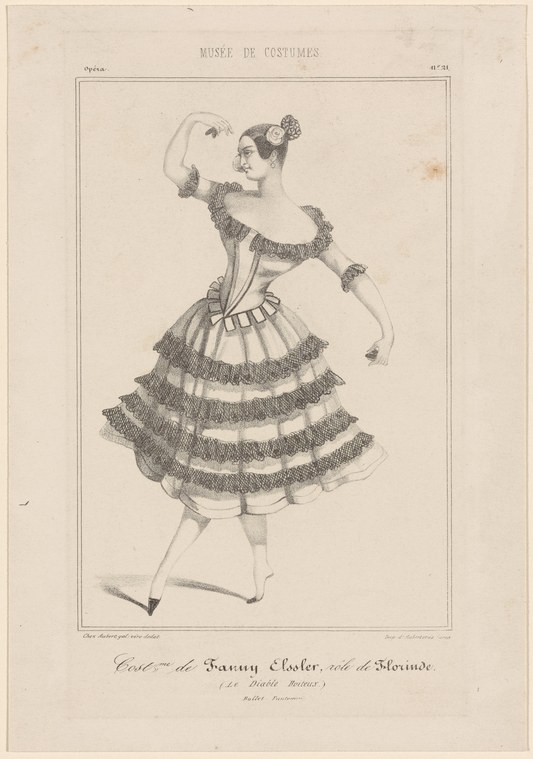
Costume de Fanny Elssler, rôle de Florinde. (Le diable boiteux). Ballet-pantomime
Unknown artist
- Collection:
- Prints depicting dance
- Source:
- New York Public Library
- Rights:
- Public domain — free to use, share and adapt.
- Recorded as:
- Public Domain
Fanny Elssler was one of the defining figures of Romantic ballet, and this print is a primary document of her theatrical presence and costume practice. For historians of 19th-century dance and dress, the image provides precise detail about the construction and ornamentation of stage costume in the 1830s, a period less well-documented through surviving garments than through such prints.
What you are looking at
A single female dancer is shown in a three-quarter pose against a plain background, captured mid-movement in an elegant contrapposto stance. She wears an off-shoulder dress with short, puffed sleeves trimmed in decorative banding, and a voluminous skirt composed of multiple horizontal tiers of flounced ruffle, each edged with scalloped or pleated trim. The skirt is gathered at the waist with a decorative band and falls to just below the knee, revealing her legs and pointed shoes. Her hair is arranged in a neat knot at the back of her head. Her left arm is raised with the hand near her face in a graceful gesture, while her right arm hangs at her side with the hand extended outward. Her body is held upright but with a slight turn, and her weight appears distributed evenly, suggesting a moment of poised equilibrium rather than vigorous movement. The figure is rendered in fine pencil or engraved line work, with careful attention to the texture and structure of the costume.
The dancing
The dancer stands alone in an elegant, frontal presentation with the body turned slightly to the left. Her raised left arm, with hand positioned near the face, creates a refined upper-body frame characteristic of early 19th-century theatrical dance. The extended right hand and the slight inclination of the torso suggest either a moment of narrative gesture or the preparation for a travelling step. Her feet are pointed and precisely positioned, indicating trained technique. The overall posture is upright and controlled, with no indication of weight transfer or vigorous elevation—this is a pose of display rather than dynamic action.
The dance depicted
This is a costume study for Fanny Elssler, the Austrian prima ballerina, in the role of Florinde from *Le Diable boiteux* (*The Lame Devil*), a ballet-pantomime that premiered in Paris in 1836. Elssler was one of the most celebrated dancers of the Romantic era, and this image documents her appearance in a major vehicle of her artistry. The costume—with its off-shoulder neckline, short sleeves, and tiered skirt—is typical of the Romantic ballet silhouette of the 1830s, though here the skirt is notably shorter and more flounced than the full-length tutus Elssler wore in her most famous roles. The image preserves the theatrical dress codes of the period and suggests the kind of semi-demi character role (neither full classical ballet nor Spanish dance) that *Le Diable boiteux* called for.
How it was made
This is a finely executed engraving or etched line drawing, identifiable by the uniform hatching and precise parallel lines used to model form and create shadow, particularly visible in the rendering of the fabric folds and the bodice. The technique allows for the sharp definition of the costume's construction and the delicate articulation of the decorative banding and ruffles. Such prints were produced and distributed widely in Paris during the 1830s and 1840s as souvenirs of major theatrical performances and as promotional images of celebrated dancers. The inscription at the bottom—visible in the original but identifying the role and dancer—confirms this as a theatrical document intended for circulation among the opera-going public.
About this work
This is a documentary engraving of the Romantic ballet era, recording the stage appearance of one of the period's greatest dancers in a specific role. It belongs to a large body of theatrical prints produced in Paris during the 1830s–1840s to commemorate performances at the Opéra and to distribute images of celebrated artists to their public. The work is valuable both as a costume document—showing the precise cut and trimming of a Romantic-era theatrical dress—and as a historical record of Fanny Elssler's practice as a performer. For dance historians, it offers direct visual evidence of how a leading dancer of the Romantic period presented herself on stage, and what the aesthetic conventions of theatrical dress were in an era when the tutu was still evolving from the longer skirts of earlier decades.
How to look at it
Attend to the precision of the costume detail: the way the ruffles are layered and trimmed, the cut of the bodice, the positioning of the sleeves. These elements are rendered with the clarity that only an engraving can achieve, making this a reliable document of Romantic-era stage dress. The dancer's pose is a presentation rather than a frozen moment of choreography—she is shown as an image for the viewer to admire, not in the midst of a step or a turn. The raised arm and averted gaze, combined with the formal frontality of the composition, are conventions of theatrical portraiture from this period, designed to showcase the dancer's beauty and bearing rather than her movement.
The artist
The artist is not recorded in the catalogue. However, the technique and the inscription format are consistent with the work of Parisian theatrical printmakers of the 1830s–1840s, a period when such images were produced in large numbers by both named and anonymous engravers for the publisher Musée de Costumes and similar enterprises. The quality of the draftsmanship and the precision of the costume detail suggest a professional theatre illustrator with access to costume pieces or rehearsal drawings.
The period
This engraving dates to the Romantic era of ballet, approximately 1836–1850, when Paris was the centre of European dance and the Opéra its most prestigious stage. Fanny Elssler's career peaked in this period; she was a rival and contemporary of Marie Taglioni, and while Taglioni embodied the ethereal, otherworldly aesthetic of high Romantic ballet, Elssler was celebrated for her dramatic presence, her technical brilliance, and her ability to perform both classical and character roles. *Le Diable boiteux* was one of several vehicles that showcased her versatility and her appeal to Parisian audiences. The costume—with its blend of classical restraint and theatrical richness—reflects the period's evolving ideal of stage dress, moving away from the heavy skirts and ornamentation of earlier decades toward the lighter, more mobile silhouettes that Romantic pointe work required. Theatrical prints like this one were a major medium for disseminating images of dancers and performances throughout Europe, functioning as both souvenirs and promotional material.
Where it lives
This print is held in the New York Public Library's collection of prints depicting dance, catalogued under the heading Musée de Costumes. It is one of many similar theatrical costume prints produced in 19th-century Paris, many of them now dispersed among institutional collections in the United States and Europe.
Dance in this work
Questions about this work
Who was Fanny Elssler?
Fanny Elssler (1810–1884) was an Austrian-Italian ballerina who was one of the most celebrated dancers of the Romantic era. She performed primarily in Paris and Vienna, and was known for her dramatic presence, her technical skill, and her ability to dance both classical ballet and character roles. She was a major rival of Marie Taglioni and had a profound influence on dance throughout Europe and the Americas.
What is *Le Diable boiteux*?
*Le Diable boiteux* (*The Lame Devil*) was a ballet-pantomime that premiered at the Paris Opéra in 1836. It was based on a popular Spanish picaresque novel and featured a diabolic character who meddles in human affairs. The ballet gave Elssler an opportunity to perform a character role that showcased her dramatic abilities alongside her technical skill.
How were theatrical prints like this one used?
Prints documenting dancers and their costumes were produced and sold to the opera-going public as souvenirs of performances. They also served as promotional images, distributed to advertise coming performances and to build the fame and marketability of celebrated dancers. They were collected, framed, and kept as mementos of attendance at important theatrical events.
What does the costume tell us about Romantic ballet?
The short, tiered skirt with decorative ruffles is characteristic of Romantic-era ballet costume, which favored lighter, more mobile garments than earlier styles. The off-shoulder neckline and short puffed sleeves emphasize the dancer's upper body and arms, which were essential to the expressive gestural language of Romantic ballet. The costume balances classical elegance with theatrical richness.
More dance artwork





