49 works in this view — arrow keys or swipe to move between them.
Dance in Art
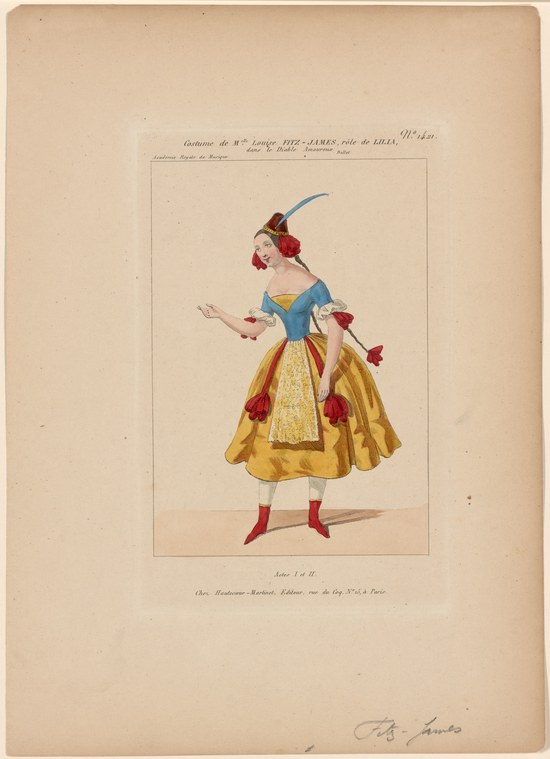
Costume de Melle Louise Fitz-James, rôle de Lilia, dans Le diable amoureux, ballet, actes I et II
Unknown artist
- Collection:
- Prints depicting dance
- Source:
- New York Public Library
- Rights:
- Public domain — free to use, share and adapt.
- Recorded as:
- Public Domain
This is a named dancer in a named role in a named production, documented with professional precision at a moment when few such records existed. It provides rare evidence of how a specific performer embodied a character and what the visual and material expectations of a major ballet role actually were—not inferred from librettos or later accounts, but recorded from theatrical practice.
What you are looking at
A solo female dancer in theatrical costume stands in a three-quarter pose against a plain background, her body caught in a moment of graceful presentation rather than active movement. She wears a blue bodice with a dramatically full skirt of golden-yellow silk or satin, gathered and voluminous, with deep red velvet decoration forming large rosettes or bows distributed across the skirt's surface. A matching red velvet headdress with a tall, curved plume rises from her head. Her arms are positioned expressively—one raised with palm open in a gesture of presentation or invitation, the other relaxed at her side. She wears red stockings and red heeled shoes, her stance poised and upright, weight distributed evenly in a position of readiness rather than mid-movement. The figure is rendered in hand-colored engraving or etching against a buff ground, with subtle shadow beneath her feet suggesting stage space.
The dancing
A single dancer, posed frontally with subtle weight shift to one leg. The raised arm and open palm convey a theatrical gesture of address or offering—a hallmark of courtly or ballet spectacle rather than vigorous movement. Her torso is held upright with lifted chest; the neck is elongated and poised. The costume's weight and volume dominate the composition, suggesting the garment itself is a primary spectacle element. There is no evidence of turned-out legs, pointe work, or the dynamic extension typical of later ballet technique.
The dance depicted
This is a costume design document for a ballet dancer in a specific historical role: Lilia in *Le Diable amoureux* (The Amorous Devil), a multi-act ballet. The inscription names the dancer as 'Melle Louise Fitz-James' and specifies this as the costume for Acts I and II. The pose and presentation suggest a grand ballet of the Romantic era, where costume and visual spectacle were as important as movement vocabulary. The dancer's posture—formal, presentational, with expressive arms—reflects the dramatic mime and noble carriage of mid-19th-century ballet rather than pure choreographic abstraction.
How it was made
A hand-colored engraving or etching, likely a costume plate from a theatrical publication or archive. The delicate line work, subtle shading, and precise rendering of fabric texture—particularly the contrast between the matte bodice and the lustrous, gathered skirt—indicate professional theatrical documentation. The hand-coloring is carefully applied and restrained, allowing the engraved line to remain visible. This technique was the standard mode of distributing costume designs and performance records before photography, allowing multiple copies to circulate among dancers, companies, and audiences interested in the production.
About this work
This is a costume design study for a named dancer in a specific historical ballet production, documenting the visual spectacle and sartorial grandeur of mid-19th-century romantic ballet. The work serves both as a record of performance practice and as a design artifact—a communication tool between artist, dancer, and company about what the role should look like on stage. The full, richly decorated skirt, the formal pose, and the theatrical headdress all signal the conventions of grand ballet at a moment when visual and narrative spectacle were central to the form.
As a document, this print occupies the borderland between fine art and theatrical ephemera. It records not a moment of choreographic action but a moment of presentation and character—the dancer as the role, paused for visual inspection. The work belongs in a dance archive not only as art history but as performance history: it tells us what Louise Fitz-James was meant to look like, and therefore something about the aesthetics, labor, and visual culture of ballet in its Romantic heyday.
How to look at it
Notice the careful balance between the dancer's body and the costume. The pose is not a moment of extreme virtuosity or extension—there is no indication of pointe work, no dramatic arabesque or attitude. Instead, the artist has frozen a moment of theatrical presentation, where the role is embodied through posture, gesture, and dress rather than through technical display. Observe how the eye is drawn equally to the figure and to the costume itself: the skirt's volume and decoration are as much the subject as the dancer's body. This reflects a Romantic-era principle that the ballerina was the vehicle for a fantasy or narrative, not yet the primary site of abstract movement innovation.
The artist
The artist is not recorded in the catalogue. The work is likely a professional costume design or documentation print, possibly commissioned by the theater company or the dancer, or published in a theatrical journal or performance record. Such prints were typically created by theater artists or engravers specializing in costume documentation; they were commercial and practical rather than fine-art objects, though they were executed with considerable skill and aesthetic care.
The period
This work dates to the height of Romantic ballet in Europe, likely the 1830s–1850s, when ballet was dominated by the pointe-dancing ballerina, elaborate pantomime narratives, and increasingly exotic or fantastic scenarios. *Le Diable amoureux* was a popular ballet scenario in this period, with versions choreographed and performed across European stages. The costume design reflects the aesthetic of the era: the full, layered skirt (precursor to the later tutu), the emphasis on vertical line and graceful port de bras, and the integration of character elements (the headdress) into the overall visual composition. Hand-colored costume plates were a primary medium of theatrical documentation and circulation before photographic reproduction became standard in the 1870s–1880s.
Where it lives
The work is held in the New York Public Library's collection of prints depicting dance. It is a documentary artifact from the history of theatrical production rather than a signed fine-art print, though it was created with professional skill and aesthetic intention. Such prints were often bound into collections or published in theatrical journals and archives.
Dance in this work
Questions about this work
Who was Louise Fitz-James?
Louise Fitz-James was a professional ballet dancer active in the mid-19th century, known for performing in major Romantic-era ballets. She danced principal roles in ballets including *Le Diable amoureux*. Beyond cast lists and costume records like this one, biographical details are sparse in surviving archives, but her name appears in playbills and performance documents of the period.
What is *Le Diable amoureux*?
*Le Diable amoureux* (The Amorous Devil) was a popular ballet scenario with multiple versions choreographed in the 19th century. It typically featured a devil character seducing or tormenting a mortal protagonist, playing on Romantic-era fascination with supernatural and exotic narratives. The ballet combined pantomime, spectacle, and dance in the conventions of grand ballet.
How was this print made?
This is a hand-colored engraving or etching, a standard technique for theatrical documentation in the 19th century. An artist first created the design; an engraver transferred it to a copper plate; impressions were printed and then carefully colored by hand (often by multiple hands in a workshop). This allowed multiple identical copies to be produced and distributed.
Why is the pose so formal?
Costume plates documented how a dancer should look in a role, not how they moved during choreography. The standing pose allowed the full costume to be displayed clearly. The expressive arm gesture signals character and theatrical intention rather than capturing a moment of active dancing—this was standard practice in costume documentation of the period.
More dance artwork





