49 works in this view — arrow keys or swipe to move between them.
Dance in Art
Jullien's original mazurka, or the Cellarius valse
Unknown artist
- Collection:
- Prints depicting dance
- Source:
- New York Public Library
- Rights:
- Public domain — free to use, share and adapt.
- Recorded as:
- Public Domain
This work is evidence of the moment when ballroom dance became spectatorial entertainment and when choreographers like Jullien elevated couple dances to the status of theatrical events worthy of documentation and promotion. It shows the mazurka at the height of its European fashion and documents the Cellarius method at the precise moment it was reshaping waltz technique and etiquette. For dance historians, it is also a window into the dress, posture, and spatial arrangement of ballroom dancing before photography—a trained eye can read the period style from the frame and hold.
What you are looking at
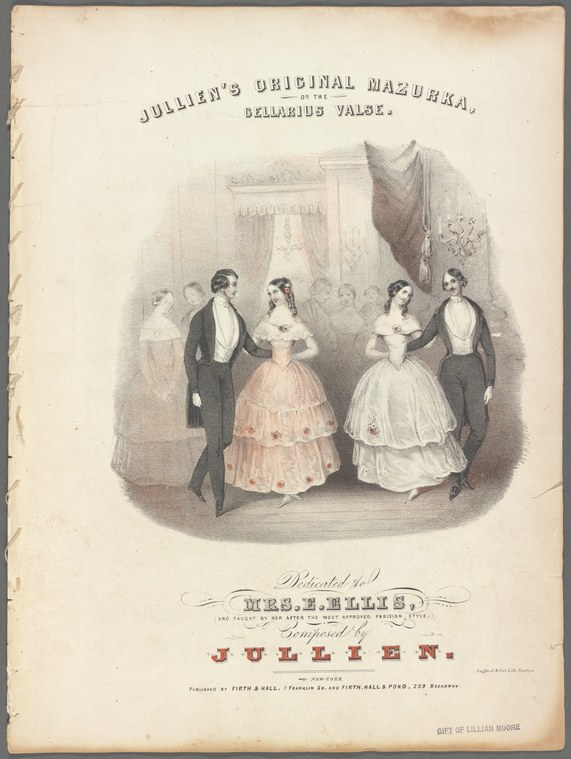
A formal ballroom scene rendered in soft tones, likely a lithograph or hand-colored print. Four couples are arranged across the composition in a staggered line, positioned as if mid-dance or about to begin. The setting is an elegant interior with drapery visible at top left and an arched doorway or alcove. Two women in the foreground wear expansive skirts—one in pale pink, one in white—both with the characteristic bell shape and multiple tiers of flouncing associated with 1840s fashion. They face men in dark tailcoats and white shirt fronts. Additional couples and onlookers are visible in softer focus in the background. The lighting is even and theatrical, with no strong shadows, emphasizing the formal arrangement. The composition has the character of a printed sheet music cover or theatrical souvenir: it documents a specific choreographic moment rather than capturing spontaneous movement.
The dancing
The dancers are shown standing or moving with restrained, upright posture characteristic of ballroom etiquette of the period. The two foremost couples are clearly differentiated: the woman in pink reaches slightly toward her partner, while the woman in white stands more formally. The men maintain the closed frame position conventional to European partner dance of the era, with one arm extended and the other at the small of the back. The skirts are voluminous enough to suggest rotational movement but are caught at a static moment. The ensemble suggests trained, choreographed sequence rather than improvisation—all figures are aligned to the picture plane.
The dance depicted
The title explicitly names two dances: the mazurka and the Cellarius waltz. This is a choreography featuring both dances, likely in sequence. The Cellarius waltz refers to the teaching method and standardized form promoted by Joseph Cellarius, whose *The Art and Etiquette of Dancing* (1847) had just codified the waltz for respectable society. The mazurka, a Polish couple dance in 3/4 time with characteristic accent on the second or third beat, was fashionable in European ballrooms during the 1840s–50s. The print documents a specific theatrical or exhibition performance—the framing and composition suggest this was choreography created for a known performer or company, likely featuring the popular dancer or choreographer Jullien. The women's elaborate dress and the formal interior setting indicate this was an aristocratic or upper-middle-class entertainment.
How it was made
This is a hand-colored lithograph, identifiable by the soft modeling of tone, the crayon-like quality of the lines, and the characteristic register and composition of 1840s theatrical prints. The technique allowed rapid, economical production of promotional material—likely printed in quantity as a souvenir or advertisement. The hand-coloring (visible in the pink and white of the skirts and the tonal gradation of the background) was applied by skilled workers in the printshop, making each impression slightly different. This mode of production means the work was made for wide circulation among theatregoers and dance enthusiasts, not as a unique artwork.
About this work
This is a titled choreographic print documenting a fashionable ballroom dance of the 1840s combining two dances: the mazurka and the Cellarius waltz. It was almost certainly created as a souvenir of a theatrical performance or exhibition, printed and hand-colored for sale to the middle and upper-class audience who attended such events. The image preserves not only the costume and setting of the period but the formal arrangement and decorum of a specific staged dance sequence—a moment in the professionalizing and theatricalization of ballroom dance in the nineteenth century. Jullien's name suggests this was associated with a known performer or choreographer whose work attracted sufficient popular interest to merit printed commemoration.
How to look at it
Attend to the posture and frame of the dancers: they maintain a formality and an upright carriage that contrasts sharply with modern ballroom dancing. The position of the arms, the distance between partners, and the restraint of the torso are all specific to the Cellarius method and the aesthetic ideal of the 1840s. Notice the progression from foreground to background—the composition freezes a particular instant in what was a continuous choreographic sequence, and the arrangement of couples suggests movement is about to happen or has just concluded. The lithographer has chosen a moment of readiness and presentation rather than dynamic action, a choice that tells you that this is a print made for a sitting room or sheet music collection, not a capture of theatrical spectacle.
The artist
The artist is not recorded in the catalogue. The print was published by Firth & Hall, a major New York music and theatrical print house, who published sheet music, theatrical souvenirs, and dance instruction material. The lithographer is unnamed but was working within a well-established commercial practice of creating promotional prints for theatrical performers and choreographers. The quality and finish suggest a professional shop, not an amateur production.
The period
The 1840s–50s were the zenith of European ballroom culture in the Western world, when the waltz had been domesticated into respectable society and the mazurka was newly fashionable, imported from Poland through the aristocratic drawing rooms of France and England. Joseph Cellarius's *Art and Etiquette of Dancing* (1847) represented a new level of standardization and systematization of partner dance technique. At the same time, theatricalized versions of these dances—performed by professional dancers and choreographers in public halls—began to blur the line between social dance and theatrical performance. This print sits at that intersection: it documents a moment when ballroom technique was becoming codified, when dance was becoming a subject for commercial promotion, and when the performance of fashionable dances could attract an audience beyond their practitioners.
Where it lives
This is a hand-colored lithographic sheet from the NYPL Prints collection, labeled as depicting dance. It is a commercial theatrical souvenir or sheet music cover, likely produced in the 1850s or shortly thereafter. No accession number, acquisition date, or previous owner history is recorded.
Dance in this work
Questions about this work
What is the Cellarius waltz?
The Cellarius waltz was the standardized, respectable form of the waltz taught by Joseph Cellarius in the 1840s. Cellarius codified the technique, posture, and etiquette of partner waltzing in his influential instruction manual, establishing rules about frame, hold, and partnering that defined ballroom waltzing for decades. It represented a departure from earlier, less formalized waltz styles and was designed to make the dance socially acceptable in aristocratic and upper-middle-class drawing rooms.
Who was Jullien?
The catalogue does not identify Jullien beyond the title. The name likely refers to either a choreographer or a celebrated dancer of the period. The fact that this print was commissioned with his name suggests he was a known figure in the theatrical dance world of the 1840s–50s, popular enough to merit a published souvenir of his choreography.
How do we know this is a lithograph?
The soft tonal modeling, the crayon-like quality of the lines, the characteristic way the background is rendered, and the overall composition are all diagnostic of lithographic printing. The technique is further confirmed by the hand-coloring, which was a standard finishing step for theatrical and commercial lithographs of this period. The printing history recorded on the sheet (Firth & Hall) also confirms this: they were a major lithographic printer.
What does the dress tell us about when this was made?
The women's skirts—bell-shaped, layered with ruffles, very full—are unmistakably from the 1840s–50s. The men's tailcoats and white shirt fronts are period-appropriate formal wear. The style of the interior drapery and the overall composition suggest a date in the mid-nineteenth century, consistent with the emergence of Cellarius's teaching and the peak popularity of the mazurka in Europe.
More dance artwork





