49 works in this view — arrow keys or swipe to move between them.
Dance in Art
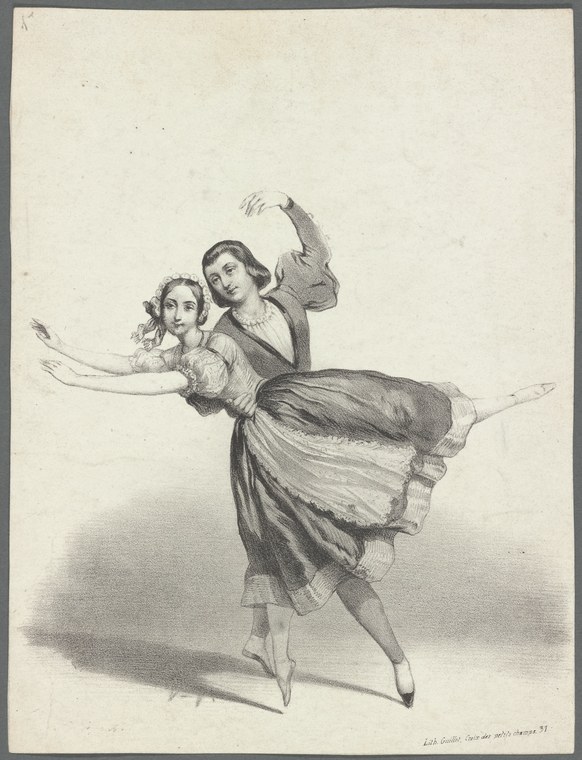
Nathalie Fitzjames and Auguste Mabille dancing in Giselle
Unknown artist
- Collection:
- Prints depicting dance
- Source:
- New York Public Library
- Rights:
- Public domain — free to use, share and adapt.
- Recorded as:
- Public Domain
This print documents a crucial technical and aesthetic moment in ballet history—the romantic-era lift—and preserves the image of dancers who were celebrated enough to merit commercial reproduction. For anyone studying how romantic ballet was actually performed, this is primary evidence of body position, costuming, and partnering practice.
What you are looking at
A lithograph showing two dancers in a moment of theatrical lift and turn, captured mid-movement against a plain background with subtle shading beneath them. The male dancer, in dark jacket and light trousers, supports and propels the female dancer upward and outward; she is airborne, her body extended and tilted, her left arm raised and right arm outstretched for balance. She wears a romantic-era tulle skirt that billows and catches the light, along with a fitted bodice and what appears to be a headdress or flower in her dark hair. Both dancers' faces are turned toward the viewer, their expressions engaged and focused. The composition emphasizes the verticality and drama of the lift—a moment of apparent weightlessness frozen mid-performance. The printing technique and the careful gradation of tone create dimensionality despite the minimal setting.
The dancing
The male dancer is in a deep supporting position, his body angled to provide leverage for the lift; the female dancer is elevated, her weight controlled by his grip (likely at her waist), her upper body arched backward in a line of extension. Her legs are not clearly visible beneath the tulle skirt, but her upper body alignment and the angle of her shoulders suggest control and training. This is a partnered lift requiring significant technical skill from both dancers: the man must support and propel, the woman must yield and extend while remaining centered. The intimacy and coordination of the hold—a feature of romantic ballet—is unmistakable.
The dance depicted
This is romantic-era ballet, almost certainly a pas de deux or highlighted moment from a full-length ballet. The catalogue identifies the dancers as Nathalie Fitzjames and Auguste Mabille in Giselle, which is plausible; Giselle (first performed 1841) was a flagship romantic work featuring such lifts. The image captures a typical romantic moment—the male as active supporter, the female as ethereal and weightless—that defines the aesthetic of the period. The dress, the lift technique, and the theatrical presentation all align with 1840s–1860s ballet practice. The image appears to document a specific performance or famous partnership, though without inscription visible in the print itself, identification relies on the catalogue record.
How it was made
This is a lithograph, a planographic printing process in which an image is drawn on stone and printed. The artist has used subtle tonal gradation (crayon work) to model the figures and suggest the space around them; the shading beneath the dancers' feet creates the illusion of a lit stage. Lithography allowed rapid reproduction and circulation of dance imagery to a wide audience—prints like this were affordable souvenirs and promoted dancers and productions. The technique's capacity for fine detail and tonal variation made it ideal for capturing the delicate fabrics and expressive poses of romantic ballet. This print was likely produced as a commercial promotional object, distributed to theater patrons, critics, and dance enthusiasts.
About this work
This lithograph documents a celebrated moment in romantic ballet—the lift, that dramatic display of male strength and female weightlessness that defined the aesthetic of the 1840s–1860s. It records (by catalogue attribution) Nathalie Fitzjames and Auguste Mabille performing in Giselle, one of the era's most important works. The image is both an artwork capturing a specific historical partnership and a technical study of romantic ballet technique: the hold, the extension, the costume, the moment of suspension. It belongs in a dance archive because it preserves not just a celebrated performance but the embodied practice of romantic ballet at its height.
How to look at it
Observe the line of the female dancer's body—the arch from her extended left arm down through her torso—and how the male dancer's positioning beneath her makes that line possible. Notice how the tulle skirt, caught mid-motion, serves a visual function: it emphasizes weightlessness and catches light in a way that a rigid or heavier skirt would not. The lithographic gradation of tone is doing work too: the shading beneath the figures anchors them to a stage while the plain background keeps attention on the bodies. This is a moment of suspension, not a step; the artist chose the instant of lift rather than descent or preparation.
The period
The romantic ballet era (roughly 1830–1870) elevated the female dancer and the illusion of weightlessness as its central aesthetic. Lifts and supported arabesques became signature technical displays, showcasing the male dancer as enabler of the female dancer's otherworldly presence. Giselle (1841) was one of the canonical works of this movement, and dancing in it was a mark of international prestige. Commercial lithographs of celebrated dancers were a major medium for promoting performances and cementing performers' reputations; they circulated widely and were collected by audiences. This print reflects both the artistic values of romantic ballet and the commercial infrastructure that supported it.
Where it lives
This print is held in the New York Public Library's collection of prints depicting dance. It appears in that collection as a record of theatrical dance imagery and may be part of a larger acquisition of romantic-era dance prints.
Dance in this work
Questions about this work
Is this from an actual performance?
The catalogue identifies the dancers as Nathalie Fitzjames and Auguste Mabille in Giselle. Both were celebrated dancers of the mid-19th century, and Fitzjames was particularly renowned in romantic roles. Whether this lithograph was drawn from a specific performance or is a composite theatrical image is not recorded, but the detail suggests it had a real performance as its source.
What is the tulle skirt and why does it matter?
Tulle is a fine, lightweight net fabric that became standard in romantic ballet. It allows visibility of the dancer's legs and feet while creating an ethereal silhouette. The way it catches light and moves in the air was central to romantic aesthetics—it made the female dancer appear weightless and otherworldly, exactly what the romantic era valued.
What dance technique is this showing?
This is a supported lift, likely an *emboîté* en l'air or a variant where the male dancer lifts the female dancer into the air while she maintains an extended, arched position. It requires the male dancer to have the strength and control to support her full weight while she remains centered and graceful—a hallmark of romantic partnership.
More dance artwork





