49 works in this view — arrow keys or swipe to move between them.
Dance in Art
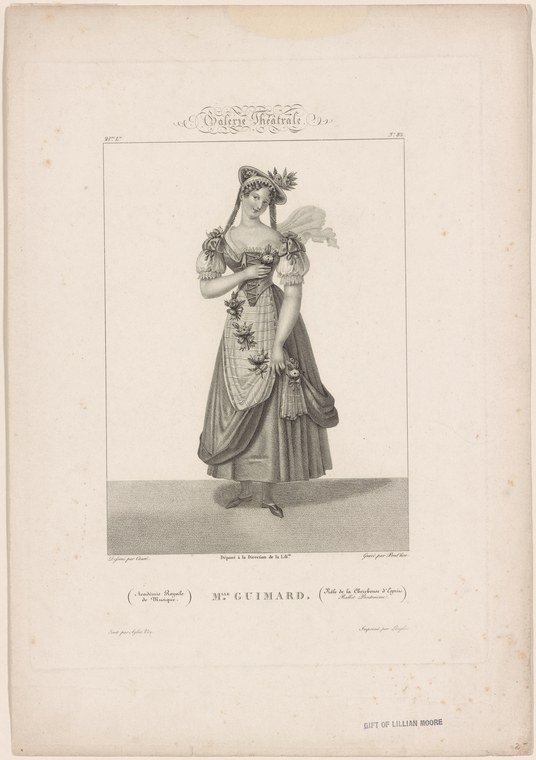
(Académie Royale de Musique). Mlle. Guimard. (Rôle de la Chercheuse d'esprit, ballet pantomime).
Unknown artist
- Collection:
- Prints depicting dance
- Source:
- New York Public Library
- Rights:
- Public domain — free to use, share and adapt.
- Recorded as:
- Public Domain
Mlle. Guimard was one of the most celebrated dancers of the late 18th century, and this print is a primary record of how she was visually and socially constructed for her audience. The image preserves evidence of theatrical costuming, the physical presentation of female dancers in the neoclassical period, and the genre of ballet-pantomime—a form now largely lost to history. For dancers and historians, the work is invaluable as a document of professional theatrical practice at the Opéra.
What you are looking at
A single female dancer stands in three-quarter view against a plain background, dressed in an elaborate theatrical costume of the late 18th century. She wears a corseted bodice with draped sleeves, a full skirt with decorative swags and fringe, and a laurel wreath crowns her hair. In her left hand she holds a large feathered fan or plume; her right arm extends gracefully to the side. Her pose is formal and statuesque, with weight centered and body held upright in the manner of stage presentation. The figure occupies the center of the composition, and the engraver has rendered fine detail in the costume's ornamentation while keeping the setting austere—a thin baseline suggests a stage floor. The inscription identifies her as Mlle. Guimard in the role of La Chercheuse d'esprit (The Seeker of Spirit) from a ballet-pantomime.
The dancing
The dancer's posture is one of dignified presentation rather than active movement—the body is upright and elongated, the frame open and frontal. Her left arm holds the accessory at mid-body while the right arm extends into a half-second or attitude position, not forcefully but with a delicate extension. The weight appears evenly distributed; there is no suggestion of jump, turn, or traveling steps. The overall carriage reads as a formal pose for display, typical of the convention of dance portraiture in this era.
The dance depicted
This is an image of a named dancer in a specific theatrical role from the Opéra in Paris. Mlle. Guimard was a celebrated ballerina of the mid-to-late 18th century, and this print records her in a pantomime role rather than a pure dance role. The ballet-pantomime genre combined narrative gesture, character expression, and dance; the costume and accessories suggest a role of elegance and allegory rather than dramatic action. The pose does not reveal the technique of the dance itself—no pointe work is possible or suggested, no specific ballet vocabulary is evident—but rather presents the dancer as an ornament of her role and the institution that employed her.
How it was made
This is an engraving, executed with fine burin lines and likely hand-finished with tonal shading or wash to create the gray values visible in the costume and background. The level of detail and the careful rendering of fabric, ornament, and physiognomy suggest a professional theatrical print made for circulation among patrons and the public. Such prints served to publicize performers and roles, and were often sold separately or collected in series. The technique allowed for exact reproduction and wide distribution, making this both a record of a historical performance and a commodity of popular demand.
About this work
This is a late-18th-century engraved portrait of the Paris Opéra dancer Marie-Thérèse Perdou, known as Mlle. Guimard, in the role of La Chercheuse d'esprit from a ballet-pantomime. It is a theatrical record—a named image of a named performer in a known work—and serves as evidence of the dress, presentation, and social standing of a major dancer of her time. The work belongs in a dance gallery because it documents both the costume and the bodily aesthetic of theatrical dance at the moment when ballet was transitioning from court to stage institution, and when the female dancer was emerging as a celebrated public performer. The image shows us not how the dance was executed but how it was valued and displayed.
How to look at it
Look at the costume as the primary text. The ornament, the cut of the bodice, the drape of the skirt, and the accessory (the fan or plume) are all intentional statements of role, character, and social rank. The pose itself is a theatrical convention—frontal, balanced, and designed to display the figure to an audience seated in a theater. The face and bearing suggest dignity and nobility of character, which the role name (The Seeker of Spirit) confirms. The engraver's choice to show the dancer at rest rather than in action is itself significant: it treats the dancer as a visual artwork rather than as an athlete, a convention of celebrity that persisted well into the 19th century.
The artist
The print is not attributed in the record. The style and inscription suggest it was made by a professional theatrical engraver working for the Paris Opéra or a commercial print publisher in the late 18th century. Such prints were often unsigned or signed only with a publisher's mark; the priority was the image of the dancer, not the artist's name.
The period
This print dates to the late 18th century, an era of rapid change in theatrical dance. The Académie Royale de Musique (the official name of the Paris Opéra) had recently elevated the status of professional dancers, and the female dancer was increasingly the star of the ballet. The costumes and aesthetic visible in this print—the high-waisted empire silhouette emerging, the neoclassical accessories, the formal presentation—reflect the shift from the heavy Baroque costume toward the leaner, more antique-inspired dress of the Revolutionary and Napoleonic period. Ballet-pantomime was a dominant genre of the era, blending narrative, gesture, and dance in ways that would evolve into Romantic ballet by the 1830s.
Where it lives
The print is held in the New York Public Library's collection of prints depicting dance. The catalogue designates it as part of the Académie Royale de Musique collection but does not record artist, date, or medium beyond the visual evidence of the object itself.
Dance in this work
Questions about this work
Who was Mlle. Guimard?
Marie-Thérèse Perdou (1743–1816), known professionally as Mlle. Guimard, was one of the most celebrated ballerinas of the late 18th century and a favorite of the Paris Opéra. She was celebrated for her grace, her acting ability in pantomime roles, and her elegance of movement. She was also known for her affairs and her salon, which made her a celebrity beyond the theater.
What is a ballet-pantomime?
Ballet-pantomime was a theatrical form popular in the 18th and early 19th centuries that combined narrative action told through gesture and facial expression with choreographed dance sequences. Dancers played characters in a plot and used stylized gestures to convey emotion and meaning, much as actors do, but they also performed danced passages. The form was a bridge between dance and drama.
What does the costume tell us?
The costume is allegorical and theatrical rather than realistic. The laurel wreath, the flowing drapery, and the ornate accessories suggest a classical or allegorical character—in this case, a seeker of wit or inspiration. The high waist and empire silhouette date the print to the late 18th century and reflect the neoclassical aesthetic that was fashionable in dress and theater design during the Revolutionary period.
Why is she posed standing still?
Theatrical dance portraits of this era almost always show the dancer in a formal pose rather than in mid-movement. This convention treated the dancer as a visual object to be admired and collected, much like a portrait of a nobleman or a heroine of literature. The pose is about display and celebrity, not about documenting actual technique.
More dance artwork





