49 works in this view — arrow keys or swipe to move between them.
Dance in Art
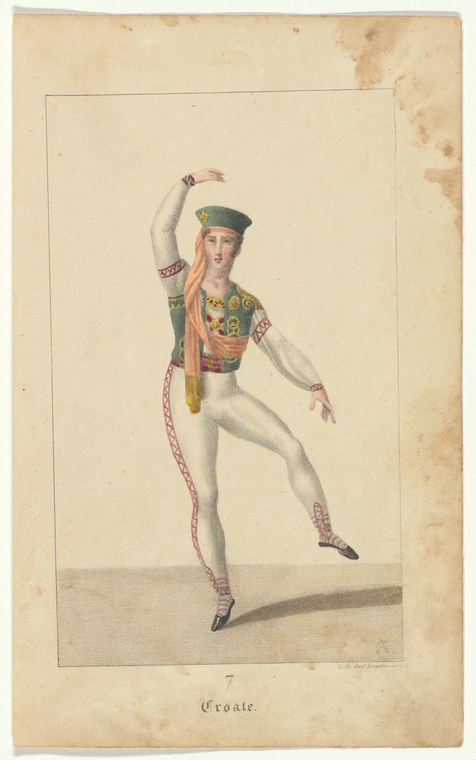
Dancers in Croatian costume
Unknown artist
- Collection:
- Prints depicting dance
- Source:
- New York Public Library
- Rights:
- Public domain — free to use, share and adapt.
- Recorded as:
- Public Domain
This image reveals how 19th-century theatrical culture represented non-European dance traditions: through technical virtuosity, romantic sensibility, and costume specificity applied to bodies trained in classical ballet vocabulary. For historians, it documents both the choreography and the circulation of such dances, and serves as evidence of how nationalism, exoticism, and theatrical fashion intersected in the era.
What you are looking at
A single figure in a dynamic, suspended pose dominates a neutral cream background. The dancer is captured mid-leap or mid-turn, with one leg extended behind and the other bent, the body tilted at a sharp angle to suggest forward momentum. The dancer wears an ornate embroidered jacket or tunic in deep green and gold, decorated with geometric patterns and embellishments, paired with white tights. A decorative rope or cord in pink/coral wraps around the lower legs and ankles. The head is crowned with a small green cap or headpiece, and the long pale hair streams to one side, emphasizing the sense of motion. One arm is raised above the head, fingers delicate, while the other extends outward for balance. The figure casts a shadow on the ground plane, grounding the composition despite the airborne quality of the pose.
The dancing
The dancer exhibits exceptional elevation and extension, with a vertical spine tilted sharply forward in a position requiring significant core control and flexibility. The raised arm carries the hand in an elegant, articulated gesture while the extended leg maintains a straight line from hip through foot. The turnout and articulation of the free leg, combined with the lifted quality through the torso, suggest a trained body with access to formalized movement vocabularies. The pose is a single-figure study in flight, not a partnered interaction.
The dance depicted
The costume—embroidered jacket, cap, wrapped leg bindings, and the title 'Croate'—identifies this as a figure from Croatian folk tradition or a theatrical interpretation thereof. The hyperextended, balletic quality of the pose suggests this is from a 19th-century theatrical or concert dance context rather than vernacular practice, likely a character dance or ethnic genre piece intended for European ballet or theatrical audiences. The impossible elevation and the stylized gesture are typical of Romantic-era ballet's treatment of 'exotic' or regional dances, in which non-European traditions were reimagined through the technical and aesthetic vocabulary of theatrical ballet.
How it was made
This is a hand-colored engraving or possibly a colored lithograph, as evidenced by the fine linear detail, the precise contours, and the careful application of color washes. The technique allowed for mass reproduction with the hand-coloring applied afterward, suggesting this was a popular theatrical print, likely issued as part of a series of character dances or national types. The quality of the engraving—the delicate line work in the embroidery detail and the precise articulation of the pose—indicates a skilled hand and a work intended for a cultivated audience.
About this work
This is a theatrical print of a Croatian dancer in character costume, rendered with the technical precision and romantic sensibility of 19th-century dance imagery. The figure is suspended in a balletically impossible leap, embodying the Romantic era's fascination with non-European traditions filtered through the vocabulary of classical ballet. The costume is richly specific—the embroidered tunic, the wrapped leggings, the cap—while the body and pose are entirely formalized and theatrical. As a colored engraving, it documents both how such dances were performed on European stages and how they were disseminated to a wider public through print culture. It belongs in a history of dance because it shows the technical and aesthetic values of a particular moment: the spectacularization of folk and ethnic dance by and for European theatrical culture.
How to look at it
Observe the impossible geometry of the pose: the height of the elevation, the extreme extension of the free leg, the articulation of the raised arm. These are not the movements of traditional folk dance but rather the idealized, balletic interpretation of folk material. Look closely at the embroidery detail on the jacket—the precision suggests the artist had either seen the costume directly or was working from a detailed description. The shadow grounding the figure paradoxically emphasizes the weightlessness of the pose, a characteristic of Romantic-era ballet imagery.
The artist
The artist is not recorded. The quality of the engraving and the style of coloring suggest a professional hand working within the commercial theater print trade of the 19th century, likely in a major European cultural center. Such prints were typically issued in series and sold as souvenirs of theatrical performances or as reference images for dance masters and choreographers.
The period
This dates to the era of Romantic ballet and the European fascination with national character dances. From the 1830s onward, European theaters incorporated 'exotic' and folk dances into ballets and theatrical spectacles, often as divertissements or in full-length works like *La Giselle* and *Le Corsaire*. Croatian, Hungarian, Spanish, and other regional dances were standardized, choreographed, and performed by trained ballet dancers in stylized costumes. Print culture played a crucial role in documenting and promoting these dances, allowing choreographers to share variations and allowing audiences to recall or study performances they had seen.
Where it lives
The work is held as part of the New York Public Library's collection of prints depicting dance. It is an example of commercial theatrical print production, likely issued and distributed in the 19th century as a popular visual record of staged performance.
Dance in this work
Questions about this work
Is this a real Croatian dance?
The costume is rooted in Croatian folk tradition, but the balletic pose and theatrical presentation are not. This is a European theatrical adaptation, designed for trained ballet dancers performing on stage. Such character dances drew inspiration from authentic regional traditions but were choreographed and stylized according to the aesthetics of Romantic ballet.
What is the rope around the legs?
This is a decorative wrapped binding, part of the folk-inspired costume. Such leg wrappings or bindings appear in various Southeast European folk traditions and were preserved in theatrical versions as markers of regional identity and authenticity.
How was this print made?
This is a hand-colored engraving or lithograph—a technique that allowed the design to be printed multiple times and then colored by hand, typically by artisans in a workshop. This made the image affordable and collectible for theater-goers and dance enthusiasts.
Why does the pose look so balletic?
Character dances and national dances in 19th-century European theaters were performed by trained ballet dancers and choreographed in the balletic idiom. The pose reflects both the training of the performers and the aesthetic values of the era, which favored elevation, extension, and the verticality of classical ballet.
More dance artwork





