49 works in this view — arrow keys or swipe to move between them.
Dance in Art
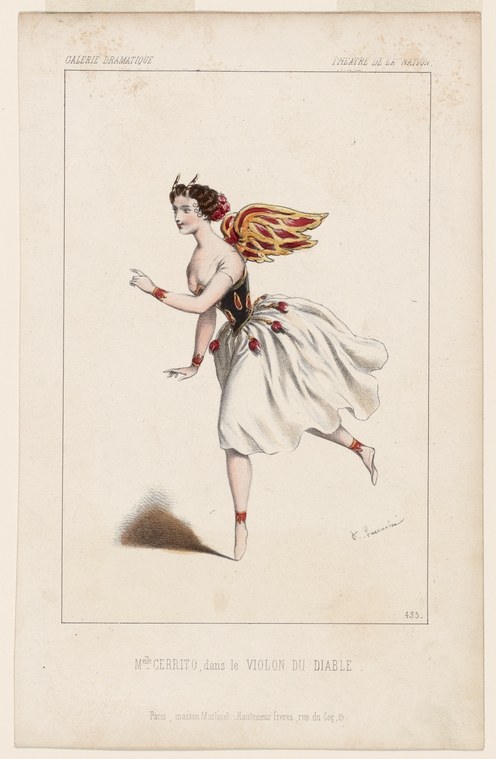
Melle Cerrito, dans Le violon du diable
Unknown artist
- Collection:
- Prints depicting dance
- Source:
- New York Public Library
- Rights:
- Public domain — free to use, share and adapt.
- Recorded as:
- Public Domain
Melle Cerrito was one of the most technically accomplished and celebrated ballerinas of the Romantic era, and this print preserves a record of how she was seen and celebrated in her own time. The image documents the physical and visual ideals of Romantic ballet at a moment when the genre was at the height of its European popularity, showing exactly what virtuosity and ethereal beauty meant to audiences of the 1840s–50s.
What you are looking at
A young female dancer is captured mid-leap against a plain beige background, her body suspended in a dynamic, weightless moment. She wears a white romantic-era tutu with layered skirts and a dark corset-style bodice with what appears to be a jeweled or ornamental belt. Her hair is styled up and crowned with what looks like a small tiara or decorative headpiece, and a flowing red and gold ribbon or scarf streams behind her in the air, amplifying the sense of motion. Her right arm is extended forward in an elegant line, while her left arm curves gracefully. Her posture suggests she is captured at the apex of a grand jeté or similar aerial step, her body angled dynamically across the picture plane. A shadow beneath her feet grounds her momentarily against the blank stage. The print bears a caption at the bottom identifying the dancer and the work.
The dancing
The dancer's body is extended in a classical balletic line—one leg appears to be bent while the other stretches behind, the torso held upright with the characteristic lifted carriage of Romantic-era ballet. Her arms frame the movement in the refined, naturalistic port de bras of the period, with the upper arm externally rotated and the wrist soft. The extended position of her limbs and the directional momentum suggest a traveling step executed with considerable height and control. The solitary figure dominates the composition, emphasizing the virtuosity expected of a named prima ballerina.
The dance depicted
This is almost certainly a scene from a Romantic-era ballet, most likely depicting Melle Cerrito in the lead role of *Le Violon du Diable* (The Devil's Violin), a work that capitalized on the supernatural and exotic themes popular in 1840s ballet. The pose and costume align with the ethereal, otherworldly characters typical of the Romantic ballet repertory—the light tutu, the upward lift, the sense of weightlessness and grace. Cerrito (1817–1909) was one of the most celebrated Italian ballerinas of her era and was known for her technical brilliance and theatrical presence. The image captures the ideal of Romantic ballet as it was performed and imagined: a solitary female figure, dematerialized and elevated, suspended in a moment of impossible beauty.
How it was made
This is a hand-colored lithograph or engraving, likely a promotional print made for circulation among ballet enthusiasts and theatre-goers. The delicate hand-coloring of the tutu, bodice, and ribbon—in shades of white, cream, red, and gold—is characteristic of theatrical prints of the 1840s–50s. The technique allowed for relatively rapid and affordable reproduction compared to oil painting, making such prints accessible to a wider audience than a unique artwork. The plain background and the careful attention to the dancer's silhouette and costume details suggest this was created from a live performance or a commissioned theatrical design, intended to memorialize a celebrated role and to advertise the dancer's skill and fame.
About this work
This is a Romantic-era theatrical print depicting the celebrated Italian ballerina Melle Cerrito in a starring role. The work captures the visual language and ideals of mid-nineteenth-century ballet at its height: a solitary female figure in the weightless, ethereal pose that defined the era's aesthetic. The hand-colored technique and careful composition indicate this was a commercial theatrical print, designed to circulate among ballet enthusiasts and to commemorate a notable performance.
The image is valuable as both a record of a specific dancer and role and as evidence of how Romantic ballet was marketed and remembered. The precision of the costume detail and the dancer's refined pose tell us how the role was understood—as a display of technical mastery combined with an almost supernatural lightness and grace. For dancers and historians, this is a primary document of mid-nineteenth-century ballet culture.
How to look at it
Pay attention to the moment the artist chose to freeze: the dancer is captured at the height of her leap, at the moment of maximum suspension and grace, rather than during the effort of takeoff or landing. This is characteristic of Romantic-era theatrical prints, which idealize and dematerialize the dancer rather than documenting the mechanics of movement. Notice how the flowing ribbon and the lifted posture create a sense of movement and weightlessness even in a static image. The refined costume and the solo focus emphasize the individual virtuosity and fame of the named dancer, which is typical of how mid-nineteenth-century ballet stars were marketed and remembered.
The artist
The artist is not recorded in the catalogue, but the print bears a signature (possibly "Lemoine" or similar) in the lower right, suggesting a professional theatrical artist working in the mid-nineteenth-century Paris print trade. Many such prints were created by anonymous or semi-anonymous artists contracted to capture famous dancers and roles for rapid commercial reproduction. The quality of execution and the careful attention to balletic convention suggest an artist familiar with theatrical dance and with the conventions of the Romantic ballet aesthetic.
The period
This print dates to the height of the Romantic ballet era in Europe, roughly 1840–1860, when ballet had become a dominant form of theatrical entertainment and when celebrated ballerinas achieved international fame and mobility. The 1840s saw the rise of the ethereal, otherworldly female dancer as the ideal—a figure associated with supernatural themes, exotic locales, and impossible physical feats. Major works of the period, such as *La Sylphide* (1832) and *Giselle* (1841), established the aesthetic and narrative conventions that Cerrito's role in *Le Violon du Diable* would have inherited. The print's style and technique are consistent with the flourishing trade in theatrical portraiture and celebrity imagery that developed alongside the growth of commercial theatre in Paris, London, and Milan.
Where it lives
This is a hand-colored theatrical print held in the New York Public Library's collection of prints depicting dance. It is one of many such commercial prints created in the mid-nineteenth century to memorialize celebrated ballet roles and dancers, and it reflects the popularity of Romantic ballet among a broad European and American audience.
Dance in this work
Questions about this work
Who was Melle Cerrito?
Fanny Cerrito (1817–1909) was an Italian prima ballerina of the Romantic era, celebrated for her technical brilliance, particularly in jumps and turns, and for her dramatic and theatrical presence. She was one of the most celebrated dancers of the 1840s–50s and performed in Paris, London, Milan, and Vienna. She was known for her collaboration with choreographer Jules Perrot and for her own choreographic work, and she retired from performing relatively young to focus on teaching.
What is *Le Violon du Diable*?
The title translates as *The Devil's Violin*. The work appears to be a mid-nineteenth-century Romantic ballet, likely a supernatural or fantastical themed piece that would have capitalized on the popularity of ethereal and otherworldly narratives. While details are limited, the title suggests a plot involving magic or diabolical intrigue—common themes in Romantic ballet. The work was evidently created as a vehicle for Cerrito's talents.
What does the ribbon/scarf signify?
In Romantic-era ballet, flowing scarves and ribbons were used both as costume elements and as devices to enhance the visual impression of movement and weightlessness. The ribbon's motion in the image contributes to the sense of the dancer being ethereal and otherworldly, a key aesthetic goal of the period. It may also have been a practical element of the costume within the choreography, used for dramatic effect or as a prop.
Why was this print made?
This print was created as a commercial theatrical souvenir and advertisement—a way of circulating the image of a celebrated dancer and role to a broad audience of theatre-goers and ballet enthusiasts. Such prints were sold in theatre lobbies and through print dealers, making them affordable mementos of a performance. They also served to build and maintain a dancer's fame and marketability.
More dance artwork





