49 works in this view — arrow keys or swipe to move between them.
Dance in Art
Fanny Elssler [inscribed on pedestal]
Unknown artist
- Collection:
- Prints depicting dance
- Source:
- New York Public Library
- Rights:
- Public domain — free to use, share and adapt.
- Recorded as:
- Public Domain
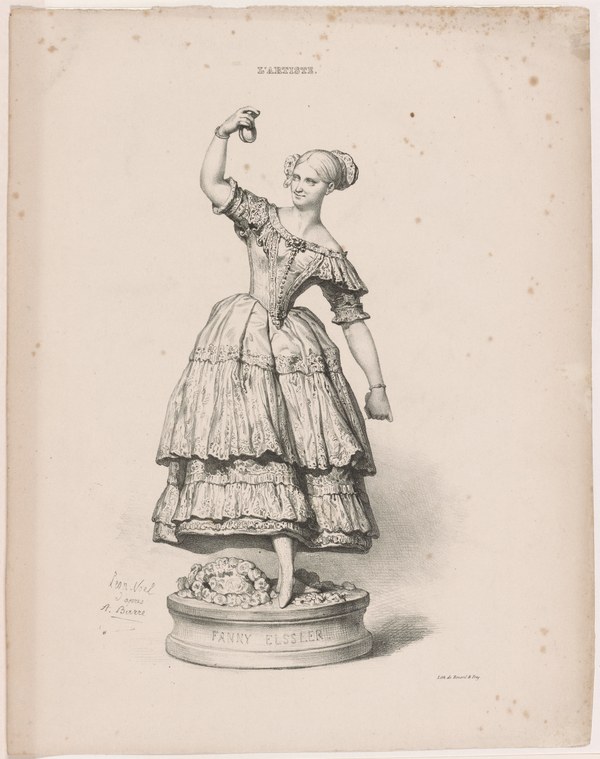
Fanny Elssler was a towering figure in dance history and the rivalry between her and Marie Taglioni shaped Romantic ballet itself; this engraving is a primary document of her celebrity and of how dancers were visualized and venerated in the 19th century. The image shows the balletic body and costume of the 1830s–1840s with anatomical and material precision, providing a visual record of the period's aesthetic ideals.
What you are looking at
A young woman in mid-19th-century dress stands on a circular pedestal inscribed 'FANNY ELSSLER', posed in a moment of theatrical exaltation. She wears a fitted bodice with short puffed sleeves over a full skirt with deep horizontal flounces that billow around her legs; her hair is drawn back in a snood. Her right arm is raised high, hand delicately curved, while her left hangs at her side with arm extended. Her body turns slightly, creating an S-curve through the torso. The pedestal beneath her feet is laden with flowers and wreaths, suggesting tribute or celebration. The engraving is rendered in fine lines against a cream ground, with careful attention to the fabric's gathered volume and the play of light across the skirt's layers.
The dancing
A single dancer, isolated and monumental. The raised arm extends high and curves inward with studied elegance; the supporting leg is straight and engaged, the free leg presumably in the working position that creates the body's slight turn. The frame is entirely vertical and frontal—a pose held for display rather than captured mid-motion. The silhouette emphasizes the balletic elongation of the arm line and the aristocratic carriage of the head, turned away from the viewer in three-quarter aspect. The body reads as weightless, the massive skirt defying gravity.
The dance depicted
This is Fanny Elssler, the Austrian ballerina who dominated European stages in the 1830s–1840s and was the chief rival to Marie Taglioni in the Romantic ballet era. The pose—the raised arm in its particular curve, the turned-out supporting leg, the ethereal port de bras—belongs unmistakably to ballet of the Romantic period. The skirt's length and construction (the short puffed sleeve worn over a fitted bodice) is characteristic of the 1830s–1840s Romantic tutu. Elssler was known for both dramatic intensity and technical precision, and the pedestal setting with floral tribute suggests this may commemorate a particular celebrated performance or may be a generic image of the dancer as icon rather than a specific moment from a ballet.
How it was made
This is an engraving—a print made from a metal plate incised with fine lines, as evidenced by the precise linear hatching that models form and shadow, the uniform cream paper, and the characteristic clarity of the printed line. Engraving was a reproductive and distributive medium: this image could be mass-produced and circulated, making it a primary vehicle for the celebrity of a major dancer to reach audiences beyond those who could attend performances. The delicate precision of the line work reflects the care taken to capture both the elegance of Elssler's carriage and the material reality of her costume.
About this work
This is an allegorical or commemorative portrait of Fanny Elssler, one of the two greatest ballerinas of the Romantic era, rendered as an engraved print. The work is characteristic of dance imagery of the 1830s–1840s: the dancer is isolated on a stage-like pedestal, dressed in the tutu and pointe-ready posture of Romantic ballet, posed in a moment of controlled grace rather than narrative action. The inscription on the pedestal and the floral wreath identify her as a celebrated figure worthy of monument and remembrance. This is not a scene from a specific ballet but rather a portrait of the dancer as icon—a type of image that was produced prolifically during this period to celebrate and memorialize the great dancers of the day, and to disseminate their image to a broad public.
How to look at it
Attend to the raised arm and its precise curve—this is not a naturalistic gesture but a codified balletic port de bras, trained and refined through years of technique. Notice the turn-out of the supporting leg and the position of the free leg (likely in dégagé or similar position, though the skirt obscures it). The pose is held and symmetrical, designed for frontal viewing like a statue: this is not a frozen moment from a dance but a formal portrait pose that displays the dancer's trained body and the aesthetic of Romantic ballet. The massive skirt, which would have been lighter in performance than the print suggests, exemplifies the period's obsession with the illusion of weightlessness and the visual dominance of the ballerina's silhouette.
The artist
The engraver's name is not recorded in the catalogue. The inscription 'Lith. & Imp. by M. Duval' at the bottom suggests this may be a lithograph rather than an engraving, and that Duval was the lithographer and printer. This does not contradict Elssler's identification but places the work in the commercial print market of mid-19th-century Europe, where celebrity portraits of performers were produced by specialized print workshops for popular sale.
The period
This engraving or lithograph belongs to the 1830s–1840s, the height of Romantic ballet. This was the era when the ballerina—not the male dancer—became the central attraction, when pointe work and the ethereal 'weightless' body became the technical and aesthetic ideal, and when the ballet skirt (the tutu) shortened and widened to frame the legs and emphasize the illusion of flight. It was also an era of intense celebrity culture around individual dancers, particularly Taglioni and Elssler, who toured Europe and the Americas and whose images were disseminated through prints, lithographs, and engravings. The pedestal and floral tribute format was a standard mode for commemorative dance portraiture of this period.
Where it lives
The work is part of the New York Public Library's collection of prints depicting dance. The inscription 'Lith. & Imp. by M. Duval' suggests it was produced in Paris or another major European print center as a commercial product for public sale, not as a unique work.
Dance in this work
Questions about this work
Was Fanny Elssler famous enough to warrant a statue?
No—this is not a statue but an engraved or lithographed print. However, Elssler was one of the two most celebrated dancers of her era and was regarded with the kind of adulation usually reserved for royalty or statesmen. Prints like this made her image accessible to a mass audience and served as a form of public monument to her fame and artistry.
Is this from a specific ballet?
No. This is a commemorative or allegorical portrait of Elssler as a dancer, not a scene from a ballet narrative. The pedestal and floral wreath are generic tributes to her celebrity, and the pose is a formal display of her trained body rather than a moment from any particular choreography.
Why is the skirt so big?
The full, gathered skirt (the tutu) was the defining silhouette of Romantic ballet in the 1830s–1840s. It emphasized the dancer's line, allowed visibility of the legs and footwork, and created an impression of weightlessness and ethereal beauty—the central aesthetic value of the period. The print may exaggerate the volume slightly, but the style is historically accurate to Elssler's era.
Who was Fanny Elssler?
An Austrian ballerina (1810–1884) who dominated European and American stages from the 1820s through the 1840s. She was the great rival of the Swedish ballerina Marie Taglioni, and their competition shaped the aesthetic and technique of Romantic ballet. She was known for both technical brilliance and dramatic intensity, and for her performance in character dances like the Cachucha.
More dance artwork





