49 works in this view — arrow keys or swipe to move between them.
Dance in Art
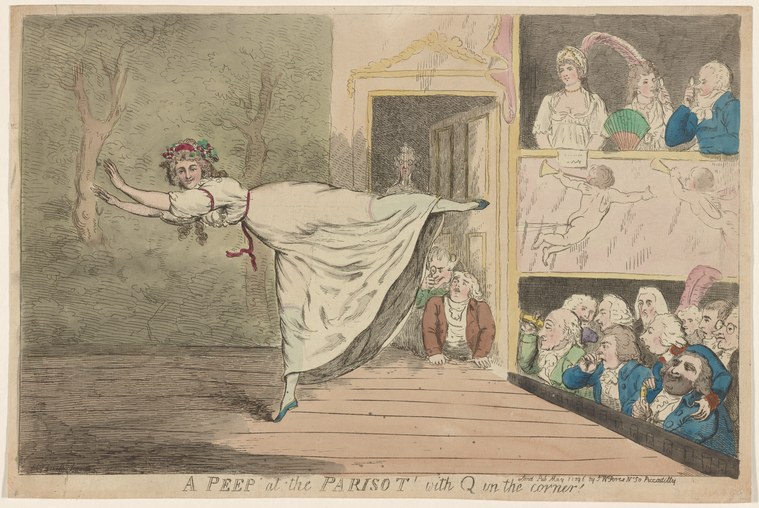
A peep at the Parisot with Q in the corner
Unknown artist
- Collection:
- Prints depicting dance
- Source:
- New York Public Library
- Rights:
- Public domain — free to use, share and adapt.
- Recorded as:
- Public Domain
This print documents a form of physical entertainment—likely acrobatic or contortion display—that has largely disappeared from historical view because it was ephemeral, performed by itinerant artists, and often dismissed as crude entertainment. Yet it reveals what the educated public paid to watch, and it shows us the lineage connecting 18th-century pleasure-garden performance to modern circus arts and athletic dance forms. The image itself is a primary source for understanding how bodies were displayed, watched, and circulated through print culture.
What you are looking at
A woman in a white neoclassical gown performs a dynamic leap or aerial pose before a doorway, her body suspended in mid-air with one leg extended, her torso arched backward, and flowers adorning her hair. She is framed by a tree on the left and a golden-trimmed doorway on the right, through which an older woman in brown dress peers out observing the performance. In the upper right, three fashionably dressed women (one holding a fan) watch from what appears to be a theater box or balcony. Below them, a crowd of heads fills another window or viewing space—men in various colored coats (blue, green) craning to see the spectacle. The composition stages this moment as a theatrical event with multiple nested audiences, each positioned at different vantage points, emphasizing the public nature of the display.
The dancing
The central dancer's body is hyperextended in a weightless, gravity-defying pose—arched backward with her torso nearly parallel to the ground, one leg kicked high, her arms raised. This is not a natural standing position but rather a moment of extreme flexibility and elevation, suggesting acrobatic training. The pose demands exceptional core strength and lower-body extension. Her isolation in the foreground against the architectural frame creates sharp visual contrast with the clothed, stationary observers positioned throughout the composition, all of whom are watching rather than dancing.
The dance depicted
This image depicts a solo female performance, likely a display of acrobatic or contortion skill rather than a formal theatrical dance. The woman's hyperextended body position—arched with elevated leg—suggests either a leap captured at its apex or a display of extreme flexibility performed as spectacle. The title references 'Parisot,' possibly identifying the performer or a specific theatrical piece. The multiple framing devices (doorway, theater boxes, ground-level crowds) suggest this was a public entertainment, possibly a theater or pleasure garden performance. The neoclassical costume and the manner of display suggest late 18th or early 19th-century popular entertainment, when acrobatic displays and demonstrations of physical prowess were popular attractions.
How it was made
This is a hand-colored engraving or etching, evident from the fine parallel lines (hatching) establishing form and shadow, particularly visible in the tree and architectural elements. The artist has used colored washes—pale yellow/cream for the woman's gown and skin, brown for the observing woman's dress, blues and greens for the male spectators' coats, and pink for the fan. This labor-intensive hand-coloring technique indicates a work intended for an educated audience willing to pay for quality; such prints circulated as satirical commentary, topical entertainment, or documentary of current fashions and performances. The technique allowed rapid dissemination of images of contemporary celebrities and events.
About this work
This is a satirical or documentary engraving of a notable performance or performer, likely from the late 18th century, capturing a moment of acrobatic display before multiple tiers of spectators. The composition itself—with its nested frames and watching audiences—comments on the spectacle of spectatorship and public entertainment. The image survives as evidence of what kinds of physical feats were publicly performed and celebrated during this period, and how popular prints documented and circulated images of these events to readers who could not attend in person.
The work belongs in a dance gallery not because it depicts choreography in the modern sense, but because it documents the body as public spectacle and entertainment—a precursor to modern circus, variety performance, and the codified acrobatic traditions that emerged from such popular displays. It shows us what 'dance' or 'performance' meant to a broader public audience in this era: flexibility, elevation, and the transgression of ordinary bodily possibility.
How to look at it
Look first at the central figure's impossible pose—the body is not at rest but captured in a moment of extreme extension and elevation that requires the viewer to read it as momentary, as a feat of acrobatic skill rather than natural movement. Notice how the artist has composed the image to make spectatorship itself the subject: the tree frames the performer on one side, architecture on the other, and then multiple layers of watching faces (the woman at the door, the three women in the upper box, the crowd below) draw the eye outward and upward, making the viewer complicit in the act of looking. The hand-coloring emphasizes the performer's nearly naked (or thinly veiled) body against the clothed observers, a visual strategy that makes the display its own point.
The artist
Unknown. The print is unsigned or unattributed in the catalogue record. The style and subject matter suggest a London printmaker active in the late 18th century, possibly associated with satirical or topical print production for public sale. The competent handling of perspective, the hand-coloring, and the contemporary reference to 'Parisot' suggest this was a timely, marketable work rather than a fine-art experiment.
The period
The late 18th century saw a boom in popular entertainment, pleasure gardens (Vauxhall, Ranelagh), and public exhibitions of curiosities and skilled performers. The rise of hand-colored satirical and topical prints created a mass market for images of current events, celebrated performers, and public spectacles. Acrobatic and contortion displays were common attractions, often performed by enslaved and colonized entertainers who were marketed as exotics. The theatrical framing of this image—with its emphasis on spectatorship and the layering of viewing positions—reflects contemporary fascination with the theater itself and the mechanics of public attention. The costume and neoclassical setting suggest the influence of Romantic aesthetics and the idealization of the body.
Where it lives
The work is held in the New York Public Library's collection of prints depicting dance. It is catalogued with minimal metadata, suggesting it was accessioned as part of a broader topical collection rather than as a recognized masterwork. The print survives as a rare document of popular entertainment and print culture from the late 18th century.
Dance in this work
Questions about this work
Was this a real performance?
Almost certainly yes. The specificity of the title ('Parisot') and the contemporary style suggest this documents an actual performer or event. However, it may also be satirical or exaggerated—18th-century prints often mocked or caricatured public entertainments. The image is a primary source for what the public found entertaining, not necessarily a documentary record of how the performance actually looked.
What kind of dance is this?
This is not ballroom or theatrical dance but rather acrobatic display or contortion—a form of popular entertainment rather than a codified dance form. The performer's extreme flexibility and elevation suggest training in gymnastics or circus arts rather than ballet or social dancing. It represents a tradition of street and carnival performance that influenced modern circus, aerial arts, and athletic dance.
Who is 'Parisot'?
The catalogue record does not identify the performer, and the artist is unknown. 'Parisot' may be a surname, stage name, or reference to a specific theatrical piece or event. Without additional archival research, we cannot confirm the identity or biography of the person depicted.
Why does the image show so many watching faces?
The composition emphasizes spectatorship as central to the spectacle—the multiple layers of watching (the woman at the door, the women in the theater box, the crowd of men below) make it clear that this was a public, ticketed performance meant to draw and astonish an audience. The print itself circulated this image to people who could not attend, making them viewers of the spectacle secondhand.
More dance artwork





