49 works in this view — arrow keys or swipe to move between them.
Dance in Art
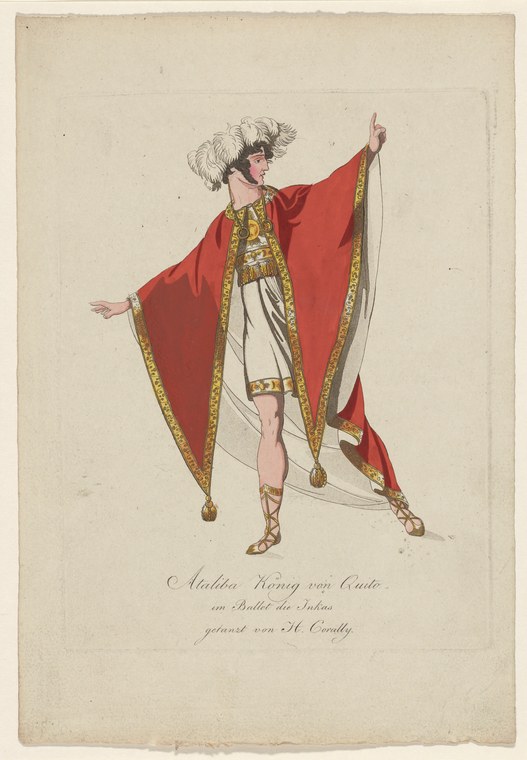
Ataliba König von Quito im Ballet die Inkas getanzt von H. Corally
Unknown artist
- Collection:
- Prints depicting dance
- Source:
- New York Public Library
- Rights:
- Public domain — free to use, share and adapt.
- Recorded as:
- Public Domain
This image reveals the 19th-century ballet tradition of casting European dancers in 'exotic' roles and the specific theatrical vocabulary used to signal non-European identity: the combination of orientalist costume, the hieratic pose, and the stationary dramatic gesture rather than technical footwork. For historians of both dance and visual culture, it documents how colonialism shaped aesthetic representation on the stage, making legible the power dynamics encoded in costume and pose.
What you are looking at
A single figure stands alone against a plain background in a theatrical pose that reads as heroic and commanding. The dancer wears a striking crimson or scarlet cloak with gold embroidered borders, lined with white silk, which billows dramatically around the body. The cloak is held aloft by the raised right arm while the left arm extends outward in a gesture of presentation or proclamation. Beneath the cloak, the costume shows a white tunic or kilt reaching to mid-thigh, paired with fitted leg wrappings or boots that extend to the ankle, typical of early 19th-century theatrical orientalism. A ornate gold necklace and plumed white headdress complete the outfit. The figure's weight is planted on the back leg, the front leg extended slightly forward, creating the impression of forward momentum held in check—a pose between action and repose. The full extension of the cloak creates a magnificent silhouette that frames the body and suggests the dynamism of performance.
The dancing
The single dancer's frame is upright and expansive, with the torso open to the viewer and the gaze directed upward and away, avoiding direct eye contact—a theatrical convention of the period. The raised right arm lifts the cloak's corner to approximately shoulder height while the left arm extends horizontally in what appears to be an open, welcoming or commanding gesture. The stance is grounded rather than ethereal: the legs are firmly planted, the weight settling into the back leg while the front leg achieves a modest extension rather than a turned-out lift. There is no indication of raised heel work or the demitasse positions of ballet vocabulary; instead, the legs suggest a walking stride momentarily arrested and exaggerated for theatrical effect.
The dance depicted
This appears to be a solo from an early 19th-century European theatrical ballet depicting an Incan or South American 'exotic' character, as confirmed by the title inscription referencing 'Ataliba König von Quito' (Ataliba, King of Quito) and 'Ballet die Inkas' (Ballet of the Incas). The printed inscription attributes the costume design or choreographic direction to 'H. Corally,' likely a performer or choreographer of the period. The pose and costume suggest a dramatic solo moment rather than a virtuosic ballet sequence: this is character work in the Romantic ballet tradition, where exotic or non-European roles were performed by European dancers in orientalist dress. The dance itself appears to be a stationary dramatic gesture rather than a traveling step phrase, prioritizing the visual impact of costume and pose over technical footwork.
How it was made
This is a hand-colored engraving or aquatint, likely from the 1820s–1840s based on the printing style and paper tone. The image shows the characteristic line work and shallow modeling of an engraved plate, with hand coloring applied afterward—visible in the careful rendering of the crimson cloak, the gold trim, and the flesh tones. The technique allowed for multiple prints to be produced from the same plate, making theatrical documentation and costume designs reproducible and distributable to a wide audience beyond the theater itself. The scale and finish suggest this was a professional publication aimed at dancers, choreographers, or theatrical patrons interested in recording notable roles and performers.
About this work
This is a theatrical costume design or stage portrait documenting a Romantic-era ballet character, likely from a work performed in Vienna or another German-speaking cultural center in the early 19th century. The work sits within the tradition of orientalist ballet, where European choreographers and dancers appropriated exotic and non-European identities for dramatic effect. The inscription suggests this image was created to preserve or publicize a specific performer's interpretation of an Incan king's role, making it both a dance document and a record of how European theater imagined and costumed the non-European world.
How to look at it
Attend to the way the costume is used to create spectacle: the cloak is not incidental but the primary visual gesture, lifted and framed by the dancer's arm. Notice that this is not a posed arabesque or attitude—the stance is grounded and frontal, closer to statuary or historical painting than to ballet technique proper. The raised plume in the headdress and the gold embroidery draw the eye upward and outward, reading the figure as regal rather than athletic. The gesture of the left arm—open, extended, almost vulnerable despite the martial costume—is the emotional center of the pose.
The artist
The artist is not recorded in the catalogue. The inscription credits a performer or choreographer named 'H. Corally' with the costume design or scenario. The print itself is a professional theatrical publication, suggesting it was created by a commercial engraving house serving the theater market—common practice in Vienna and other European theater centers during the 1820s–1840s.
The period
This work dates to the height of Romantic ballet in Europe, a period when choreographers and dancers were fascinated by the 'exotic'—whether historical (medieval), geographical (Ottoman, Incan, Indian), or fantastical (supernatural). The early 19th-century ballet stage was populated by orientalist fantasies in which European dancers, primarily women but also men in character roles, performed invented versions of distant cultures. The politics of these representations were entirely unquestioned at the time: the combination of fine costume, statuesque pose, and absence of technical virtuosity in roles like this one conveyed nobility and exoticism without demanding the footwork expected of a prima ballerina. Such roles were often assigned to male dancers or to dancers less celebrated for technique.
Where it lives
The print is held in the New York Public Library's collection of prints depicting dance, catalogued as 'Prints depicting dance.' It is a theatrical publication, likely produced in Vienna or a German-speaking center and distributed among theater professionals and patrons in the 1820s–1840s.
Dance in this work
Questions about this work
Who was Ataliba and why was he in a ballet?
Ataliba was a historical Incan ruler, but his appearance in this ballet is entirely a product of 19th-century orientalist fantasy. The Romantic ballet era was fascinated by 'exotic' subjects drawn from history, geography, and literature, and choreographers created ballets based on these themes with little regard for historical accuracy. European dancers performed these roles in costumes designed to suggest otherness and nobility without necessarily understanding or respecting the cultures being depicted.
Is this a solo dance or part of a larger work?
Based on the inscription and the nature of the pose—stationary, commanding, without indication of traveling or partnered movement—this appears to be a solo moment, likely a dramatic highlight in a larger ballet. Such character solos were common in Romantic ballet, offering performers a moment to convey emotion or status without the technical demands of the corps de ballet or pas de deux.
Why does the dancer look so stiff compared to modern ballet?
This is not stiffness but the deliberate vocabulary of 19th-century theater: an upright, grounded stance conveyed dignity and nobility in dramatic roles, in contrast to the ethereal lightness expected of fairy or supernatural characters. The pose is closer to history painting or sculpture than to the weightless quality we associate with ballet today, reflecting different aesthetic values and technical training.
Who was H. Corally?
The catalogue does not identify H. Corally beyond the credit on this print. The name likely refers to the performer, costume designer, or choreographer associated with this production, but without additional documentary evidence, their identity remains uncertain. Theater archives or dance histories of German-speaking cities in the 1820s–1840s might yield more information.
More dance artwork





