49 works in this view — arrow keys or swipe to move between them.
Dance in Art
Fanny Cerrito
Unknown artist
- Collection:
- Prints depicting dance
- Source:
- New York Public Library
- Rights:
- Public domain — free to use, share and adapt.
- Recorded as:
- Public Domain
Fanny Cerrito was a major creative force in romantic ballet, known not only as an incomparable dancer but as a choreographer who created roles for herself and other dancers. This portrait is a primary document of how the most celebrated female performers of the era were visualized and consumed by audiences. The image records the costume conventions, hairstyling, and idealized femininity associated with romantic ballet at its zenith.
What you are looking at
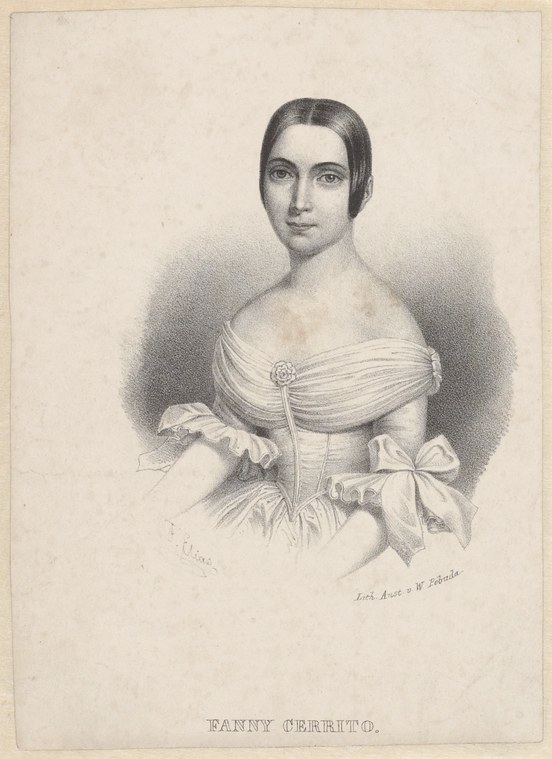
This is a portrait engraving of a young woman identified as Fanny Cerrito, shown in the half-length format typical of 19th-century celebrity prints. She faces the viewer in three-quarter pose, her body angled slightly to the right. She wears a pale off-shoulder dress with a draped neckline fastened by a brooch, the fabric gathered at the shoulders and falling away to reveal her upper chest and arms. Her left arm (on the viewer's right) is extended downward, the hand rendered in delicate detail with fingers relaxed; her right arm rests across her body. The dress is finished with white ribbon bows at each shoulder—theatrical rather than purely fashionable. Her dark hair is parted and smoothed close to her head in the romantic-era style. The background is an even pale tone, shading subtly to suggest depth behind the figure. The engraving technique creates a soft, almost luminous quality through careful gradation of line and tone.
The dancing
The figure is presented in a formal, composed pose rather than in movement. The arrangement of her arms and the slight turn of her body suggest a balletic carriage—the upright posture and refined hand positions are consistent with the aesthetic discipline of classical ballet training. The bare shoulders and graceful arm extension would be typical of romantic-era ballet costuming. The overall presentation emphasizes grace and refinement of line rather than dynamic action.
The dance depicted
Fanny Cerrito (1817–1909) was one of the most celebrated prima ballerinas of the romantic era, famous for her roles in *La Sylphide* and *Giselle* and for her own choreographic work. This portrait captures her as a star performer of the 1840s–50s, during the height of her fame in London, Paris, and Europe. The image shows her in the idealized form in which audiences knew her—refined, youthful, and dressed in the romantic-era ballerina costume of pale tulle and silk. The portrait serves primarily as a celebrity image rather than a documentation of a specific movement or dance.
How it was made
This is a steel or copper engraving, a reproductive printmaking technique that allowed mass distribution of celebrity portraits. The fine linear work and subtle tonal gradations characteristic of 19th-century engraving are evident throughout—particularly in the rendering of fabric texture, skin tone, and the diffused background. The technique was ideal for circulating images of famous performers to an audience eager for likenesses of stage stars. Engravings of this quality and scale were affordable enough for middle-class collectors and theaters while maintaining the prestige associated with fine printmaking.
About this work
This is a celebrity portrait engraving of Fanny Cerrito, the renowned romantic-era prima ballerina, produced during or shortly after the height of her international fame in the mid-19th century. The print presents her in idealized form—poised, elegant, and dressed in the pale silk and ribbon characteristic of romantic ballet costuming. As a reproductive engraving, it circulated widely, making Cerrito's image available to theater audiences, admirers, and print collectors across Europe and beyond. The work belongs in a gallery of dance imagery as evidence of how nineteenth-century ballet stars were celebrated and commercialized through portraiture, and as a visual record of romantic-era performance aesthetics and costume.
How to look at it
Attend to the costume details—the draped neckline, the ribbon bows, the pale fabric—which are the visible markers of romantic-era ballet. Notice the refinement of the hand and the carriage of the body, which convey the technical training and grace expected of a prima ballerina. The engraver has chosen to present Cerrito in a composed, frontal pose rather than in a moment of movement; this was the convention for celebrity portraits, designed to show the star's face and general elegance rather than to document specific choreography. The soft, luminous quality of the engraving creates an effect of idealization appropriate to the romantic aesthetic.
The artist
The engraver is not recorded in the catalogue. The work is signed with what appears to be an artist's mark or initials in the lower left, and carries a publisher or printer's imprint. Steel-engraved portraits of stage celebrities were a major commercial enterprise in the 19th century, produced by specialist firms in London, Paris, and other cultural capitals. These prints were often created by accomplished reproductive engravers working from original paintings or drawings, or directly from life studies.
The period
This portrait dates to the romantic era of ballet (approximately 1830s–1850s), when the art form experienced an unprecedented flourishing and when female dancers achieved celebrity status rivaling that of opera singers. The romantic ballet emphasized ethereal femininity, supernatural themes, and a visual aesthetic centered on the pale, weightless, otherworldly ballerina. Fanny Cerrito was one of the four great prima ballerinas of this period—alongside Marie Taglioni, Carlotta Grisi, and Lucile Grahn—and she was distinctive for her Spanish heritage and her gifts as a choreographer. Mass-produced engraved portraits like this one were a crucial technology for building and sustaining the celebrity of stage performers in an era without photography (or before photography became the standard medium for theatrical portraiture).
Where it lives
The print is held in the New York Public Library's collection of prints depicting dance. It is catalogued simply as "Fanny Cerrito" with no recorded artist, date, or medium, indicating it is part of a broader documentary collection rather than a curated fine-art print collection.
Dance in this work
Questions about this work
Who was Fanny Cerrito?
Fanny Cerrito (1817–1909) was an Italian prima ballerina of the romantic era, celebrated for her virtuosity and grace. She was one of the four most famous dancers of her time, and she was unusual among romantic-era ballerinas in her talent as a choreographer—she created roles for herself and others, most famously the "Pas de Quatre" danced by the four great ballerinas of her era. She performed across Europe and was particularly celebrated in London.
What was romantic ballet?
Romantic ballet (c. 1830s–1850s) emphasized ethereal, supernatural, and emotionally expressive themes, with a strong visual focus on the female dancer in pale tutus and pointe shoes. Ballets like *La Sylphide* and *Giselle* defined the style. The period elevated the prima ballerina to unprecedented celebrity status and established many of the visual and technical conventions of classical ballet still practiced today.
Why was this printed as an engraving?
Before photography became standard, engraved portraits were the primary way to circulate images of famous performers. Steel engraving allowed high-quality prints to be produced in large numbers, making them affordable to middle-class audiences. Theaters and print sellers sold thousands of such portraits of celebrated singers, dancers, and actors to an eager public.
What can we learn about 19th-century ballet costume from this image?
The portrait shows the characteristic romantic ballet costume: a pale, off-shoulder silk or satin bodice with soft fabric (likely tulle) below, decorated with ribbon bows. This aesthetic—pale, ethereal, with emphasis on the neck, shoulders, and refined arm line—became the template for classical ballet dress and remains influential today.
More dance artwork





