49 works in this view — arrow keys or swipe to move between them.
Dance in Art
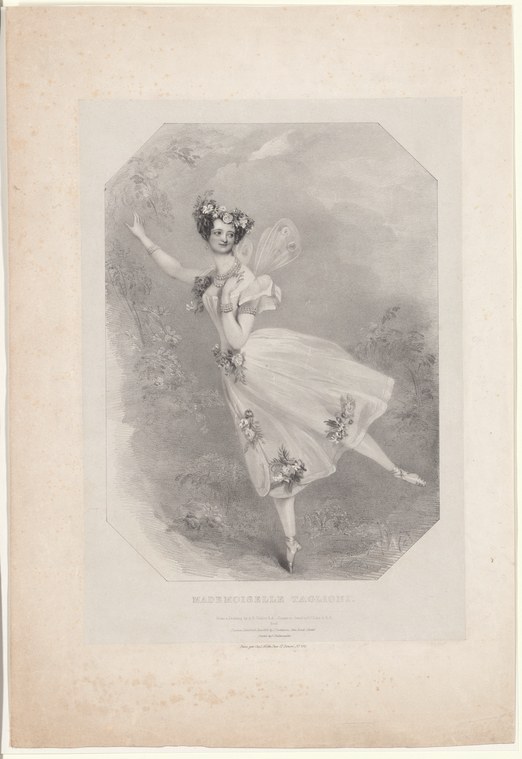
Mademoiselle Taglioni
Unknown artist
- Collection:
- Prints depicting dance
- Source:
- New York Public Library
- Rights:
- Public domain — free to use, share and adapt.
- Recorded as:
- Public Domain
This image is a primary document of Romantic ballet aesthetics and the international celebrity of a major historical dancer. It shows how 19th-century audiences understood and valued the art form: as a practice devoted to creating the illusion of weightlessness, grace, and supernatural beauty. For historians, it is evidence of what Romantic ballet looked like and how it was promoted.
What you are looking at
A young woman in theatrical dress floats across a misty, moonlit landscape, her body suspended in a pose of ethereal lightness. She wears a white tulle skirt gathered at the waist, with the skirt itself decorated with sprigs of flowers or leaves at intervals down its length. Her bodice is fitted and her shoulders are bare. She wears a wreath or crown of flowers in her dark hair. Her left arm extends upward and back, her right arm curved gracefully; her legs are in a balletic position, one foot pointed, the body tilted as if weightless. The background is rendered in soft grey washes suggesting a romantic nocturne—trees or foliage emerge hazily from mist, and the overall mood is one of supernatural, dreamlike beauty. The composition is framed within an octagonal border, and the print has the quality of a well-finished engraving or lithograph, with careful attention to light, shadow, and the delicate rendering of fabrics.
The dancing
A single dancer occupies the entire composition. Her frame is pulled upward and elongated; her weight appears to rest on or shift between her feet in a manner suggesting she is either en pointe or about to lift. Her arms are raised and positioned in a romantic, opened frame—the upper arm is lifted away from her body, creating line and lightness rather than any closed or structural hold. Her leg position suggests a pointed foot and extended line through the body. The deportment is one of extreme verticality and lift, the body held as if defying gravity.
The dance depicted
This is almost certainly Romantic ballet, most likely depicting a scene from a mid-19th-century ballet featuring Taglioni or in her style. The white tulle skirt, the floral decoration, the ethereal pose, the nocturnal setting, and the supernatural quality of the image are all hallmarks of Romantic ballet aesthetics—the genre that emerged in the 1830s and dominated through the 1850s. The figure may represent a sylph, fairy, or other otherworldly being, roles that defined both the technical and aesthetic vocabulary of this era. The pose itself demonstrates the vocabulary of Romantic ballet: lightness, verticality, elongation, and a sense of the dancer as weightless or magical rather than grounded.
How it was made
This is an engraving or lithograph, likely hand-colored or printed in tone, dating to approximately the mid-19th century. The soft, delicate handling of light and shadow, the fine line work, and the careful modeling of the figure are characteristic of high-quality theatrical prints made for circulation among the ballet-going public. The octagonal frame was a conventional choice for theatrical portraits of this period. The technique allowed for mass production and distribution of images of celebrated dancers, making this likely a popular print sold to audiences attending the theatre.
About this work
This is a mid-19th-century theatrical print of a dancer, titled 'Mademoiselle Taglioni,' depicting a figure in the Romantic ballet style. The work celebrates the aesthetic of weightlessness, ethereality, and supernatural beauty that defined the era and the dancer's celebrated technique. The image captures not just a moment of dance but an entire visual and philosophical approach to the art form—one in which the dancer appears to transcend physical law.
As a print, this object tells us about the circulation of dance imagery in the 19th century and the cult of celebrity surrounding major ballet stars. Taglioni was among the most celebrated dancers of her time, and images of her were widely reproduced and consumed by theatre audiences. This print is both a record of a particular dancer and an artifact of how Romantic ballet was understood and consumed by the public.
How to look at it
Attend first to the pose itself: the figure is not in a stable, frontal position but in a moment of apparent suspension or ascent, with the body slightly tilted and the arms opened. This is not a pose of rest but of flight. Notice the softness of the background and the way the figure floats free of any real ground—the mist and undefined space reinforce the supernatural quality. The floral crown and the flowers on the skirt place her outside everyday reality. Finally, look at the technical execution of the print: the fine, careful line work and the subtle tonal gradations would have been costly to produce, indicating that this was a premium object made for consumers who valued both dance and fine craftsmanship.
The artist
The artist is unrecorded in the catalogue. However, the quality of the engraving, the theatrical subject, and the style suggest this was produced by a professional print maker working in the mid-19th century, likely in France or Britain where Taglioni was celebrated. Theatrical prints of celebrated dancers were a major commercial category, and this object was likely created soon after a successful performance or as part of a series of portraits of leading dancers.
The period
This print belongs to the era of Romantic ballet, roughly 1830–1860, when the art form underwent a profound aesthetic shift. Where Classical ballet (and its predecessor, court and court-derived dance) had valued symmetry, architectural clarity, and formal structure, Romantic ballet prized the opposite: asymmetry, softness, mystery, and the illusion of weightlessness. Pointe work—dancing on the tips of the toes—became the norm, not a novelty, and was associated with this new aesthetic of ethereality. Taglioni was one of the principal architects and celebrants of this style; her technique emphasized sustained balance and an almost supernatural lightness. The print circulated in the 1840s–1850s, at the height of her fame and influence. Artistically, Romantic-era theatrical prints like this one combined engraving technique with soft tonal effects influenced by contemporary painting, creating a form of image well suited to promoting the visual and emotional values of Romantic ballet.
Where it lives
The print is held in the New York Public Library's collection of prints depicting dance. This collection contains theatrical prints, reviews, programs, and images documenting professional and amateur dance practice from the 18th century onward. This particular object is a commercial theatrical print, the kind that would have been sold to audiences after attending performances or distributed as part of promoting a dancer's fame.
Dance in this work
Questions about this work
Who was Taglioni and why was she famous?
Marie Taglioni (1804–1884) was a Swedish-Italian dancer who became the most celebrated ballet dancer of the 19th century. She was the principal dancer of the Paris Opéra and is credited with perfecting the pointe technique and embodying the Romantic ballet aesthetic. Her technique emphasized apparent weightlessness and ethereal beauty, and she danced in major ballets including La Sylphide (1832), which helped define the Romantic era. Prints like this one circulated widely and made her an international celebrity.
What is Romantic ballet?
Romantic ballet (c. 1830–1860) was a movement that rejected the formal, architecturally precise Classical ballet in favor of softness, mystery, and supernatural themes. Dancers performed in white tulle skirts, often representing sylphs (spirits) or fairies. The aesthetic valued the illusion of weightlessness and effortlessness, and pointe work became standard. Major works include La Sylphide and Giselle. Taglioni was one of its defining figures.
How were theatrical prints like this one made and distributed?
Theatrical prints were commissioned or produced by print makers working from sketches, paintings, or sometimes from live observation at performances. They were engraved or lithographed, often hand-colored, and sold to theatre audiences and collectors. They served as souvenirs, promotional images, and a form of fan merchandise. The quality and finish of a print indicated both the popularity of the dancer and the commercial investment in promoting her image.
What do the flowers on her skirt mean?
In Romantic ballet, floral motifs on the skirt associated the dancer with nature, springtime, and the supernatural world of spirits and beings outside human civilization. The flowers reinforce the character as otherworldly and magical—a sylph or fairy rather than a human woman. This was a visual convention of the era.
More dance artwork





