49 works in this view — arrow keys or swipe to move between them.
Dance in Art
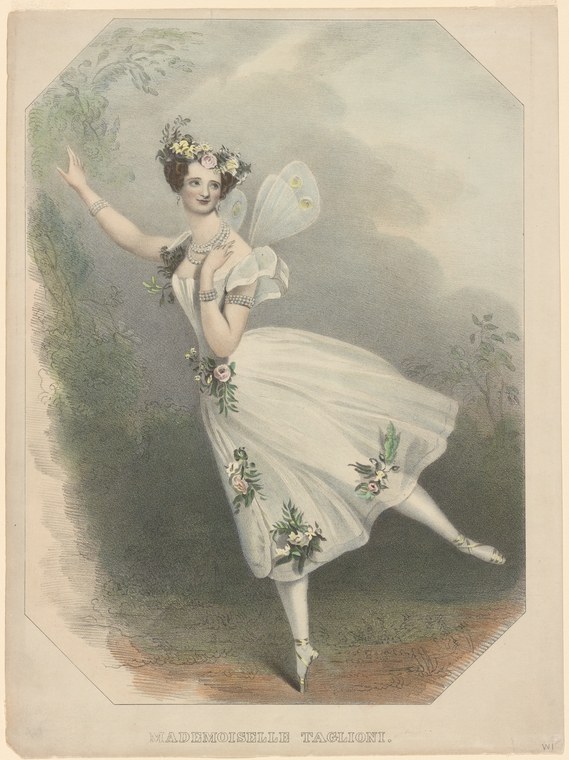
Mademoiselle Taglioni
Unknown artist
- Collection:
- Prints depicting dance
- Source:
- New York Public Library
- Rights:
- Public domain — free to use, share and adapt.
- Recorded as:
- Public Domain
Marie Taglioni was the ballerina of the Romantic era and a transformative figure in dance history; this print documents her appearance in the role that defined her legacy and revolutionized ballet technique and aesthetics. For historians and dancers alike, the image is crucial evidence of how Romantic ballet was performed, how it was publicly presented, and what ideals of the female dancer's body and presence the period valorized.
What you are looking at
A young woman in Romantic-era pointe work is captured mid-leap or hovering moment against a soft, atmospheric background of pale green and gray tones suggesting a sylphide's forest or ethereal realm. She wears a white muslin skirt decorated with sprigs of flowers at the hem, a fitted white bodice with off-shoulder sleeves in the characteristic Romantic ballet style, and a delicate wreath of flowers in her dark upswept hair. Her right arm is raised in an arc overhead, her left arm extended to the side at shoulder height, and her legs are positioned in a classical ballet pose—one leg bent beneath her, the other extended. She faces the viewer with a demure but direct gaze, her expression serene and aristocratic. A pale, translucent wing or drapery element appears at her back. The composition is intimate and frontal, framed by a decorative octagonal border that distances us slightly from the scene, as if viewing a theatrical moment through a window.
The dancing
The figure displays the lifted, weightless port de bras and épaulement of mid-nineteenth-century ballet technique. Her arms frame the body in a soft, rounded position; her raised arm curves gracefully overhead while the other balances at shoulder height, creating the symmetrical harmony of Romantic ballet. Her legs suggest the turned-out positions of classical training, with clear articulation of the ankle and foot. The pose conveys the illusion of flight or suspension—a quality central to Romantic ballet's aesthetic—achieved through a combination of lifted carriage, extended line, and the pose itself, frozen between ascent and descent.
The dance depicted
This is a portrait of the Romantic ballet dancer, almost certainly the famous ballerina Marie Taglioni, who revolutionized ballet in the 1830s–1840s and is most celebrated for creating the role of the Sylphide. The ethereal costume, the sylph-like wing, the forest-like setting, and the pointe work all align with her signature role in *La Sylphide* (1832). The image documents the essential qualities Taglioni brought to Romantic ballet: an illusion of weightlessness and otherworldliness, delicate lyricism, and the perfection of pointe work, which she refined to an unprecedented degree. The engraving captures not just a dancer but an ideal—the spirit of Romanticism itself.
How it was made
This is a hand-colored engraving or possibly a lithograph, typical of mid-nineteenth-century theatrical portraiture. The soft modeling of tone in the background, the fine linear detail of the costume, and the warm hand-coloring in flesh tones and botanical details are characteristic of print technology circa 1830s–1840s. Such images were widely circulated as souvenirs and promotional materials, making them affordable records of celebrated performers. The technique allowed for mass production while retaining the prestige of an artistic medium, making this both a document and a commodity—a souvenir for theater-goers and a tool for the dancer's fame.
About this work
This is a hand-colored engraving of a Romantic ballet dancer in the 1830s–1840s, rendered with the theatrical flattery and ethereal aesthetics characteristic of prints celebrating the ballet stars of the period. The title *Mademoiselle Taglioni* almost certainly refers to Marie Taglioni, the era's most celebrated ballerina and the creator and originator of *La Sylphide*, the quintessential Romantic ballet. The image captures the essential visual language of Romantic ballet: the dominance of pointe work, the ethereal white costume, the supernatural setting, the lifted and seemingly weightless body, and the refined aristocratic bearing. It belongs in a gallery of dance because it is both a portrait of a legendary performer and a visual codification of an entire aesthetic movement in dance—one that fundamentally shaped what ballet became.
How to look at it
Observe the pose itself: the lifted carriage, the turned-out legs, the extended line of the raised arm, and the pointed foot all convey the classical training that Taglioni perfected. Notice how the artist has rendered the illusion of weightlessness—the figure appears to hover rather than stand, achieved through the pose, the lifted arms, and the soft, atmospheric background that suggests an ethereal realm rather than a stage. The delicate costume, the wreath of flowers, and the pale palette are all devices of Romantic aesthetics; look at how the artist uses them to create an image of idealized, transcendent femininity.
The artist
The artist is not recorded in the catalogue, but the print is typical of commercial theatrical portraiture from the 1830s–1840s. Such prints were produced by publishing houses in Paris, London, and other major cities, often after drawings or paintings by theatrical artists. They were sold in print shops and at theater doors, making them accessible to a broad middle-class audience fascinated by celebrity and the theater.
The period
The 1830s–1840s were the height of Romanticism in the arts and in ballet. In dance, this was the era of the Romantic ballet—characterized by ethereal female dancers en pointe, supernatural narratives, and an aesthetic centered on illusion, otherworldliness, and the delicate beauty of the female form. Marie Taglioni epitomized this ideal. In the visual arts, theatrical prints and lithographs were a major medium for distributing images of celebrated performers and reproducing the spectacle of the stage for domestic consumption. Hand-colored prints like this one brought the theater into the home.
Where it lives
The work is held in the New York Public Library's Prints collection, a major institutional archive of theatrical imagery from the eighteenth through twentieth centuries. Such prints were among the most widely circulated images of the nineteenth-century stage and have survived in large numbers.
Dance in this work
Questions about this work
Is this a portrait of Marie Taglioni?
The catalogue title is 'Mademoiselle Taglioni,' and the visual evidence strongly supports this identification: the characteristic Romantic ballet costume, the pointe work, the ethereal setting, and the sylph-like appearance all point to the famous ballerina. However, the catalogue does not confirm authorship or provide a date; readers seeking scholarly certainty should consult specialized histories of Taglioni and the Romantic ballet.
What is the role or ballet depicted here?
The costume, setting, and especially the delicate wing visible at the figure's back strongly suggest the role of the Sylphide from *La Sylphide* (1832), the ballet most associated with Taglioni and one of the foundational works of Romantic ballet. It remains the most famous role in her repertory.
How is she on pointe, and why is that significant?
Marie Taglioni was among the first dancers to perfect the technique of dancing en pointe—on the tips of the toes—and she used pointe work far more extensively and skillfully than her predecessors. This engraving documents that technique visually. Pointe work became essential to Romantic ballet and remains central to classical ballet today; Taglioni's mastery helped establish it as a fundamental technique.
How was this image made and distributed?
This is a hand-colored engraving or lithograph, a commercial theatrical portrait typical of the 1830s–1840s. Such prints were manufactured in large quantities, hand-colored by teams of workers, and sold in print shops and at theaters, making them affordable mementos for theater-goers and a major means of circulating images of celebrated performers.
More dance artwork





