49 works in this view — arrow keys or swipe to move between them.
Dance in Art
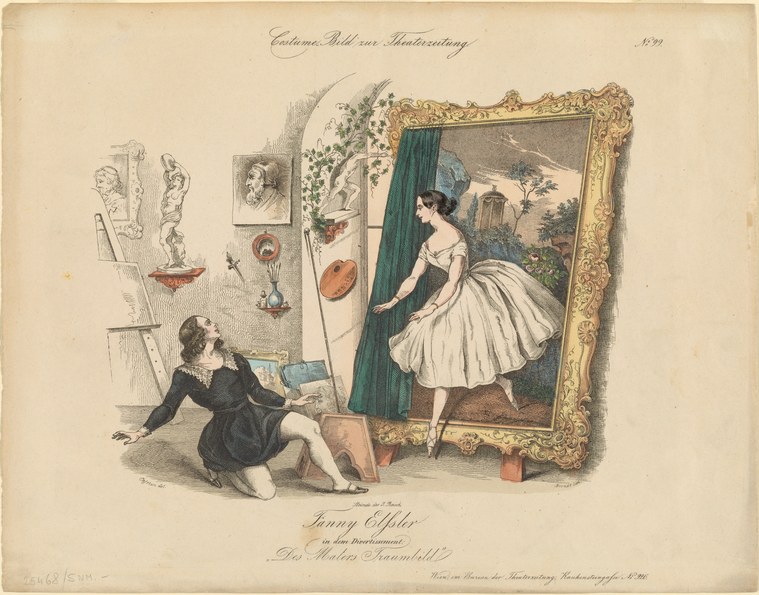
Fanny Elssler in dem Divertissement: "Des Malers Traumbild"
Unknown artist
- Collection:
- Prints depicting dance
- Source:
- New York Public Library
- Rights:
- Public domain — free to use, share and adapt.
- Recorded as:
- Public Domain
Fanny Elssler was one of the two most celebrated dancers of the Romantic era, and this print preserves an image of her in a specific role that shaped her European reputation. Unlike photographs, which would not capture dancers in significant numbers until the 1870s and beyond, these hand-colored engravings are among the most reliable visual records we have of how Romantic ballet actually looked on stage—the exact fit of the costume, the proportions of the dancer, the spatial composition of a theatrical moment.
What you are looking at
A woman in a white Romantic-era ballet costume kneels before a large gilt-framed painting, gazing up at it in rapt attention. The painting within the print shows an idealized landscape with classical ruins. To the left, a second figure in dark clothing sits or crouches on the floor, surrounded by scattered objects—statuettes, vessels, brushes, and what appear to be artist's materials—suggesting a studio or salon setting. Ivy or flowering vines frame the top of the composition. The print is hand-colored in muted greens, whites, golds, and flesh tones, with fine engraved linework throughout. The title and subject matter suggest this depicts the famous *Traumbild* (Dream Picture) solo that Fanny Elssler performed, a theatrical piece in which a painter's romantic dream materializes before him.
The dancing
The primary dancer—identifiable as Elssler by the title—wears the canonical Romantic tutu of the 1840s: a white bell-shaped skirt, fitted bodice, and what appear to be ballet slippers. She kneels with her body angled toward the painting, one arm raised in supplication or wonder, her gaze directed upward in an attitude of romantic yearning. Her posture is vertical and elongated, emphasizing the ethereal quality of the female form. The second figure, presumably the male dreamer or painter, is compressed and earthbound by contrast, hunched among mundane studio objects. The spatial separation and vertical difference in their positions encodes the dream-reality divide central to the narrative.
The dance depicted
This is a theatrical tableau vivant or divertissement piece from the Romantic ballet repertoire, most likely depicting the solo *Des Malers Traumbild* (The Painter's Dream Picture) performed by Fanny Elssler around the 1840s. Elssler was the leading dancer of the period after Marie Taglioni, and this work exemplifies the Romantic ballet's preoccupation with ethereal female beauty, supernatural themes, and the male artist's desire. The image captures not a moment of balletic movement but rather a narrative tableau—the apotheosis of the dreamed vision—which was typical of the interludes and divertissements embedded within longer theatrical works. The dance itself would have involved pantomime, supported by ethereal port de bras and the visual grammar of the tutu and pointe work.
How it was made
This is a hand-colored engraving or aquatint, likely produced in Germany or Austria (the German text in the title suggests Central European origin). The fine linear work and subtle tonal gradations indicate professional engraving, probably by a theatre-publishing house producing star imagery for a broad middle-class audience. Hand-coloring allowed individual customization and enhanced the appeal of the print for collectors and fans. The soft-focus romantic effect—achieved through selective use of tone and the delicate handling of light—was well suited to selling the Romantic ballet's ethos of dreaminess and otherworldliness to a public hungry for lithographs and engravings of celebrated dancers.
About this work
This is a commemorative theatre print documenting Fanny Elssler's performance in a Romantic-era divertissement that dramatized the painter's timeless dream of female beauty incarnate. The engraving captures the iconic visual language of 1840s ballet—the white tutu, the ethereal posture, the male observer's humble awe—while embedding the narrative in a studio setting that speaks to the Romantic obsession with art, inspiration, and desire. The print served as a record, advertisement, and souvenir for a performance that was central to mid-19th-century theatrical culture.
For dancers and historians, this work is essential documentation of how Romantic ballet was staged, marketed, and consumed. It shows a moment of stillness within a narrative work, revealing how choreographic vision depended on costume, framing, and the charisma of the individual star. The dual perspective—the painter's mundane tools below, the dancer's transcendent vision above—encodes the Romantic era's simultaneous embrace of realism and idealism.
How to look at it
Look first at the extreme vertical contrast: the compact, tool-surrounded figure of the male dreamer below, and the elongated, upright kneeling figure of the dancer above, framed by the golden arch of the painting. This composition embodies Romantic ideology—the male imagination elevated, transfigured, and made visible through the female body. Notice how Elssler's gaze is locked onto the painting rather than toward an audience; she is absorbed in her own dream rather than performing for ours, a key Romantic convention. The scattered artist's materials—palette, brush, statuettes—ground the fantasy in a plausible narrative: a painter's studio where the boundary between creation and vision dissolves. The delicate linework and hand-coloring emphasize the ethereal over the photographic, reinforcing the work's investment in romantic ideality.
The artist
The artist is not recorded. The print was published by Kunst- und Industrie-Comptoir in Vienna, a major theatrical print publisher of the period. The style is consistent with professional theatre printing of the 1840s, suggesting a trained engraver working in the Austro-German printmaking tradition.
The period
This print dates to the height of Romantic ballet (c. 1835–1850), when Marie Taglioni and Fanny Elssler dominated European stages. Elssler, an Austrian dancer trained in classical technique, was known for her technical precision and dramatic presence; she and Taglioni embodied rival aesthetics—Elssler favored character dances and theatrical narrative, while Taglioni represented ethereal, otherworldly femininity. The *Traumbild* divertissement sits squarely in the Romantic repertoire of supernatural encounters and male fantasy. Theatre printing had become a mass medium, with hand-colored engravings and lithographs sold to subscribers and audiences as mementos and promotional materials. Vienna, as Elssler's home city and a major operatic and balletic center, was a hub of such production.
Where it lives
This print is held in the New York Public Library's collection of prints depicting dance. It is a mass-produced commemorative object, one of many such theatrical prints circulated in Europe in the 1840s, and carries no special provenance beyond its publication by a Viennese print house.
Dance in this work
Questions about this work
Who was Fanny Elssler?
Fanny Elssler (1810–1884) was an Austrian ballet dancer and one of the two dominant figures of Romantic ballet, rivaled only by Marie Taglioni. She was celebrated for her technical prowess, dramatic presence, and mastery of character dances drawn from European folk traditions. She toured internationally, including a famous visit to the United States, and was a star of the Vienna State Opera and the Paris Opéra.
What is the 'Traumbild'?
The *Traumbild* (Dream Picture) was a divertissement—a short theatrical interlude—in which a painter's romantic fantasy comes to life before him. The work exemplifies Romantic ballet's favorite themes: the boundary between dream and reality, male artistic desire, and the ethereal female form made visible through dance. Elssler performed it as a solo showcase at various points in her career.
Why is she kneeling in the painting?
The kneeling pose embodies Romantic conventions of female submissiveness and supplication. In the narrative of the dream, the dancer enacts the role of the painter's idealized vision—she gazes upward and outward in wonder and yearning, her body arranged to emphasize her ethereal beauty. This pose would have been held as a tableau at the climax of the solo.
How do we know what Romantic ballet looked like without photographs?
Hand-colored engravings and lithographs like this one are among our most reliable visual sources for Romantic-era dance. Dancers, publishers, and theatres commissioned these prints to document and publicize celebrated performances. When combined with written accounts, costume pieces, and music, they provide a detailed picture of how the ballet actually appeared on stage—the exact proportions and fit of costumes, the spatial arrangement, the key moments chosen for commemoration.
More dance artwork





