49 works in this view — arrow keys or swipe to move between them.
Dance in Art
Masquerade ticket
Unknown artist
- Collection:
- Prints depicting dance
- Source:
- New York Public Library
- Rights:
- Public domain — free to use, share and adapt.
- Recorded as:
- Public Domain
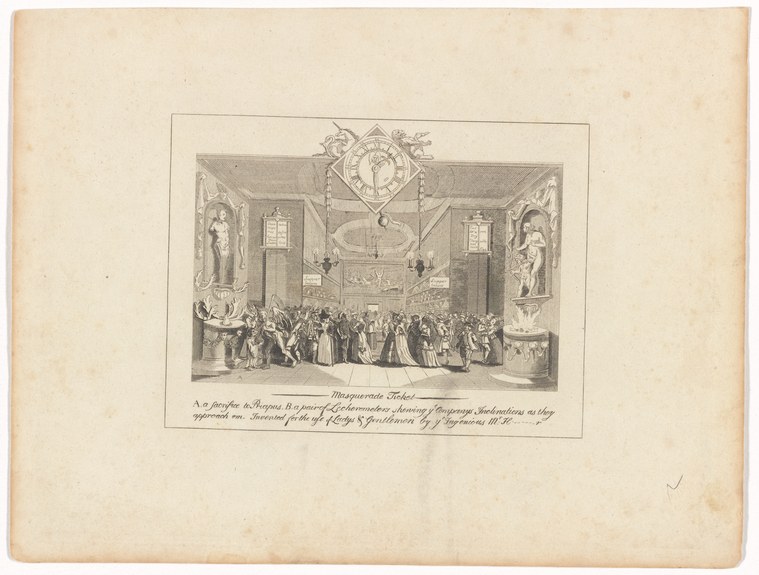
Masquerade balls were crucial occasions for social dancing in 18th-century aristocratic life, and this image captures the scale, formality, and costume culture that framed such dancing. It shows the visual world in which minuets, gavottes, and contredanses were performed, and the social hierarchies and display conventions that shaped movement and interaction.
What you are looking at
A masquerade ball in an elegant interior space, probably early 18th century. Dozens of richly dressed figures fill a grand room with high ceilings, ornate wall panels, and tall windows admitting light from the left. The composition is symmetrical and theatrical: figures crowd the central floor in animated conversation and movement, while sculptural or painted allegorical figures—possibly representing virtues or the seasons—occupy niches in the walls on either side. Above, a coat of arms or decorative emblem hangs from swags and foliage. The crowd wears elaborate costumes typical of masquerade: long gowns for women (with full skirts and high bodices), coats and breeches for men, many wearing masks or dominoes. The lighting is even and detailed throughout, creating a sense of spectacle and social display. The mood is one of courtly revelry and formal entertainment.
The dancing
The figures are upright and posed rather than captured mid-movement, which is typical of masquerade documentation. Most stand or move in small conversational groups across the floor with relaxed arms and dignified posture befitting formal dress. The women's bodies are oriented to display their voluminous skirts; the men stand in attitudes of courtly address. No active partnered dancing is visible—this is a social gathering rather than a choreographed performance. The density and arrangement suggests a procession or parade of guests entering and moving through the space.
The dance depicted
This is a record of a masquerade ball or carnival celebration, not a depiction of a specific dance form. Masquerade balls were fashionable among European nobility in the 17th and 18th centuries and often included dancing, but what is shown here is the social spectacle of the gathering itself—the costumes, masks, and social performance—rather than active choreographed movement. The masquerade tradition involved both social dancing (likely minuets, gavottes, or country dances of the period) and promenading for display. Without inscriptional evidence, it cannot be assigned to a particular dance style, though the formal court dress and setting indicate historic-baroque social conventions.
How it was made
This is an engraving, likely hand-colored, produced for circulation as a print. The fine line work and the capacity for reproducing detail in the architectural setting and costumes suggest professional engraving. The technique allows reproduction of the scene at modest cost, making it a document for distribution to a wide audience—probably as a record of a specific ball or as a general illustration of masquerade fashion and protocol. The existence of an inscription below the scene (partially legible) suggests this was a publishable record, possibly a souvenir or satirical commentary on a real event.
About this work
This engraving documents the visual culture of the masquerade ball, a central form of aristocratic entertainment and social display in the 17th and 18th centuries. Masquerades were occasions for both dancing and elaborate costuming, and this image preserves the setting, dress, and gathering protocol of such events. The work sits at the intersection of dance history, costume history, and social history, showing how masquerade integrated performance, spectacle, and the formal dance practices of the baroque court. For dance historians, it is valuable as material evidence of the spaces where social and theatrical dancing occurred and the contexts in which fashionable movement was displayed.
How to look at it
Attend to the architecture and framing: the artist has chosen a symmetrical, stageable view that emphasizes the formality of the space and the ordered display of costumed figures. Note how the figures are arranged in social clusters across the floor rather than in active partnered dance—this is a procession or assembly, not a choreographed moment. The detail in the costumes and masks is the point: masquerade was as much about the look of the gathering as about the dancing that occurred within it. The coat of arms or emblem above suggests this may be a record of a specific, named event.
The period
Masquerades became fashionable in Venice in the 16th century and spread to aristocratic circles across Europe in the 17th and 18th centuries. In England and France, they reached peak popularity between roughly 1710 and 1770, becoming occasions for elaborate costumes, anonymity, satire, and social mixing—all celebrated and critiqued in prints, poems, and conduct literature. Masquerades always included dancing, typically country dances and contredanses alongside minuets and gavottes, and the events were documented in engravings that circulated as prints. The baroque court was the setting for formalized, choreographed social dance, and masquerades offered a semi-anarchic alternative that still maintained courtly decorum in dress and movement.
Where it lives
The work is held in the New York Public Library's collection of prints depicting dance. It is catalogued as a masquerade ticket or invitation, suggesting it may have circulated as a souvenir or promotional print for a specific event, though the record is sparse.
Dance in this work
Questions about this work
What is a masquerade ball?
A masquerade ball is a formal dance and social gathering where guests wear masks and elaborate costumes, often including allegorical or exotic dress. Masquerades became fashionable in 18th-century aristocratic society, particularly in England and France, and were occasions for both dancing and social satire. Guests could move anonymously and interact across social boundaries that would normally be fixed, though the events remained formally choreographed and rule-bound.
What dances were performed at masquerade balls?
Masquerades included the full range of fashionable social and court dances of the period: minuets, gavottes, contredanses, and country dances. These were typically performed in sequence, with minuets opening the evening and livelier contredanses and country dances following. The formality of the space and costume did not prevent lively movement, but it was still structured and choreographed rather than improvised.
Is this a record of a real event?
The catalogue identifies this as a masquerade ticket, which suggests it may document a specific, named ball. The coat of arms or emblem above could indicate the patron or venue. However, without a visible inscription or clear identification, it may equally be a generic illustration of masquerade protocol and costume, produced for sale or circulation among fashionable society.
More dance artwork





