49 works in this view — arrow keys or swipe to move between them.
Dance in Art
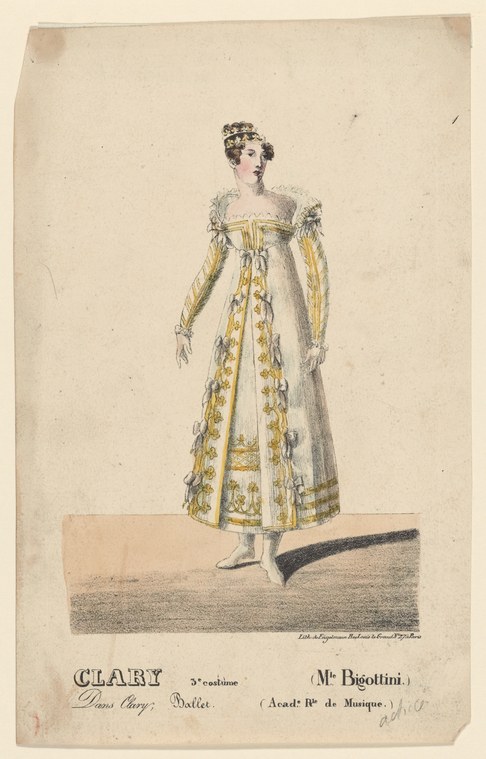
Clary 3e costume (Mle Bigottini): Dans Clary, ballet
Unknown artist
- Collection:
- Prints depicting dance
- Source:
- New York Public Library
- Rights:
- Public domain — free to use, share and adapt.
- Recorded as:
- Public Domain
Costume plates like this one are among the most direct surviving records of how early 19th-century ballet looked on stage—more reliable than narrative paintings, which often took liberties, and more specific than written descriptions. They document not only the aesthetic of Romantic ballet but the economics of theatrical production and the fame of individual dancers, in this case the celebrated ballerina Mademoiselle Bigottini.
What you are looking at
A young woman stands in a three-quarter pose against a pale ground, wearing the costume of Clary from the ballet of that name. She is dressed in a high-waisted white muslin gown typical of early 19th-century fashion, with the Empire silhouette characteristic of Regency dress. The skirt falls straight to the ankle. Over this she wears a sleeveless overdress or tunic of pale yellow or cream silk, densely embroidered or patterned with gold floral motifs arranged in vertical stripes. The overdress has short puffed sleeves that sit off the shoulder, leaving much of her upper arm bare. Her dark hair is arranged in the Grecian style fashionable in the period, with curls pinned high on the crown and adorned with what appears to be a jeweled circlet or wreath. She wears long white gloves reaching above the elbow. Her posture is upright and dignified, with her weight evenly balanced, one arm extended slightly and the other at her side. The figure is rendered in fine detail with hand-coloring — the flesh tones and face delicately finished, the embroidered dress worked in gold leaf or metallic pigment that catches light. A signature or printer's mark appears at the bottom of the sheet.
The dancing
A single female figure stands in classical contrapposto, weight centered and posture formally upright. Her arms are relaxed and unstretched, with hands visible in long gloves—no dramatic port de bras or extended épaulement. The body shows no indication of active movement or mid-choreography; instead, the figure is presented as a formal portrait, the kind of posed presentation used in early costume documentation for the stage. Her frame is narrow and vertical, the silhouette emphasizing verticality over the weight shifts or curvature expected in a dynamic dance position.
The dance depicted
This is a costume study for the ballet *Clary*, created for the dancer Mademoiselle Bigottini. The inscription confirms this: "CLARY 3e costume (Mle Bigottini): Dans Clary, ballet / À Bord de Musique." The work documents a single costume state worn during the performance, likely the third act or scene ("3e costume"). The ballet itself was part of the theatrical-ballet repertory of early 19th-century Paris, though the specific choreography and narrative are not evident from the costume alone. The silhouette and ornament suggest a Romantic-era aesthetic—the high waist, the neoclassical overtones, and the exotic patterning point to early 1800s theatrical fashion. No active dance movement is depicted; this is a costume plate intended to record and perhaps circulate the design for the production.
How it was made
This is a hand-colored engraving or aquatint, a reproductive print technique widely used for theatrical costume documentation in the early 19th century. The base image was engraved in black line, then selectively hand-colored with watercolor or gouache—note the metallic gold work on the embroidered overdress, the flesh tones, and the subtle gradations in the background. The signature or mark at the bottom indicates a professional print shop, likely Parisian. This technique allowed rapid, repeatable circulation of costume designs to dancers, theater administrators, and a curious public; hand-coloring added prestige and visual fidelity. Such prints were often collected in bound albums documenting the costumes of celebrated dancers and ballets.
About this work
This is a costume plate documenting the third costume worn by Mademoiselle Bigottini in the ballet *Clary*, rendered as a hand-colored engraving in the early 19th century. The work is not a depiction of dance in motion, but rather a formal record of theatrical dress—a genre that occupied a significant place between fashion illustration, portraiture, and theatrical documentation. It belongs in a gallery of dance imagery because it is evidence of how dance was dressed, how costumes were designed and circulated, and who danced them. The figure of Bigottini herself matters: she was a celebrated dancer of the Romantic era, and this print is part of the visual record of her career and the ballets she performed.
Such costume plates were valuable to dancers (who needed to commission or replicate costumes), to theater managers (who needed designs for new productions), and to the public (who collected them as souvenirs and evidence of spectacle). The print format made them accessible in ways that a unique painting could not be. This particular work is a small but genuine window into early Romantic ballet production, costume practice, and the celebrity of Parisian dancers.
How to look at it
Examine the costume's construction and ornament: the vertical gold striping on the overdress, the precise embroidery or printed pattern, and the way the sleeves sit. Note the influence of neoclassical and Empire dress on the silhouette—the high waist, the straight skirt, the Grecian hair—which would have been instantly legible to a 1820s viewer as a marker of refinement and classical taste. The formal pose of the figure is characteristic of costume plates, which prioritize visibility of the garment over any suggestion of movement. Look at how the hand-coloring emphasizes the precious materials: the metallic gold, the pristine white muslin, the gloves. These visual choices communicate luxury and the status of the dancer who would wear such a costume.
The artist
The artist or engraver is not recorded in the catalogue. The work is from a professional print shop, likely based in Paris, which produced costume plates as part of the commercial apparatus of Parisian theater. Such prints were created by specialized reproductive engravers working from costume designs or from life studies of dancers in costume. The hand-coloring may have been done in-house or by piece workers. This was a significant professional niche in early 19th-century Paris, sustaining teams of skilled craftspeople.
The period
The work dates to the early 19th century, the era of Romantic ballet's emergence and consolidation in Paris. The Opéra was the dominant venue, and star dancers like Bigottini were celebrities whose costumes were collected and admired. The Empire silhouette and Grecian ornament of the costume itself reflect the neoclassical taste that persisted in French fashion and theater well into the 1820s and 1830s, even as Romanticism came to dominate ballet aesthetics. Theatrical costume plates were a booming commercial genre in this period: as ballet became more spectacle-driven, the appetite for images of costumes grew. The New York Public Library's collection of dance prints includes many such works from French and Italian opera houses, documenting the visual culture of early Romantic theater.
Where it lives
The work is held by the New York Public Library in its collection of prints depicting dance. It is a theatrical costume plate, a reproductive print from a professional workshop, likely retained in Paris or circulated internationally as part of the commercial trade in ballet imagery. Such prints often entered collections through the networks of dancers, impresarios, and enthusiasts who traveled between European theater capitals.
Dance in this work
Questions about this work
Who was Mademoiselle Bigottini?
Mademoiselle Bigottini was a celebrated Parisian ballerina of the early 19th century, known for her performances at the Opéra during the height of the neoclassical and early Romantic periods. This costume plate is one of the visual records of her career and the ballets she danced. Like other star dancers of her era, her costumes were documented and circulated in print form, making her image and style accessible to a wide public.
What does '3e costume' mean?
It indicates this was the third costume worn in the ballet *Clary*, likely the costume for act three or a third scene. Dancers often wore multiple costumes in a single ballet, each marked and documented separately. Costume plates were made for significant costumes in major productions, creating a visual record of the full theatrical presentation.
How were these prints made and used?
A professional engraver created a black-line engraving or aquatint from a design or sketch, which was then hand-colored by hand using watercolor or gouache. The resulting prints were sold and collected—by dancers, who needed to see or commission costumes; by theater managers, who used them as design references; and by the public, who bought them as souvenirs of celebrated ballets and dancers. They were often bound together in albums documenting the repertory.
What do the neoclassical elements in the costume tell us?
The Empire waist, straight skirt, Grecian hairstyle, and classical ornament were fashionable in French theater and high fashion during the 1810s and 1820s. They communicated refinement, education, and taste, and were associated with serious or elevated theatrical genres. Even as Romanticism emerged in ballet, these neoclassical elements persisted in costume design, especially for roles associated with classical mythology or high society.
More dance artwork





