49 works in this view — arrow keys or swipe to move between them.
Dance in Art · 2019
The dance
Unknown artist
- Medium:
- Source:
- New York Public Library
- Rights:
- Public domain — free to use, share and adapt.
- Recorded as:
- public_domain
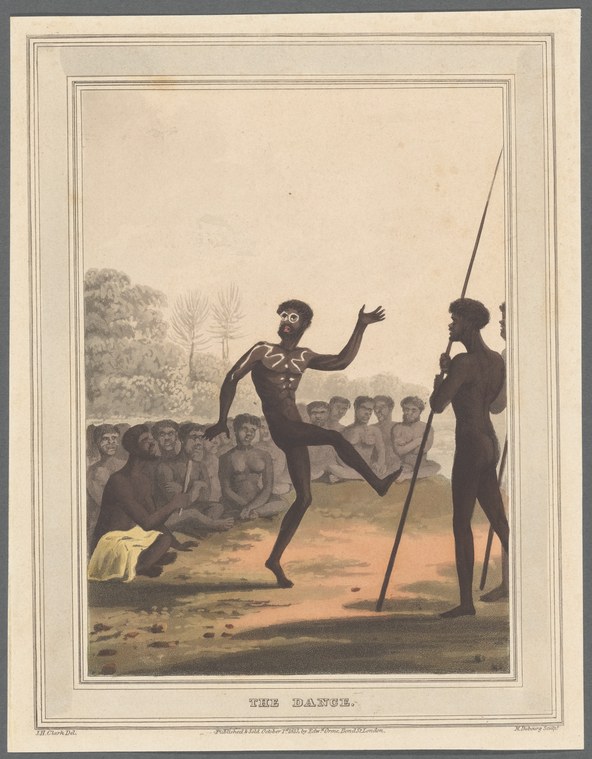
This image exemplifies how dance documentation has been entangled with power and empire: a European engraver's interpretation of African dance circulated as evidence and spectacle to distant audiences who had no direct access to the tradition. For dance historians and curators, it demonstrates the necessity of critical reading—recognizing that aesthetic choices (silhouetting, the isolation of a single dancer, the passive audience) and ethnographic framing are interpretations, not transparent records. The work is a document of European perception as much as African practice.
What you are looking at
A figure stands in dynamic motion at the center of the composition, one leg lifted high and arms gesturing outward in an expansive pose. The body is rendered in dark silhouette with minimal anatomical detail, presented in profile against a warm ochre ground. A second standing figure holds a long staff or spear on the right, equally silhouetted. Behind them, a seated or crouching audience of perhaps a dozen figures, also in silhouette, forms a loose semicircle. The setting is sparse—a few scattered botanical forms (possibly palm or acacia trees) sketched lightly in the background suggest an African landscape. The entire scene is contained within a double-lined rectangular border typical of 19th-century prints.
The dancing
The central dancer's weight appears to be on one leg with the other extended or lifted, while both arms move freely away from the torso in an open, celebratory gesture. The posture suggests neither European ballroom hold nor locked frame, but rather uninhibited, full-bodied movement. The silhouetting of the figure removes all detail of footwork and precise alignment. The secondary figure with the staff stands upright and appears to be an observer or musician rather than a dancer. The audience sits passively, watching rather than participating.
The dance depicted
This print depicts a social or ceremonial dance among African peoples, though the specific tradition cannot be identified with certainty from the image alone. The style of representation—silhouetted figures, outdoor setting with minimal props, and the posture of the central dancer with high leg lift and open arm gestures—is consistent with 19th-century European ethnographic or colonial documentation of African dance. The lack of costume detail, structured hold, or codified footwork suggests either a naturalistic approach to documentation or the artist's unfamiliarity with the actual dance grammar. The presence of an audience and the apparent single central dancer indicate a performance viewed rather than a participatory social dance.
How it was made
This is a hand-colored engraving or etching, characteristic of late 18th- or 19th-century print production for book or periodical illustration. The plate shows fine cross-hatching in the background foliage and figure rendering, with selective hand coloring applied afterward—the warm ochre ground and pale sky are watercolored or tinted, while the silhouetted figures remain in black line. This technique was economical for mass reproduction and circulation; such images were widely distributed in ethnographic volumes, travel narratives, and popular periodicals aimed at a European audience curious about colonial subjects.
About this work
This is a European ethnographic print depicting African dance, executed in the idiom of 19th-century natural history illustration. The unknown artist captures a moment of public performance or ceremony, recording the silhouetted figure of a dancer in dynamic pose before an assembled audience in a landscape minimal of detail. The work belongs to a vast body of colonial-era visual documentation that sought to catalog the customs and practices of non-European peoples for European consumption—a perspective embedded in the style of representation itself. The print's significance lies not in its accuracy or understanding of the dance tradition it purports to show, but in what its conventions reveal about how 19th-century European artists and audiences understood, framed, and reproduced African performance.
How to look at it
Attend to the artist's choice to render the dancer entirely in silhouette: this flattens and simplifies the body, removing the texture, musculature, and precise technical detail that would be visible in a fully modeled figure. The pose—one leg high, arms open—reads as a moment of abandon or ecstasy rather than controlled, measured movement. Notice that the artist has given far more anatomical attention to the audience members' seated postures than to the dancer's footwork. This inversion of priorities is revealing: the dance is presented as spectacle for consumption rather than as a skilled practice worthy of close study. The landscape is similarly flattened and generic, suggesting 'Africa' as a category rather than a specific place.
The period
This print was made during the height of European imperial expansion and the systematization of ethnography as a visual science. Across the 19th century, images of non-European dance and ceremony proliferated in books, magazines, and exhibitions aimed at metropolitan audiences; they served both as entertainment and as pseudo-documentary evidence of 'primitive' or 'savage' culture. Simultaneously, this period saw the codification and formalization of European concert dance—ballet was developing Romantic idioms and technical vocabulary—creating a sharp visual and conceptual distance between the 'disciplined' dance of European high culture and the 'spontaneous' or 'natural' movement attributed to colonized peoples. The print sits at the intersection of these currents.
Where it lives
The work is held in the New York Public Library collection. It is identified in the catalogue as a print from an unknown era and unrecorded artist, catalogued under the generic title 'The dance.' No publication information, date, or plate attribution is recorded.
Dance in this work
Questions about this work
Is this a historical record of a real African dance tradition?
It is a representation made by a European artist and intended for European viewers, and should be read with that context in mind. The silhouetting, compositional choices, and ethnographic framing are interpretations shaped by the artist's own visual vocabulary and the expectations of the European audience. While it may be based on an observed performance, the image tells us as much about 19th-century European ideas about African dance as it does about African dance itself.
Who danced this dance?
The print does not identify the people, region, or tradition depicted. The generic landscape and lack of specific costume or cultural markers make it impossible to determine from the image alone. The archival record similarly offers no information beyond the title 'The dance.'
What technique or movement vocabulary is shown here?
The silhouetting and loose anatomical rendering prevent precise analysis. The high leg lift and open arm gestures suggest a movement aesthetic quite different from European ballet of the same period, but without greater detail or documentation, we cannot identify specific steps, rhythms, or the logic of the movement.
More dance artwork