49 works in this view — arrow keys or swipe to move between them.
Dance in Art
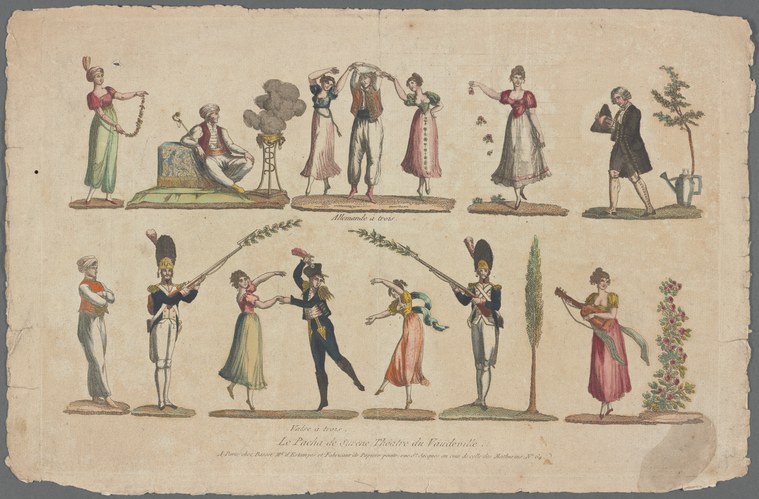
Le pacha de Surene. Théatre du Vaudeville
Unknown artist
- Collection:
- Prints depicting dance
- Source:
- New York Public Library
- Rights:
- Public domain — free to use, share and adapt.
- Recorded as:
- Public Domain
This image is valuable evidence of how early 19th-century theater in Paris visualized and marketed its entertainments to the public—what was considered visually distinctive enough to print and sell. It shows the relationship between costume, character, and theatrical spectacle at a moment when ballet and vaudeville were merging, and it preserves a specific production history that would otherwise be lost to text alone.
What you are looking at
A hand-colored engraving presenting nine figures arranged in two horizontal rows, each posed as if on a stage. The upper row shows five figures; the lower row shows four. All stand on small ground lines suggesting a theatrical platform. The figures wear early 19th-century dress: women in high-waisted Empire-line gowns with long skirts in muted reds, yellows, and greens; men in tailcoats, breeches, and tall hats or military dress. The palette is soft and washed, typical of period hand-coloring over engraved lines. Each figure occupies its own vignette, isolated from the others, as if illustrating a dance manual or theatrical costume guide. Several figures hold or gestures toward props—fans, garlands, branches. The setting is spare and abstract; there is no stage architecture, scenery, or context beyond the costume itself. The composition suggests these are either character types or sequential moments from a single theatrical work.
The dancing
The poses vary from standing with arms extended, to figures in profile showing the silhouette of dress, to one figure seated. Arm positions range from raised and extended (as in a balletic port de bras) to held at the side or gesturing outward. No two figures are in identical posture. The women's long skirts and high waists dominate the visual impression; several poses show the skirt in profile or slight extension. One male figure in the center of the upper row appears to hold a female figure's raised arm in what could suggest a dance grip, though the spacing and isolation of the vignettes makes partnering ambiguous. Footwork is not clearly visible. The overall effect is of a costume or character inventory rather than a choreographic sequence.
The dance depicted
The print is most likely a theatrical costume or character chart associated with a specific vaudeville production—the title references 'Le pacha de Surene. Théatre du Vaudeville.' The dress, the Empire silhouette, and the formal poses suggest early 19th-century theatrical dance or ballet de caractère rather than concert ballet proper. The mix of male and female figures in formal and semi-military dress, along with props like garlands and branches, implies a narrative or divertissement rather than abstract classical dance. No specific dance vocabulary (turn-out, pointe, precise arm frame) is legible enough to confirm a style. The work documents theatrical costume and character-type more than choreographic method.
How it was made
This is a hand-colored engraving, evident from the fine line-work visible beneath the watercolor or gouache wash. The engraved lines define form and drapery; the colored wash articulates costume and creates visual hierarchy. The technique was standard for theatrical documentation in the early 19th century and allowed for rapid, affordable reproduction and distribution—this kind of image circulated as a souvenir, advertisement, or reference document among theatregoers, costumers, and performers. The wear and foxing visible on the sheet suggests handling and age consistent with an ephemeral print from the 1810s–1830s.
About this work
This is a theatrical costume chart, a form of visual documentation common in early 19th-century vaudeville and ballet cultures. Rather than depicting a choreographic moment or narrative scene, it presents an inventory of character-types or costume variations associated with a specific production at the Théâtre du Vaudeville in Paris. The print serves as both a record of what the performers wore and a guide to the visual 'types' that made up the entertainment. Such prints were cheap, portable, and widely circulated; they shaped public memory of theatrical works and helped standardize the look of popular theater. The isolation of each figure, and the emphasis on silhouette and dress over movement, identifies this as a document of theatrical production and fashion rather than choreographic analysis.
How to look at it
Attend to the isolation and repetition: each figure is a type or moment, presented without narrative or spatial context. Notice the variety in pose and the emphasis on how the costume reads in profile and in full face—this is a guide to silhouette and visual effect, not a record of movement quality. The prints like this one were meant to be read quickly and remembered visually; they make their impact through costume, posture, and the convention of the theatrical inventory rather than through complex gesture or choreographic detail.
The artist
The artist is not recorded in the catalogue. The print bears no visible signature. The style and execution are consistent with the commercial theatrical print market of Paris in the early 19th century, when prints of this kind were produced in series by engravers and publishers associated with the theaters themselves. Attribution and workshop practice would require further archival research.
The period
The early 19th century saw rapid expansion of vaudeville and ballet de caractère in Paris, particularly at theaters like the Vaudeville, which specialized in light, narrative entertainment rather than the grand ballet tradition. The Empire silhouette and the year the title appears to reference (c. 1810–1830) place this in a period of intense theatrical innovation, when ballet moved away from the 18th-century salon and into commercial stages serving a broad public. Theatrical costume was becoming more standardized and codified; images like this one served as both advertisement and technical record. The hand-colored engraving was the dominant medium for theatrical prints in this era, before lithography and photography overtook it.
Where it lives
The print is held in the New York Public Library's collection of prints depicting dance. It appears to be part of the general circulating theatrical print culture of early 19th-century Paris and was likely acquired as part of a broader collection documenting theater history.
Dance in this work
Questions about this work
Is this the same as a ballet?
Not necessarily. The title references the Théâtre du Vaudeville, which specialized in light comedies, pantomimes, and mixed entertainments. While dance was part of vaudeville, it was not classical ballet. The costume and the mix of characters suggest a narrative theatrical work with dancing, rather than a pure ballet production.
Why are all the figures shown separately rather than in a scene?
This is a costume or character chart—a reference document. It presents the visual 'types' or costume variations used in the production so that audiences, critics, and other theaters could quickly recognize and remember the characters. Theatrical prints of this kind prioritized clarity and legibility over narrative coherence.
What is 'Le pacha de Surene'?
The title suggests an Orientalist or exotic narrative, common in vaudeville of this period. 'Pasha of Suren' would involve a despot, a harem, intrigue, and comic characters—typical ingredients of early 19th-century light theater. The mix of formal, military, and feminine dress in the print supports this interpretation.
How do I know when this was made?
The Empire-line silhouette, the style of the engraving, and the reference to the Vaudeville theater (which was active in Paris from 1792 onward) suggest a date in the 1810s–1830s. The catalogue record does not specify a date, and the image alone cannot fix one precisely.
More dance artwork





