49 works in this view — arrow keys or swipe to move between them.
Dance in Art
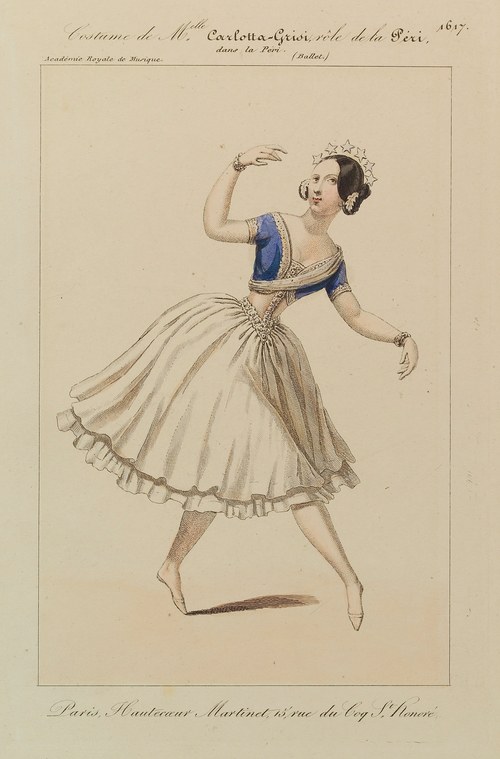
Costume de Melle Carlotta Grisi, rôle de la Péri, dans la Péri: (Ballet). Academie Royale de Musique
Unknown artist
- Collection:
- Prints depicting dance
- Source:
- New York Public Library
- Rights:
- Public domain — free to use, share and adapt.
- Recorded as:
- Public Domain
This image documents the visual language of Romantic ballet at the moment of its greatest cultural prestige, showing both the dancer's technical vocabulary and the costume design that was central to theatrical meaning in this era. The Péri became one of the most frequently performed roles in the classical repertoire, and this costume became iconic; studying the image tells us what a nineteenth-century ballet body was trained to look like and how it was meant to move. The print format also matters: these were mass-produced souvenirs and advertisement, circulated across Europe, and they shaped how ballet was understood by audiences who might never see a live performance.
What you are looking at
A single female dancer in theatrical costume is captured mid-movement against a plain background. She wears a pale, voluminous skirt with a deep ruffle at the hem, fitted at the waist with vertical striping or gathering that suggests the garment's structure. Over this sits a short blue silk corsage or bodice, cut low across the shoulders with short sleeves. Her dark hair is styled close to her head and crowned with an ornate tiara or decorative headdress. Her right arm is raised gracefully with the hand articulated in a refined gesture; her left arm extends downward and outward. She stands in a balletic pose on the point of one foot—the other leg is extended or held in support—with her weight clearly forward and her body angled into the movement. The figure is rendered in a three-quarter view against an unadorned cream-colored ground, lit evenly from the front, so that the silhouette of the costume and the line of the body read clearly.
The dancing
A single dancer, drawn with anatomical care. Her posture shows the lifted, elongated frame characteristic of ballet: the supporting leg is straight and appears to work from a turned-out hip, the free leg is active and extended, and the torso is held upright with the shoulders back and down. Both arms are positioned with deliberate grace—the raised arm bent at the elbow with the hand softly articulated, the lower arm open and extended. The pose reads as a moment of balanced suspension or transition between steps, with the weight fully engaged and the body demonstrating the control and extension expected of a trained dancer.
The dance depicted
This is a costume study for the role of the Péri in the ballet *La Péri*, first performed at the Académie Royale de Musique (the Paris Opéra) in 1841. The Péri is a supernatural being—a fairy-like spirit from Persian mythology—and the role became one of the most celebrated and technically demanding parts in the Romantic ballet repertoire. The figure's pose and bearing confirm she is trained in the vocabulary of classical ballet: the turned-out legs, the lifted port de bras, and the balletic line are all hallmarks of the style. The costume itself—the ethereal, pale skirt combined with the close-fitted corsage and ornamental headdress—is iconic of the Romantic era, designed to suggest otherworldliness and grace.
How it was made
This is a hand-colored engraving or possibly a lithograph with watercolor or gouache added. The precision of the line-work, the delicate hatching that models form and texture, and the way the image is framed within a rectangular border all point to commercial printmaking in the nineteenth century. The subtle tinting of the blue corsage and the soft rendering of the skirt's folds suggest hand-coloring after a printed base. This technique allowed the work to be reproduced and distributed to a broad audience—dancers, ballet enthusiasts, and subscribers to fashion and theatrical periodicals—making it a form of celebrity portraiture and costume documentation.
About this work
This is a costume study of a dancer in the role of the Péri, a supernatural protagonist in the 1841 Paris Opéra ballet *La Péri*. The image documents both the dancer's trained body—her balletic carriage, turned-out legs, and lifted frame—and the costume designed to project an ethereal, supernatural presence: a low-cut corsage paired with a voluminous pale skirt and an ornamental headdress. The work is a hand-colored print of the kind that circulated widely in nineteenth-century theater culture, serving at once as a record of choreography and costume, a souvenir of a celebrated performance, and a form of publicity. It belongs in this collection because it captures the moment when Romantic ballet reached its technical and aesthetic peak, and because the image itself reveals what audiences of the 1840s expected a prima ballerina to embody: otherworldly grace allied with disciplined bodily control.
How to look at it
Attend to the dancer's posture and line first: the elongated neck, the squared shoulders, the lifted ribcage, and the engaged legs form a vertical column that reads as effortless grace but requires rigorous training to achieve. Note the precision of the arm placement—both arms are active, neither is merely ornamental, and both serve the overall line of the body. Look at the costume: the contrast between the fitted, structured corsage (which emphasizes the dancer's upper body and the line of the arms) and the weightless skirt (which suggests flight and otherworldliness) is a central visual conceit of Romantic ballet design. The headdress, while ornamental, sits high and allows the face and neck to be seen; this too is characteristic—the dancer's face and emotional expression were considered essential to Romantic ballet performance. Finally, consider what moment in movement the artist has chosen: this is neither a preparatory position nor a fully extended jump or turnout, but a held, balanced moment that shows both control and the promise of further movement.
The period
This image dates to the Romantic era in ballet, a period (roughly 1830–1870) in which supernatural and exotic themes dominated the stage, female dancers became the central focus of choreography and audience attention, and the technical demands placed on dancers—particularly pointework and extensions—grew steadily. *La Péri*, choreographed by Jean Coralli and Joseph Mazilier with music by Frédéric Burgmüller, premiered on 17 July 1841 and became one of the signature works of the Romantic repertoire. It was performed by and later associated with the greatest ballerinas of the era, including Marie Taglioni and Carlotta Grisi (to whom this costume study is attributed). The work exemplifies Romantic aesthetics: an emphasis on the ethereal and otherworldly, a narrative centered on a female protagonist's quest or transformation, elaborate spectacle, and a sophisticated vocabulary of movement that blended classical line with newfound technical virtuosity. The print culture that surrounded ballet in this period—costume studies, portraits, souvenir lithographs, and fashion plates—was itself a form of celebrity and cultural documentation.
Where it lives
This image comes from the Prints collection of the New York Public Library, a holding of printed theatrical and dance imagery from the eighteenth and nineteenth centuries. It is a professional costume study of the type produced for circulation within theater circles and to the paying public.
Dance in this work
Questions about this work
Who danced the role of the Péri in the original production?
The title page attributes this costume to *Melle* (Mademoiselle) Carlotta Grisi, the celebrated Italian-born ballerina who was a dominant figure in European ballet during the 1840s and 1850s. However, the work may document the costume as worn by other dancers as well; the print is a costume study, not necessarily specific to a single performance or dancer.
What is a Péri?
In Persian mythology, a Péri is a supernatural being—typically female, beautiful, and ethereal—who exists in an intermediate realm between the divine and mortal. Romantic-era ballet drew heavily on such exotic and supernatural themes, using them to explore ideas about transcendence, longing, and the limits of the human body.
How was *La Péri* different from earlier ballets?
By the 1840s, ballet had become increasingly virtuosic and female-centered. *La Péri* showcased pointe work, extended legwork, and intricate footwork while maintaining a strong narrative. The role required technical mastery alongside the ability to suggest otherworldliness and emotion—a combination that defined Romantic ballet at its height.
Why was the costume designed this way?
The pale, voluminous skirt and fitted corsage served multiple purposes: they emphasized the dancer's silhouette and the line of her arms, they suggested weightlessness and grace, and the pale color created an ethereal, supernatural effect under the lights of the nineteenth-century stage. The headdress marked her as a supernatural being while allowing her face to remain visible and expressive.
More dance artwork





