49 works in this view — arrow keys or swipe to move between them.
Dance in Art
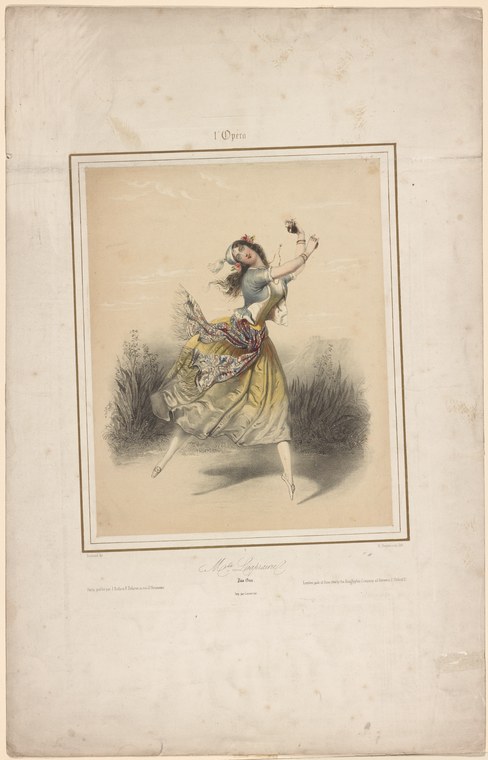
Mlle Laprairie. Pas grec
Unknown artist
- Collection:
- Prints depicting dance
- Source:
- New York Public Library
- Rights:
- Public domain — free to use, share and adapt.
- Recorded as:
- Public Domain
This image is among the primary visual evidence for how early Romantic-era dancers actually moved and what they wore during performance. The precision of the rendering makes it valuable for historians reconstructing the technique, turnout, arm carriage, and aesthetic ideals of early 19th-century theatrical dance. For dancers, it offers a direct window into the physical vocabulary and presentational style of an earlier tradition.
What you are looking at
A young female dancer in a classical pose dominates the composition, captured mid-movement against a pale, atmospheric background. She wears a pale yellow or cream-colored dress with a patterned bodice in red and gold, the skirt caught in a dynamic swirl around her legs. Her pose is one of classical elevation: one leg extends upward in a controlled développé or attitude, her supporting leg turned out, her upper body arched backward with arms raised in a graceful port de bras. Her dark hair is styled in ringlets typical of the early 19th century, and her face is turned upward in an expression of effort and refinement. The setting is minimal—only a few brushstrokes of grass or foliage suggest ground—allowing the figure to float almost weightlessly against the composition. The print's hand-coloring emphasizes the luminous quality of her skin and the rich pigments of her costume.
The dancing
The dancer's posture reveals classical ballet training: a pronounced turnout from the hip, an arched supporting leg, and the lifted port de bras of a trained ballerina. Her extended leg is held high, supporting a significant degree of elevation and line control. The single figure is shown in full profile or near-profile, allowing the viewer to read the entire leg line and the arch of the torso. Her arms frame the extended leg in a position consistent with académie ballet technique—raised and shaped with apparent ease, despite the physical demand of the pose.
The dance depicted
This is Mlle Laprairie performing a classical solo, most likely a pas grec (Greek step or style), which was a popular form of Romantic-era solo dance drawing on Grecian aesthetic ideals. The title 'Pas grec' and the date range visible in the print's style place this work in the early-to-mid 19th century, when such stylized national or classical variations were common features of theatrical dance. The barefoot or near-barefoot presentation, combined with the Grecian-inspired drapery and the ethereal quality of the pose, are hallmarks of the neoclassical dance idiom popular in Romantic ballet. Mlle Laprairie was likely a professional dancer of some renown, captured here at a moment of technical refinement and physical achievement.
How it was made
This is a hand-colored lithograph or engraving, evidenced by the fine linear work in the background and drapery, the subtle tonal variations achieved through printing, and the applied watercolor or gouache additions (particularly visible in the costume details and skin tones). The technique allowed for broad circulation of the image—such prints were popular merchandise in theatrical contexts, sold as souvenirs and promotional images of celebrated dancers. The hand-coloring process suggests this was a higher-end version of the print, likely destined for collectors or as a memento of a specific performance. The quality of the figure drawing and the careful rendering of the fabric folds indicate a skilled artist with knowledge of both theatrical costume and human anatomy.
About this work
This print documents a moment in early-19th-century theatrical dance, preserving the image of a solo performer at the height of the Romantic ballet era. Mlle Laprairie's execution of the pas grec represents the synthesis of classical technique, neoclassical aesthetics, and the theatrical conventions of her time. The work belongs in a gallery of dance in art both as evidence of how professional dancers were documented and celebrated in their era, and as a visual record of the physical technique and costume norms of Romantic dance. The print was created for public consumption and pleasure—to preserve the memory of a particular dancer's artistry for an audience that had experienced her performance or wished they had.
How to look at it
Observe the moment of suspension: the artist has chosen to freeze the dancer at the apex of her elevation, when all her weight appears lifted and her line is most fully extended. Notice how the supporting leg is rendered with particular care—the turnout, the flexed foot, the invisible muscular work required to sustain the pose. The gesture of the raised arms and the arch of the torso are not relaxed but held with evident control, and the face is not merely decorative but shows the effort of concentration. The print also rewards attention to the costume: the cut and drape of the dress, the way the fabric catches the implied light, and the precision of the gold and red patterning on the bodice all suggest the materiality of stage costume and the care taken in its construction.
The artist
The artist is not recorded in the catalogue. However, the quality of the draftsmanship and the professional nature of the print suggest a commercially successful theatrical printmaker working in Paris or another major European theater capital in the first half of the 19th century. Such images were often produced by print houses attached to theaters or by independent publishers specializing in theatrical souvenirs; they were frequently unsigned or credited only to the printer rather than the draughtsman.
The period
The print dates to the height of the Romantic ballet era (c. 1830–1850), when classical technique was being synthesized with Romantic theatrical aesthetics. Neoclassical and Grecian themes were fashionable in both visual art and dance, particularly following the success of works like La Sylphide (1832) and the continued popularity of classical variations within longer ballet narratives. The solo pas grec was a common feature of evening programs, allowing individual dancers to showcase technical refinement and to present themselves to the public as cultivated artists. In the visual arts, lithography and hand-colored prints had become the dominant medium for theatrical documentation and promotion, flooding the market with images of celebrated dancers.
Where it lives
This print is held in the Prints depicting dance collection at the New York Public Library. It is one of a large category of 19th-century theatrical prints made for popular circulation as souvenirs, advertisements, and cultural documents. Such prints were typically bound into albums, given away at the theater, or sold separately to collectors.
Dance in this work
Questions about this work
Did dancers actually perform barefoot in the 1830s?
The print shows the dancer in bare feet, which is consistent with neoclassical and Grecian-inspired choreography of the period. However, whether she actually performed barefoot or in soft ballet slippers is not certain from the image alone. Romantic-era dancers often wore tight silk shoes that appeared nearly bare in prints. The barefoot presentation here serves the aesthetic ideal—linking the dancer visually to classical statuary and suggesting lightness and a return to 'natural' movement.
What is a 'pas grec'?
A pas grec (Greek step) was a short, solo dance in Romantic-era ballet, typically featuring stylized movements designed to evoke classical Greek or neoclassical aesthetics. Such pieces were not narrative but rather showcases for an individual dancer's technical skill and ability to embody a particular style. They were common in evening programs and in diversissements within longer ballets.
Who was Mlle Laprairie?
Mlle Laprairie was a professional dancer active in the early-to-mid 19th century, but detailed biographical information is scarce in standard dance histories. The fact that her image was printed and circulated suggests she was known enough to be marketable to the public—a dancer of some reputation in the theaters where such prints were sold.
How can I tell this is a lithograph and not a painting?
The combination of linear detail (visible in the fine lines of the background and drapery folds), the texture of the paper, and the technique of hand-coloring applied over a printed base all point to a lithograph or engraving rather than an oil painting. The regularity of the tone in the background and the way the color sits on top of the printed image are characteristic of the print medium.
More dance artwork





