49 works in this view — arrow keys or swipe to move between them.
Dance in Art
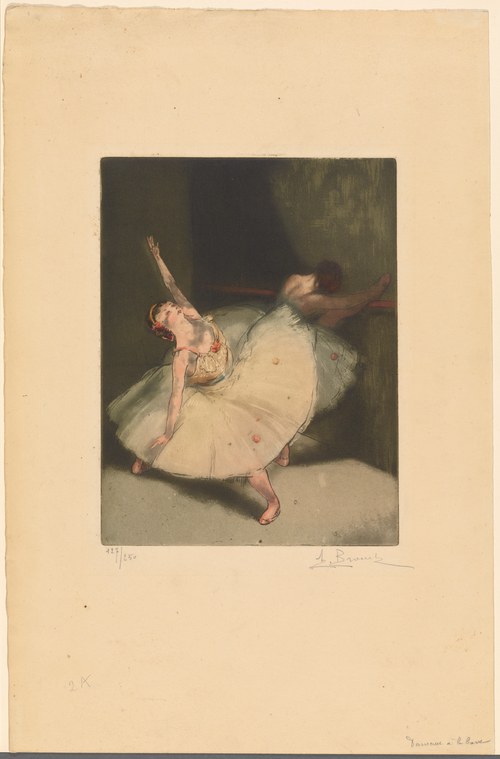
Danseuse à la barre
Unknown artist
- Collection:
- Prints depicting dance
- Source:
- New York Public Library
- Rights:
- Public domain — free to use, share and adapt.
- Recorded as:
- Public Domain
This work is essential evidence of how Romantic ballet was visualized, commodified, and remembered in the 19th century. For dancers and historians, it documents the actual silhouette, costume construction, and aesthetic of a major historical dance form, as seen through the eyes of a contemporary artist working for a mass audience. It shows us not just what the dance looked like, but what made it culturally legible and desirable to people who saw it.
What you are looking at
A young female dancer stands alone against a dark, shadowed background, caught mid-movement in a pose of classical grace. She wears a pale tutu—short, structured, and cartridge-pleated in the style of mid-to-late 19th-century ballet—along with what appears to be a decorative bodice with warm, peachy tones. Her posture is balletic: one leg appears to extend or support her weight while the other is positioned in a controlled line, her upper body tilted back with an arched spine and her head tilted upward in an expression of romantic reverie. One arm is raised, the other positioned across her body. The stage floor is rendered in cool gray-blue tones, creating shallow depth beneath her feet. The overall lighting is theatrical—a single figure isolated against darkness, as if spotlit on stage. This is the moment of a solo, intimate and vulnerable.
The dancing
A single dancer, shown in three-quarter view from approximately waist-height upward. Her spine is deeply arched, her gaze lifted and directed away from the viewer in a classically feminine, romantic pose. Her legs appear to be in a relationship that suggests balance or transition—possibly a cambré (backbend) or a preparation for a traveling step. Her arms frame the upper body rather than extending decisively outward, which is consistent with romantic-era vocabulary. The overall quality is one of ethereal lightness despite the solidity of the figure; the tutu, while precisely delineated, suggests the fabric's tendency to catch light and air.
The dance depicted
This is almost certainly a work depicting Romantic ballet, the theatrical form that dominated European stages from the 1830s to the 1870s. The tutu style, bodice, and characteristic pose of reverie and backbend are hallmarks of that aesthetic. The dancer appears to be performing a solo, possibly a variation or an adagio moment—the kind of intimate, emotionally charged moment that was central to Romantic narrative ballet. The absence of partners, the dreamlike quality, and the directional focus upward and away all suggest the lonely, yearning quality characteristic of roles like Giselle, Sylphide, or the Shades' choreography in La Bayadère. The image does not show a specific technique (like pointe work) clearly enough to narrow it further, but the posture and dress leave no doubt of the ballet idiom.
How it was made
This is a hand-colored print—likely a lithograph or colored engraving based on the soft modeling of light and shade and the way the figure is built up in layers of translucent color. The technique allows for broad washes of tone (the dark background) set against precisely rendered figures, which was ideal for theatrical subjects intended for a middle-class audience. The artist has used warm and cool tones expressively: peachy flesh tones against cool grays and deep, almost black greens and browns. The signatures visible in the lower margin suggest this is a published work, likely a collectible theatrical print. Such prints were commonly sold to theaters and collectors as affordable records of celebrated dancers and roles.
About this work
This is a portrait of a Romantic ballet dancer, rendered as a hand-colored print, capturing the aesthetic and emotional tenor of early-to-mid 19th-century theatrical dance. The work records not a specific narrative moment but an archetypal pose of Romantic ballet femininity: solitary, yearning, physically refined, and emotionally withdrawn. The tutu, bodice, and posture are all precisely rendered and immediately recognizable to an audience familiar with ballet, making this a valuable document of how the form presented itself to its contemporaries. The print format indicates wide circulation among middle-class audiences who consumed theatrical imagery as collectibles and mementos.
How to look at it
Attend first to the arched spine and lifted gaze: this is the signature pose of Romantic ballet reverie, the moment when the dancer is most inward and unreachable. Notice how the tutu is rendered not as fabric lying flat but as a structured skirt held aloft by the dancer's movement and the architecture of her body. Look at the handling of light and dark: the figure emerges from near-blackness, which amplifies both the pallor of her skin and the sense of theatrical isolation. The pose is held, not in transition; the artist has chosen a moment of stillness that reads as eloquence rather than motion.
The artist
The artist is unrecorded in the catalogue, but the technical and stylistic qualities suggest a professional theatrical printmaker working in Paris or another major European theater center in the mid-19th century. The competence of the anatomical rendering and the sophistication of the color handling indicate training in life drawing and chromatic theory. Unsigned theatrical prints of this era were often produced in studios or publishing houses rather than by individual named artists; attribution would require archive research into lithographic workshops.
The period
This work dates to the era of Romantic ballet's full flowering (roughly 1830–1870), when the form had achieved mythic status across Europe and dancers like Marie Taglioni and Carlotta Grisi were international celebrities. Lithographic color printing had made theatrical portraiture affordable and collectible, and prints of celebrated dancers were as common in middle-class parlors as photographs would later become. The Romantic aesthetic in both dance and visual art prized ethereality, melancholy, and the supernatural—qualities all evident here. This was also the era in which ballet began to document itself visually for posterity, establishing an archive of the form that scholars would later rely on.
Where it lives
The work is housed in the New York Public Library's Prints collection, a holding that specializes in theatrical and artistic prints of the 19th and early 20th centuries. The signatures and notations visible in the margins (including what may be a printer's mark and an artist's or publisher's signature) indicate this is a published print, not a unique drawing. The collection context suggests this was recognized as an important document of dance and theatrical history at the time of acquisition.
Dance in this work
Questions about this work
Is this a portrait of a specific, named dancer?
The catalogue record does not identify a named sitter, and the title 'Danseuse à la barre' is generic (literally 'Dancer at the barre'). However, the technical skill and careful rendering suggest this may be a portrait of a celebrated dancer of the era. Without archival research into the signatures and publication details visible in the margins, that cannot be confirmed. The work is valuable whether or not we know the dancer's name.
Why is the title 'at the barre' when there is no barre visible?
The title may refer to the dancer's class or training rather than literally depicting a barre. 'Danseuse à la barre' can also be understood as a type or category—a ballet dancer, one trained in the discipline of the barre. Alternatively, the title may be a publisher's or cataloguer's generic label applied to many similar prints. The image itself shows a stage or performance moment, not a rehearsal.
What is the pose the dancer is in?
The exact balletic term is difficult to determine from a still image, but the pose combines a deep backbend or cambré with a lifted upper body and a directional focus upward. This is typical of the adagio (slow solo) vocabulary of Romantic ballet, where the emphasis is on sustaining lines and expressing interiority through the body's relationship to space.
How do I know this is Romantic ballet and not another era of dance?
The tutu is short and cartridge-pleated—a style that emerged in the 1830s–1840s and remained standard until the mid-20th century. The bodice, the idealized feminine form, the ethereal palette, and above all the emotional tenor of the pose—the reverie, the inwardness—are all signatures of Romantic aesthetics. The print technique and style also align with mid-19th-century theatrical production.
More dance artwork





